Wednesday, June 16, 2010

Member Bio: Glendon Mellow

(time for an update! updated June 2010)

Glendon Mellow, B.F.A. - Art in Awe of Science


Links


-Portfolio


Professional Art + Illustration

Since
The Flying Trilobite's inception in March 2007, I have found support and resonance from the science, secular and artist communities online. I continue to be available for freelance art and illustration. My work has been featured on numerous blogs in the past couple of years as examples of the intersection of art and science. I have also been a speaker and given interviews about my work and ind the intersection of art + science.


Glendon Mellow: Art in Awe of Science, my professional portfolio can be found here.
The Flying Trilobite Reproduction Shop
can be found here.


Artist's Statement
With my drawings and paintings, I seek to increase our metaphorical vocabulary using the discoveries of science, particularly biology and palaeontology. The genius of representational painting, epitomized by the Renaissance masters, the Symbolists and a handful of Surrealists has never had a more apt time for inspiring wonder in humanity than during our modern scientific age.

Why use Odin to portray wisdom when I can paint Darwin?

Why paint flowers when the beauty of the structure and oxygen produced by diatoms is so compelling?

Regard the resilient stony success of the legions of trilobite species waiting in the rocks.


I can stand here, separated by 550 million years and look at this long dead animal and understand some things about it. I can imagine adventures for it. The absurdity of unimaginable time, and my eyes and hands crafting an image of a fossil still make me shake my head in wonder.

I have an Honours Bachelor of Fine Art from York University, majoring in art history, drawing and oil painting. The Symbolist era of fin-de-siecle Europe inspires much of the aesthetic of my work. The urgency of Symbolist artists such as Fernand Khnopff, Odilon Redon, Arnold Böcklin, as well as the Surrealist Frida Kahlo, appeals to the dark lens through which we see the world, complete with scattered fragments of hope. The imagination found in faery artists like Arthur Rackham, and current illustrator Alan Lee are delightful, and shaped much of the themes of my early work.


* * * *

Timeline of work:
In the fall of 2010, I will be switching careers to concentrate full-time on illustration and fine art work.

June 2010, I graduated with my Bachelor of Fine Arts, Honours from York University. I have majored in Studio and Art History.

May 2010, I completed an original painting, The Last Refuge, for Deep Sea News blogger Kevin Zelnio.

May 2010, scienceblogger Scicurious of Neurotopia unveiled the caffeine-molecule tattoo I designed for her.

In April 2010, I became the webmaster for the Southern Ontario Nature & Science Illustrators (SONSI) group.


In March 2010, New Scientist magazine's online blog, CultureLab: where books, art and science collide included an interview about my artwork.


March 2010, I was invited to be a speaker and panelist at the Centre for Inquiry Ontario's Educational Conference, entitled, “Art & Science: Freethought at the Intersections of Two Worlds”.

January 2010, I attended ScienceOnline2010 and was involved in two sessions. I led aworkshop introducing the versatility of digital tablets and the program Gimp. Also, with session co-leader Felice Frankel, we discussed our topic, Push it 'til it breaks: what are the limitations of visual metaphors?
An interview and 4 illustrations appeared in the new coffee table book, Geology in Art: an unorthodox path from visual arts to music for geologist and trace fossil artist Andrea Baucon for his. You may preview the entire book at the link.


Beginning in the fall of 2009, I began a series entitled Going Pro at the group paleo-art blogArt Evolved. My aim is to discuss with new illustrators some of the lessons I have learned so far in my career.


Published in Fall 2009, my illustration of an Ent from can be seen in issue #48 of Mallorn, the journal of the Tolkien Literary Society.

The group paleo-art blog to which I belong, Art Evolved, was featured in a two-page spread in the September 2009 issue of EARTH Magazine, the publication of the the American Geological Institute. The issue included my Mythical Flying Trilobite Fossil III as one of four illustrations from the Art Evolved members.

The Flying Trilobite was included in an article entitled Blogging Evolution by Adam Goldstein for the journal Evolution: Education and Outreach as an example of "imaginative" blogs about evolution. Other blogs featured on the list od evolution-education included Pharyngula, Why Evolution is True, The Loom, The Beagle Project, and many more excellent blogs.

In May 2009 I completed a blog banner commission for Migrations, a blog about science, society conservation and migration patterns.

Also in May 2009, I took part in SciBarCamp Toronto and moderated a session entitled, "Can art benefit science?"

The popular Darwin Took Steps is now appearing on a book of science philosophy, entitled La Mente di Darwin, ("The Mind of Darwin") by Andrea Parravicini, and published by Negretto Editore of Milan.

In early 2009, my Darwin Took Steps image was seen on the cover of Secular Nation magazine, and I was interviewed in a podcast about it. This image has been quite popular, and was included as part of my contribution to the cover of an annual science blogging anthology Open Laboratory 2008, and again on the 2009 edition. I also have donated a portion of the sales of t-shirts, cards and prints of the image to The Beagle Project.

In January 2009, I attended Science Online '09 in North Carolina, U.S.A. In the unconference format, I moderated a session about Art & Science, and co-moderated an online-image workshop with artist-biologist Tanja Sova.

In November 2008, I produced a poster for PZ Myers' Toronto lecture, hosted in part by The Center for Inquiry Ontario.

Summer 2008, I completed a blog banner for The Meming of Life , a secular parenting blog.

In March 2008, I was commissioned to produce a new blog banner for the Scienceblog, Of Two Minds. I had previously been commissioned in September 2007 by one of the blog authors for a banner for Retrospectacle.


In May 2007, I discussed with Virginia Hughes how unreal trilobites with insect or bat wings have been a part of my work for over 12 years now and I have painted some of them on pieces of shale, as in this
interview on Page 3.14.


* * * *

A bit more about me...

I was born under a cabbage leaf in the summer of 1974, covered in stork feathers and placenta. I’m inspired by evolution and biology to create my paintings. I’m particularly fond of Naples Yellow. Delicious looking colour, and not healthy at all.


I live in Toronto, Ontario, Canada with my wife Michelle and our hermit crab Shiny and school of neon tetras collectively known as Roger. We hang a lot with our awesome nephew every week. I love to sketch at the Royal Ontario Museum. In 2008, I had one of my Mythical Flying Trilobite Fossils tattooed on my arm.


Feedback and commissions keep me going!

- - - - - - - -

Original artwork on The Flying Trilobite Copyright to Glendon Mellow

under Creative Commons Licence.
Flying Trilobite Gallery ### Flying Trilobite Reproduction Shop ###

Monday, June 14, 2010

Initiating Anti-Spam Measures!

In an effort to combat the spam-bots, ART Evolved has decided to try using Blogger's comment moderation. Hopefully this will stop the increased spam attacks we've been noticing in the comments section!

Do not be alarmed!

The administers promise to be very quick in approving comments, allowing wonderful palae-art discussions to continue uninterrupted!

If you are an ART Evolved member, you will not have to have your comments moderated. Blogger will allow any member of the blog to comment instantly! So no problems all around! Yay!

Thanks,
Peter, on behalf of the admin team!

Thursday, June 10, 2010

Philosofossilising- What is Palaeo Art (Matt van Rooijen)

This is a reply to the question:
What is Palaeo-Art?

This is an individual opinion on this topic. To read a number of different peoples' answer to this question click this link here. If you have your own answer, read the last paragraph of this post for details on how to get yours posted.

We have our first guest essay entry to this topic from Matt van Rooijen! We would like to thank Matt for taking the time to send us his thoughts, and hope our members and readers could take the time to show our collective appreciation for him taking the time to enter this discussion!

The administrators would just like to apologize to both Matt and our readers, that due to blogger's formatting restrictions, we were unable to underline the capital A's in Matt's essay as he wished them to be. So whenever you encounter the word "Art" with a capital A, Matt places emphasis on this as per his discussion.

Hi, my name's Matt van Rooijen and I'm an illustrator and animator living about as far away as you can get from anywhere else in Tasmania, Australia.

You might know me from illustrations such as these:

http://news.nationalgeographic.com/news/2010/03/100319-new-dinosaur-species-raptor-killer-claw/ or this: http://news.bbc.co.uk/earth/hi/earth_news/newsid_8592000/8592749.stm

I really wanted to talk about the notion of Art and art/illustration, and why the majority of Paleo-art isn't Art.

Before you rush to the keyboard to set the comments section on fire, take a deep breath and read on to discover why this is a good thing.

Now you might have noticed I've used Art with a capital A which I've underlined to make it stand out even more (insecure ain't I?).

This is because when most people talk about art what they really mean is a practice that depicts the world or an idea through human craft.

This is art with a small 'a'. People who are in the capital 'A' Art world consider this to be illustration, or even craft.

Why? Well there's a couple of things missing before something can be moved into the Art category.

Art has two significant components that move it away from illustration.

First is a conscious act of interpretation on the part of the Artist. What does this mean? Stuffed if I know.

Sorry, wine talking.

It's the decision to use the technique of the Artist(whether it be paint, sculpture, etc.) as a vehicle to interpret the meaning of the subject.

After re-reading that sentence possibly the wine is still talking.

Essentially the Artist doesn't care about accurate depiction or technique beyond achieving the second component of Art, which is:

Commentary.

A modern Artists' function is to personally comment upon their subject, usually to send a message to the audience of the Art.

To most people this sounds like self indulgent claptrap and their 5 year old could do Jackson Pollock's 'Blue Poles' in a frenzied 5 minutes of red cordial induced paint frenzy.

This is because the majority of people see Art as it was before the advent of photography. Accurate or even photographic depiction is what people admire because it has recognisable craftsmanship and demonstrates an ability honed with practice and dedication.(remember I said this, it'll help below)

Art had to move on and many painful decades on, guys throwing cow blood at walls elicit the same reaction now as the Impressionists did in their time.

So where does this leave Paleo-art?

Generally in the same place as Fantasy art, Science Fiction art, Wild life art, movie concept art, comic book art etc. It's for the most part Illustration.

Before firing up the flame cannon in the comments section remember: this is a good thing.
Often when I've said this to people who consider themselves Artists (who are actually doing illustration) they've become a bit insulted, for some reason they feel I'm saying what they do is somehow inferior.

It's not, it simply has a different goal. Art's job is to subjectively interpret and comment upon human existence.

So just stop and ask yourself, is that what you're doing when you paint, or draw or sculpt?
Then ask yourself, "Why the heck would I want to???? I was just painting Styracosaurus as accurately as I possibly could! Look, it's drinking at a river! It makes me happy! Leave me alone!"
So here's the clincher, Art doesn't demand what most people admire and recognise as skill: craftsmanship, realism, beauty, accuracy, style, interest.

Illustration, on the other hand, is a cruel and demanding mistress who actually asks you to make something that looks like something! Draw in your viewer! Use your understanding of perspective, values, composition! (must stop drinking wine)

It isn't to say Art can't have those qualities, but they aren't a prerequisite, and they certainly aren't valued in the same way.

After reading a couple of essays on Paleo-art, for the most part the goal of Paleo-art is to create accurate images which are the depiction of a somewhat removed reality.

People talk about accuracy and current understanding of the science as significant criteria, not whether the work will convey the deeper meaning of that science on culture and subjective human existence.(yawn)

I've seen a few works here that do actually do this, but those quietly move themselves outside the realm of Paleo-art and into just Art. The Paleo tag becomes redundant.(Art's selfish ain't it?)
So what is Paleo-art? I know it's most often not Art, but most of what we think of as Art isn't anyway. What we usually value and regard as admirable doesn't need that label.

Nor should it want it.

Matt

PS: I trained as a Fine Artist, but what I admire and enjoy most in life is illustration, art with a little 'a', in all its forms.

-- Matt van Rooijen

http://www.optimisticpainter.wordpress.com/

ART Evolved is very interested in other opinions on this topic, and would welcome your answer to this question. If you would like to enter an article on "What is Palaeo-art", please read the brief criteria here, and send your essay to artevolved@gmail.com.

Trilobites in Art

Once more into the breach, my friends!  Here, with less then 3 week until the Trilobite Gallery goes live, it's time for ART Evolved to showcase the work of professional artists and their take on our arthropod friends.


Here is a small overview of with Trilobites in Art!

I have not tried to name the specific trilobite genus or orders, as I honestly don't know them and would probably just embarrass myself!  If anyone feels the need, be my guest and label them in the comments section.

For a fantastic source on trilobite orders and inspiration, check out Sam Gon III's great website!


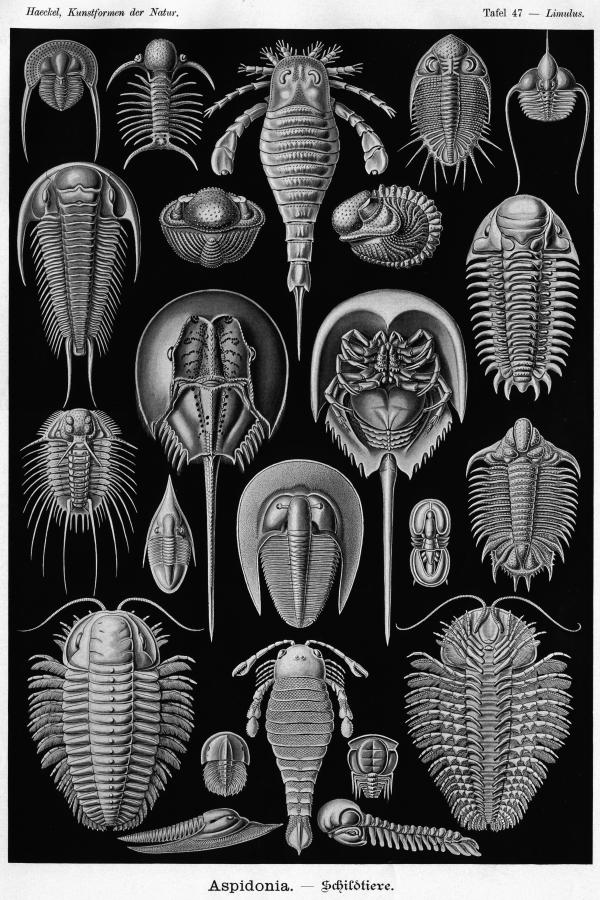
Trilobites by Ernst Haeckel


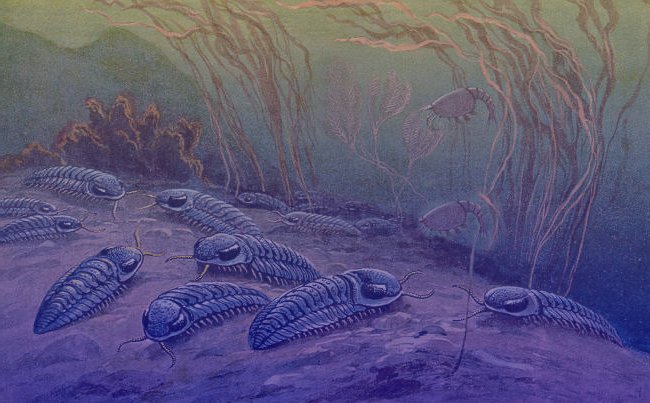
Trilobites by Heinrich Harder


Trilobites by Zdenek Burian


Trilobite (on the right) by Charles R. Knight


Trilobites by Sam Gon III


Trilobite Orders by Sam Gon III


Spiky Trilobite by Sam Gon III


Trilobite by Melissa A. Benson


Comic Trilobites by our own Marek Eby


Flying Trilobite by our own Glendon Mellow (more here and here!)


CG Trilobite by our own Craig Dylke


More CG Trilobites by Surface Vision

Trilobite toy by Bullyland (I own this guy!)


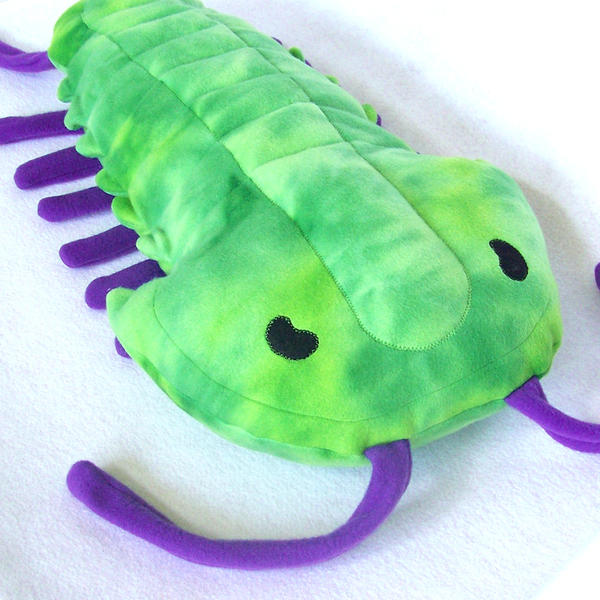
Stuffed Trilobite by Weird Bug Lady! (more here and here!)


Trilo-kite by Cambridge Natural History Museum (photo by me)


Metal Trilobite by Jud Turner


I've attempted to pull together artists using different mediums (traditional paint, CG, sculpture, etc), which probably indicates my own definitions of palaeo-art (coming soon!)  

Hopefully, these wonderful pieces inspire you to create your own wonderful trilobites, which will soon be scuttling out of the July's Trilobite Time Capsule!

Send in your trilobite art to artevolved@gmail.com!

Wednesday, June 9, 2010

Philosofossilising- What is Palaeo Art (Jenn)

This is a reply to the question:
What is Palaeo-Art?

This is an individual opinion on this topic. To read a number of different peoples' answer to this question click this link here. If you have your own answer, read the last paragraph of this post for details on how to get yours posted.

A long time ago (in a galaxy far far away) I stopped trying answer the question, "What is art?" If you've ever really made a serious attempt at answering the question, then you'll know how tedious the process is; if you think you've come to a pretty good definition- maybe not perfect, but good- someone will eventually come along and show you something that will violently disrupt your understanding of what art is. And even though you might confidently look at said object (or performance... or musical composition... or whatever) and think, ".... that's not art... definitely not art...," there will always be that voice in the back of your head saying, "...is it? Maybe it is." At that point you have to begin redefining, and, eventually, your brain explodes.

All that given, you can imagine my hesitation to jump to the front of the line to answer the question, "What is palaeo art?" The writing and re-writing I've done so far in this post is just a sign of how eerily similar the questions "What is art?" and "What is palaeo art?" are. Maybe not because they're the the same thing (because I doubt they are), but because both are so difficult to define verbally. Incorporate the word "art" into any term, and you're heading into murky waters. Whatever one's personal definition of palaeo art is, I think they'd be surprised at how many artworks they never viewed as palaeo art might somehow fall under that definition. Once again, time to redefine.

Ultimately, I believe that art and palaeo art are NOT the same thing (in that not all art is palaeo art, although all palaeo art is art). But that doesn't mean we can define them (in the traditional way). I think that [palaeo] art can only be defined as "I know it when I see it." And how appropriate that we CAN see it! In fact, so many of the things that we spend time defining are things that have to be defined verbally because there is no other way to understand them, and they can be defined verbally because the scope of their form and function is so limited. For art, I think it's just the opposite. We don't make art and THEN define "art". We make art TO define "art." Every artist's creative career is the exploration of answering the the question "What is art?" just as the creative career of every artist who's interested in paleontology is the exploration of "What is palaeo art?"

So, what is palaeo art? It's this, or this, or this, or any host of others.

As a last note, does this mean that I believe asking the question "What is paleo art?" is futile? No, absolutely not. It challenges preconceived notions, and anything that does that is certainly not futile. Similarly, does this mean that I disagree with the other artists' definitions? No way. In fact, that we all have different views and definitions that are so equally valid and true just goes to show how dynamic this art form is, and while we all might read the responses to this question (my own included), we are never so sure as when we have a-punch-in-the-face, clear-as-day, why-didn't-I-think-of-that-before?, it's so obvious! reaction as we do when we LOOK at the work of artists who say, "I made this, and this is what I think paleo art is."

For me, for now, in response to the question "What is paleo art?" I have only one thing to say definitively:

"
"

Feel free to disagree :)

Philosofossilising- What is Palaeo-Art? (David)

This is a reply to the question:
What is Palaeo-Art?

This is an individual opinion on this topic. To read a number of different peoples' answer to this question click this link here. If you have your own answer, read the last paragraph of this post for details on how to get yours posted.


Some great thoughts on what paleoart is and isn't here already, and I can only stand on the sidelines for so long. Here's my take:

Paleoart is obviously art - the name says so. And since no one can agree on what that is, I'm not going to make the mistake of offering any answers here... I couldn't do better than the talented Andreas Cau in the image above. What a great summary. It has everything: the geeky latin name-throwing, the pop culture fascination and a wonderful humor. Paleoart is art, and thus a matter of its perception.

This changes drastically if you follow John Conway's lead and call it palaeontography however. Then you cut the camp out of it and focus on the intent to communicate, illustrate. Whether you take the art out of it in the process is another question... I think not. But palaeontography certainly sounds a lot less fun than paleoart - it sounds like measurements and analysis and scientific debate. If that sounds like fun, you may be the palaeontographic breed of paleoartist. You're more likely to understand the power that you wield in your pen - be it ink or wacom: the power to prove. Because if you draw it, it's out there and it unfairly has an impact that the science itself lacks. 3D realism has the added punch of potentially making something look as if it really was photographed, and thus assumed to have existed as presented... one of my gripes with the overall praise-worthy 3D visualization ala Walking with Dinosaurs. There's the responsibility of paleoart. You have the long years of a number of people in your hands - a community of fossil-hunters, preparators, scientists and publishers. This responsibility generally follows two different tactics: get science in there and keep implausibility out. The remaining space is there to - bluntly put - make it rock.

Getting science in


allenypterus_montanus_290The purest form of palaeontography is the drawing of fossils with the intent to create a document which states and which communicates (I here prove my point by being unable to name the artist of this coelacanth). There is a lot of skill and knowledge involved in this, but this type of work is seldom admired to the degree that life reconstructions are.

haeckel_ammonitida
That it doesn't have to be this way is demonstrated by Ernst Haeckel, whose drawings prove themselves to this day as valuable artistic prints, or the scientist David Goodsell who creates fantastically beautiful work of his research with the cellular subjects of his research. The initial intention in both these artists was to illustrate in the literal sense of the word: to show, to make clear. As they delved into their subject matter and mastered their craft, their imagery began to stand for itself, while retaining their function in transporting scientific knowledge. While Haeckel only partially engages in paleoart (here his ammonites) and Goodsell not at all, both are role models for how aesthetically ambitious scientifically accurate paleoart can be.

goodsell


One of the most influential artists in this direction has been Greg Paul, who goes beyond the fossil into its reconstruction... the skeletal as seen below, or the life reconstruction. The intent then is to visualize his vision of the creature in question as plausibly as possible. The skeletals have less conjecture, the life reconstructions a good deal more. The formulation is very important: What could the animal have been like? The drawing is a proposition and acts as a sort of dialogue. The animal is presented as a sum of scientific discussion. There is a good deal of imagination involved in this work, and the reaction in the general public has been immense... up to the point of introducing a paradigm shift about how we view dinosaurs. Despite the large amount of fantasy employed in this art, I still categorize his drawings within the scientific approach.


gregpaul

This approach can be very exciting when it comes to communicating movement an biomechanics. This illustration by Julia Molnar is at the top of my "achieve this" list.
Launch_myology5

Keeping implausibility out


This other approach is best presented via the work of Douglas Henderson. His steps back and shrouds the unproven details in atmospheric landscapes. Its like a safari snapshot. He favors every day river-crossings and stand-off encounters over sensational beast vs beast moments. Despite his deep-rooted knowledge and apparent amount of research, the details of anatomy and behavior are only alluded to. He leaves them to be filled in with the level of knowledge that the viewer brings to the table.

henderson

There are endless degrees between these approaches, and others that focus on a translation to anthropomorphism or a dramatic function within an entertainment format. I also hope to revisit this discussion with the question: what can paleoart offer the paleontologist? Beyond inspiring future scientists, I'm convinced that there are opportunities for visualization and art to pay back a scientist's engagement in consulting its creation.

But, enough for now. Keep the discussion going!

ART Evolved is very interested in other opinions on this topic, and would welcome your answer to this question. If you would like to enter an article on "What is Palaeo-art", please read the brief criteria here, and send your essay to artevolved@gmail.com.

Tuesday, June 8, 2010

The Paleoart Teaching Event

A public service announcement from Santino Mazzei.

Late this summer (near the end of August early September) the Museum de LourinhĂŁ, will be hosting the "PALEOART TEACHING" event. Put on by Santino Mazzei, Fabio Pastori, and Jordan Nenna this Palaeo-art event will be sure to teach something to artists new and old!

For more information check out the PALEOART TEACHING website in a couple weeks (they are still getting it set up... we'll do a reminder post once their site is up and running).

Also be sure to check out their overall blog Jurassic Park Italy!

Monday, June 7, 2010

Philosofossilising: What is Palaeo-Art? (Craig Part 2)

This is a reply to the question:
What is Palaeo-Art?

This is an individual opinion on this topic. To read a number of different peoples' answer to this question click this link here. If you have your own answer, read the last paragraph of this post for details on how to get yours posted.

Craig once again weighing in on this topic. This is partially a rebuttal to Nima's reply. You can read my own definition of Palaeo-art here.

One of the major issues with defining Palaeo-art is determining what proportions of palaeontology and art are needed to make a piece. Does Palaeo-art need to be very creative and artistic or does it have to be very confined within scientific understanding?

At the risk of sounding non-decisive, I'd argue any ratio works just fine. So long as it has some science and some art it is a perfectly fine piece of Palaeo-art.

In his recent essay on the topic, ART Evolved member Nima took the question of "what is Palaeo-art" to a different level and answered "what is good Palaeo-art". He than outlines why he believes scientific accuracy is a key ingredient to "good" Palaeo-art.

Now immediately I appreciate the fact he took the time to explain this was his definition of what is good Palaeo-art. As this way the artworks he criticizes and deems not good, are still implied to be Palaeo-art. If he had not done this, I would have had to take aim at his definition altogether. As is, I'll leave this as his opinion, and admit I also share a large part of his opinion for some standards on scientific illustration.

I however find this lacking as a definition for overall Palaeo-art, as there are a number of sub-genres in the art form I feel serve an equally important purpose to scientific illustration that would be excluded if we adhered to the standards of simple this one sub-genre.

Sadly the attitude that absolute scientific accuracy being an opinion of"good" palaeo-art has shifted into an outright definition of Palaeo-art for some people. I find this both paradoxical, and frankly a little egotistical. No matter how much we stick to scientific facts, our reconstruction will always be wrong.

If there is one thing history should have teach us with palaeontology, is that our scientific understanding keeps expanding and changing all the time. Meaning what is a fact today typically won't be a fact in the long run. Additionally the fossil record simply doesn't record all the information we need to "accurately" restore prehistoric creatures.

So how can you define Palaeo-art as a piece that accurately depicts an extinct creature when there is no such thing as accuracy for that creature?

Here is my argument boiled down (so you don't have to bore yourself with my very long version in a moment).

Let us imagine an artist in the remote land of Kookamunga is given a skeleton of a Magpie and asked to create a totally accurate recreation of this creature. Let us also say there are no Magpies in Kookamunga and no record or trace of them apart from this one skeleton. The artist creates a perfect Magpie, having meticulously measured and studied the skeleton. Somehow determining all the unknown muscle attachments, soft tissue arrangements, even the feathers perfectly! Than in the end coloured it yellow and grey... Would we consider this a accurate drawing of a Magpie?

No we wouldn't, as he got the colouration (a key aspect of what makes a Magpie unique from other birds). This is just with the colour in mind a definite unknown, for the most part, in palaeontology. As I hinted at a moment ago if all you have is a skeleton of an animal things like the underlining muscle arrangements, the overlaying soft tissues, and finally ornamental loose bits like feathers or hair are all impossible to directly determine. You can guess yes (using lots of scientific evidence), and possibly get very close, but you are never going to be correct (or demonstrably correct in any case... without getting your hands on the real animal!).

Before anyone argues that we know lots about Prehistoric animal's soft tissue, think about how much we know about them. A whole picture's worth?

For example I attended a talk the other month that clearly demonstrated how we've been recreating Theropod tails completely incorrect due to misunderstandings of their musculature systems. Luis Rey excellently illustrates (literally) how we know next to nothing about Dinosaur soft tissues, by drawing Turkey flapped raptors and puffy nosed Ceratopsians. The debate on this very site about Pterosaur wing attachments demonstrated there is no where near a consensus on that topic.

So to attack a piece because it hasn't measured out the skeletal proportions, and claim yours is more realistic simply because you have, is a little silly. In the end yours is only slightly less made up than theirs. In the end both both works are inaccurate! When you think about it the degree by which it is not important. Wrong is still wrong... Setting up a defination based in right means both pieces are equally useless.

That is the end of my short argument.

To coherently explore this topic, I'm going to draw on the following definition of Palaeo-art provided by palaeo-artist John Conway, as it perfectly illustrates the philosophic problems of this type of definition. I am not taking aim at Mr. Conway personally here, I consider him a top notch Palaeo-artist, however I consider his definition in the following explanation of his artwork, which he calls "Palaeontography", very flawed.

"Palaeontography is the reconstruction and depiction of fossil organisms (this is often called "palaeoart"—however, this is both pre-occupied by ancient art, and horribly mal-formed). My main interest is trying to formalise many of the methods for reconstructing fossil organisms, in an attempt to bring a cohesive and critique-able methodology to the field. " (Click on the quote to be taken to Mr. Conway's site)

Now I consider this definition to about Palaeo-art. My reasoning is that he admits Palaeontography should be called Palaeo-art, and he than makes no real effort to differentiate the two other than Palaeo-art is "pre-occupied by ancient art, and horribly mal-formed". This than implies that Palaeontography is an artform with no body of work to reference, and thus does not actual exist.

I want you to read and think about the line Palaeo-art "is both pre-occupied by ancient art, and horribly mal-formed". I find this definition of Palaeo-art baffling, and frankly a little elitist. In a single sentence we have all the problems of a scientific accuracy model of Palaeo-art fleshed out. The first is this concept of previous work being "ancient art", and the second is a blanket criticism of these previous works all being "horribly mal-formed".

To view Palaeo-art as "pre-occupied by ancient art" is a dangerous road for any palaeo-artist to go down, no matter how talented they are!

A Palaeontography attitude would hold that when our scientific knowledge has changed since a piece was created, this renders this older Palaeo-art inferior. Thus the amazing work of say Charles Knight would all have to be thrown out of Palaeo-art, as far too many of the ideas that fueled and shaped his work have been discredited after the fact. Yet when the pieces were made this was the cutting edge research of its time!?! More to the point this is a great insult to the the people who pioneered early Palaeo-art. The artform wouldn't exist without them, but that doesn't matter now as their "ancient"...

What about our "modern" palaeontographer? I believe the statement goes "time stands still for no one". Sooner or later your piece is not only going to be old, but it's going to become "horribly mal-informed" despite the current research you used at the time. To define an art field like this is to voluntarily admit your art is going to be rubbish eventually.

If you're wanting to counter by saying Palaeontography is "trying to formalise many of the methods for reconstructing fossil organisms, in an attempt to bring a cohesive and critique-able methodology to the field" and thus somehow remain relevant, think about what you're calling for. Art does not and can not follow a concrete "cohesive and critique-able methodology", that is engineering (again you can't reverse engineer an animal for which you are missing all but the skeleton). More to the point it implies that we are doing something radically different than old artists like Knight. He measured and proportioned his animals very similar to how we do it today. The only critique-able part of palaeo-art I have encountered working with a real palaeontologist, is the measurements, everything else is subjective. Sure soft tissues, muscle placement etc. might be based on comparison with real animals or scientific intuition but you could just outright make them up and there is no way to know for sure with is right. In the end they are all stabbing at the darkness shroud by deep time, we have no clue what the real thing exactly looked like.

I also find this idea of old efforts being "ancient" and "mal-informed" very presumptuous and egotistical. It implies that we today are somehow smarter than these people of the past, and that they were foolish for "mal-inform[ing]" their art with the current scientific knowledge of their time. We have had both the benefit of additional time to acquire new knowledge, and more to the point we couldn't have arrived at this new understanding without the basis of their previous work in the first place!

It also to me implies that we feel our modern understanding is the end of the scientific road, and we have arrived at the final truth. The whole point of science is it is constantly trying to refine the truth, and will never settle on a single answer (at least without relentlessly testing it all the time). More to the point modern palaeontology is nothing but change these days! So Palaeo-art should never get stuck in a groove (and it hasn't... I find today's palaeo-art to be among the most varied and diverse of any era!).

(Artwork credits from left to right: Charles Knight, Ely Kish, Unknown artists of the American Museum of Natural History, and Robert Walters)

When we look at all these depictions throughout the last hundred years of Laelaps (aka Dryptosaurus) I do not see them as a litter of "pre-occup[ying]...ancient art [that are] horribly mal-formed", I see a range of very believable possibilities of prehistory. Sure some are more probable than others (the ones on the right in particular), but we'll never know for sure one way or another (unless Dr. Brown invents a flux capacitor :P). More to the point the scientific facts that went into their construction are every bit as legitimate as the others. They were just put together at different points in our journey of scientific discovery.

More to the point, anyone you show these t0o would be able to instantly recognized them as a Dinosaur. Which brings me to my last problem with a scientific accuracy being the only criteria for Palaeo-art. It has the assumption that a scientific understanding overrides a cultural one.

Now I wish it were true that the average person cared about scientific accuracy, and the universal truth about the world around them. Sadly it isn't the case, and to impose this type of understanding on them is again a bit self important on our part, and off putting to those who might shift to our point of view (I hate it when people try to shoove their conflicting point of view down my throat... why shouldn't they?).

By an Unknown Artist, but this is unacceptable. They deserve credit for this great piece of work. If you know the artist behind this piece please email us at artevolved@gmail.com

While some science is essential in the make up of a restoration of any prehistoric creature, for it to be recognizable, beyond a general likeness this science is not crucial. In this example piece that Nima stated wasn't "real" palaeo-art, I know what all these creatures are supposed to be, and they communicate the core essence of what each was. Admittedly they are not the most correct versions of these animals, but again I don't see how this makes it inferior or "mal-informed". A mal-informed piece would give the Stegosaurus 8 legs, and the Tyrannosaurus breathing fire and having wings. There is more science in this sort of piece than palaeontographers give it credit for. It is just missing the finer details.

I follow Nima's desire for a higher standard of quality, but this is not answering "what is Palaeo-art?". He is answering "what is good Palaeo-art?" To me these are drastically different questions, and is telling me what we should launch for our next Philosofossilising topic ;)

So long as a piece communicates something about how the world has changed in the last 4 billion years, it a perfectly fine piece of palaeo-art... It just might not count as scientific illustration. Which is fine. There is room in any art form for different sub-genres.

For example I point immediately to Jurassic Park. Yes it had a lot of scientific input into it, making its Dinosaurs close to scientifically accurate, but anyone who knows the behind the scenes of JP knows that there were a lot of changes made for artistic and entertainment reasons. Yet this movie is probably the single most important and far reaching work of Palaeo-art of the last 20 years.

It connected millions of people to palaeontology like no scientific illustration or sculptor could have. Should we dismiss it because the theropods are all holding their hands the wrong way, the T-Rexes skull is way to wide at the base, the Brachiosaurs are somehow chewing, etc? That would only really come across as jealously to me. In my experience working with kids at the Tyrrell, this movie only did good things for the science. The tiny details can be ironed out with anyone who wishes to know them. Yet if any piece conveys a general idea about deep time it serves as Palaeo-art just fine.

Despite my beating up on the concept of "Palaeontography" I do follow what Mr. Conway is probably trying to say. I think a high quality within scienctific illustration or otherwise scientific reconstruction is needed for this subgenre of Palaeo-art. I however think one needs to be careful with their regard to previous work, and especially making blanket comments about the quality of their forbearers. It is also important to recognize there are many other possible realms of palaeo-art than simply pure scientific reconstruction!

I believe I will leave off on this note, and threaten my next post being on the sub-genres I see existing in Palaeo-art (or more to the point what parts of palaeontology we don't normal see as palaeo-art that we should reconsider!)...

ART Evolved is very interested in other opinions on this topic, and would welcome your answer to this question. If you would like to enter an article on "What is Palaeo-art", please read the brief criteria here, and send your essay to artevolved@gmail.com.

Tuesday, June 1, 2010

Article-Philosofossilising What is Palaeo-Art (Manabu Sakamoto)

This is a reply to the question:

What is Palaeo-Art?

This is an individual opinion on this topic. To read a number of different peoples' answer to this question click this link here. If you have your own answer, read the last paragraph of this post for details on how to get yours posted.


It has been a while since I contributed anything to Art Evolved, so I thought, 'when better to start than "Philosofossilising" (if I can ever pronounce it, let alone spell it right!)?'.

As a professional palaeontologist, I owe quite a lot to palaeo-art; palaeo-art is pretty much the sole inspiration for me to I go into palaeontology. I didn't grow up hunting fossils, neither did I grow up going to museums to see fossil on display. I can't even remember being fascinated by fossils as a kid. No, I grew up mesmerized by life reconstructions of dinosaurs. It was mostly books, but also Betamax (remember those?) recordings of TV shows featuring stop-motion dinosaurs, and the occasional roaring dinosaur animatronics that at museums and exhibitions that my dad would take us to. So for me, it has always been life-restorations, or palaeo-art, that drew me to palaeontology.

There was one book in particular that I liked very much. Some of the illustrations in it were so realistic to me, I thought for a long time that they were photographs. Of course, all the bipedal dinosaurs are rearing up like GOJIRA so it's not terribly accurate any more.

Photo of the book cover

But they did what they were supposed to do; bring extinct creatures back to life. Some may argue that research on fossils brings extinct creatures back to life, but I would argue that raw research output is not necessarily easy to visualise. What I mean is that research output wouldn't necessarily make it into a kids book of dinosaurs; but illustrations do. Palaeo-art puts the flesh on the bones, breaths life into fossils, and places the organisms in their living environment. Fossils and research on them provide evidence and educated inferences on the life-anatomy or life-function of some physical traits but it requires some extra steps for that information to be incorporated into a 'life-restoration', the organism brought back to life in a way people can see. People (not just kids) need to see these extinct creatures as they may have looked in life, in order for them to appreciate that such creatures existed as living, breathing creatures on this very Earth. Life-restorations have the power to convince people that fossils were at one time living organisms, eating and frolicking like cats and dogs (or maybe scuttling around like bugs or just swaying in the current of the ancient seas). And palaeo-art, whether it be painting, sculpture or animatronics, is pretty much the only way to present them as living organisms.

To close, I guess I should answer the question 'what is palaeo-art?' - for me, palaeo-art is the art of bringing long dead creatures back to life, and giving us excitement and inspiration as a result. Inspiration, because here is one palaeontologist that was inspired to be one thanks to palaeo-art.

ART Evolved is very interested in other opinions on this topic, and would welcome your answer to this question. If you would like to enter an article on "What is Palaeo-art", please read the brief criteria here, and send your essay to artevolved@gmail.com.