Hey all,
Craig here. It's been a little while.
Life has not ceased to be busy on my end, and I just can't afford the time and energy for palaeoart like I could in the old days, let alone this blog.
Given blogging's overall near extinction over the past years, and the complete lack of new proper palaeoart posts on this site, I thought it was time to properly and truly admit that this site and its mission are over.
What has in particularly prompted this mode of thinking, is a number of correspondence to the site's master email of nature's I'm uncomfortable with: science denying palaeo-bros complimenting the recent posts for their "ivory tower bashing" ( posts I have not been vetting or really reading), and others wishing to advertise/promote their own commercial interests on this site without any real contribution of art to the great palaeo community.
Peter and myself did not establish this site for these purposes. This was supposed to be a community site where artists could share their prehistoric artwork, and for several glorious years we succeeded. However with the evolution (fittingly) of social media, I feel this site's purpose has completely expired.
I'm especially uncomfortable with the anti-science enthusiast emails, and this has really resolved my decision. This blog was me and Peter's brain child, and I do not want it to be remembered as being anti-palaeontologic science.
As of such I'm truly mothballing ARTEvolved. I'm disabling all non founder members access to the site, and expect this will be the last post unless blogging undergoes some sort of miraculous resurgence (and again I'm pro science, so miracles don't hold any stock with me).
Thank you to ALL our contributors and artists. You all helped make this a site a big success back in the day, but I feel that time is now long past, and I want to formerly retire the ARTEvolved legacy...
The blog will be left in its articulated form to fossilize in the strata of the internet. So fret not, the content we all created will continue for as long as this virtual geologic formation we call the internet endures.
Thank you again everyone
Craig (and Peter)

Saturday, January 26, 2019
Friday, January 18, 2019
My Paleontology Education Experience
 |
| https://theartoflucasculshaw.bigcartel.com/product/night-of-the-living-dinos |
Short version: My Paleontology Education experience was like Ben's "Night of the Living Dead (1968)" experience (I.e. He went to what he thought was a safe place, fought off a bunch of zombies w/little-to-no help from the non-zombies, & was killed by the non-zombies who were supposed to help him). If you want consistently good sources of paleo education info, I recommend "Prehistoric Beast of the Week" ( http://prehistoricbeastoftheweek.blogspot.com/ ), "Paleoaerie" (which, as you may remember, is how I found out about "Dinosaur Ecosystems": http://blogevolved.blogspot.com/2018/12/my-dinosaur-ecosystems-experience.html ), & "Palaeos, la historia de la Vida en la Tierra" (the author of which made sure that my text is accurate: http://palaeos-blog.blogspot.com/ ), especially to non-expert dino fans like me who like reading/writing book reviews.
Long version: Read on.
~1 year ago, I joined the Paleontology Education group (henceforth PE) on Facebook. According to PE's description & header, it's "for educators, students, parents, and academic professionals who are interested in paleontology education...to share ideas and projects". Based on that, I was looking forward to joining PE & sharing book reviews. Just in case, though, I asked the Admins if that'd be OK & sent Gabriel Santos a link to "My 21st Pair of Reviews" ( https://blogevolved.blogspot.com/2017/11/my-21st-pair-of-reviews.html ). In response, he said, "Sweet! I thought these were like paid reviews. In that case, I think it should be totally fine." Robert Gay also gave me the OK, & I was OK until September 2018. During that time, I was messaged by the Admins only twice & only about minor issues: The 1st was about being more descriptive when (re-)posting ( https://www.facebook.com/groups/paleontologyeducation/permalink/1536144796454852/ ); The 2nd was about (re-)posting less often ("Could I ask you to please limit your posts to 1 per day? Otherwise it swamps our other posts").
1) The trouble began when my "Top 4 Natural Histories of Dinos" post was deleted by mistake: 1st, I re-posted it w/a new description (See the 1st quote); Then, Denver Fowler commented on my re-post (See the Fowler quote); Not only is his comment full of misleading/wrong claims, but also anti-non-expert sentiment; I then replied to his comment, explaining how misleading/wrong his claims & sentiment are (See the 3rd quote, which is modified to include the Chudzinski reference).
2) The trouble continued when other, like-minded experts continued where Fowler left off. More specifically, Bobby Boessenecker, Sarah Boessenecker, & others tried bullying me into not sharing book reviews (I.e. Ganging up on me & peer pressuring me into adopting their exclusive POV; See "Relational Bullying": https://studylib.net/doc/5442771/anti--bullying ). You can read the resulting comment thread if you want, but I wouldn't bother. It basically went as follows ad nauseam (& thus, got old quick):
-Them: You shouldn't share book reviews here b/c we don't find them useful.
-Me: "This group isn't just for you, but "for educators, students, parents, and academic professionals who are interested in paleontology education...to share ideas and projects"."
-Them: You still shouldn't share book reviews here b/c they're not ideas or projects.
-Me: "They are to many others, scientists (See "Research, Fieldwork and Publications": http://www.dayofarchaeology.com/a-year-in-a-day-my-life-as-an-arkansas-archeological-survey-archeologist/ ) & [educators] alike ( https://eduscapes.com/tap/topic87.htm )."
-Them: You still shouldn't share book reviews here b/c reasons.
-Me: That doesn't make sense.
-It's also worth mentioning the Admins' comments on the matter: At best, Taormina Lepore's comment was well meant, but didn't tag Fowler or the bullies (who thus didn't seem to notice it: https://www.facebook.com/groups/paleontologyeducation/permalink/1777433795659283/?comment_id=1777514125651250&comment_tracking=%7B%22tn%22%3A%22R%22%7D ); At worst, Ashley Hall's response to my comment on a different-but-related post was almost as bad as Fowler's ( https://www.facebook.com/groups/paleontologyeducation/permalink/1777187159017280/?comment_id=1777196285683034&reply_comment_id=1777416285661034&comment_tracking=%7B%22tn%22%3A%22R2%22%7D ).
3) The trouble ended when the Admins updated/clarified the rules of conduct & posting ( https://www.facebook.com/groups/paleontologyeducation/permalink/1781747511894578/ ). I originally thought that the conduct part was in response to the obvious relational bullying. As for the posting part, I messaged the Admins about how I could make my (re-)posts more descriptive for them, starting w/"My 25th Pair of Reviews" ( http://blogevolved.blogspot.com/2018/09/my-25th-pair-of-reviews.html ). As you may have noticed, I don't like being overly descriptive, partly b/c it makes me feel like I'm talking down to my audience. However, I wanted to show the Admins that I was taking the updates/clarifications seriously, so I worked very hard to make my 25th pair post as overly descriptive as possible per their recommendations (See the last quote). Gabriel seemed to agree when he said, "Your most recent post is better than previous ones. Thank you for taking our recommendations into consideration." Despite this, my 25th pair post was still being deleted, allegedly to be reviewed/re-posted later. When I asked when they'd finish reviewing/re-posting it, Gabriel said, "You will notified of our decision." At the same time, I found out that the conduct part wasn't about controlling the bullies, but controlling me:
-Gabriel: "After this conversation, the admins will be monitoring your posts (and all posts by all members) to ensure that they follow our criteria as admins."
-Me: "Does that mean all members are doing only 1 per week now? Just wondering."
-Gabriel: "No. Just you since we have had complaints and reports on many of your posts by multiple members." Presumably, "multiple members" = Fowler & the bullies, given everything that's happened up to this point.
-In other words, the updates/clarifications apply to everyone, but are meant to target the bullied rather than the bullies. Hmm, where else has something like that happened? Oh yeah, 1960s California ( https://www.youtube.com/watch?v=31ZoH5P6UIE )!
-It's also worth mentioning that the "apply to everyone" part doesn't seem to be true (E.g. Ashley's 12/3/18 post; Yes, it is "touching", but it has nothing to do w/paleo education & she doesn't even try to describe its relevance: https://www.facebook.com/groups/paleontologyeducation/permalink/1879435632125765/ ).
In my last message to the Admins, I said, "Sorry to bother you guys about this. I understand that you're probably busy with other things. It's just that it's been a week since I originally posted my 25th pair of reviews (which seems like an extremely long time to re-post something). Plus, said pair was meant to be posted in Sept (which is almost over). I hope you understand my concern." Both Taormina & Gabriel had seen my message by 10/10/18, yet neither of them have replied to it as of 1/17/19. Thus, my 25th pair post was the last time I tried to (re-)post anything in PE.
Quoting myself ( https://www.facebook.com/groups/paleontologyeducation/permalink/1777433795659283/ ): "I originally shared this post here back in August & have added a few updates along the way (including 1 last night). However, I just realized that the original post has since disappeared for no apparent reason, probably by mistake. This is very upsetting for 2 main reasons: 1) As explained in this post & its predecessor, NHDs are the best non-encyclopedic dino books (& thus, some of the best paleo education-related resources) & these 4 NHDs are the best of the best; 2) When the original post disappeared, so did all the nice reactions/comments from appreciative group members (E.g. Cam Muskelly). In any case, all I can do now is re-share this post, re-add the most recent update, & hope that the same mistake isn't made again."
Quoting Fowler ( https://www.facebook.com/groups/paleontologyeducation/permalink/1777433795659283/?comment_id=1777461982323131&comment_tracking=%7B%22tn%22%3A%22R1%22%7D ): "Disagree. This is just a blog post which lists the 4 favourite books of the blogger, who (by their own admission) is a fan, not someone qualified to assess the quality of the books -it's fair enough for them to make an article like this, but it is not educational or useful for education. Indeed, these books aren't even new. Moreover, in the previous version of this post I drew attention to the fact that a review (by Prof. Ray Rogers in the Journal of Vertebrate Paleontology, in 2011) of Dinosaur Odyssey (published nearly 10 years ago) outlined specific concerns that it was not a good book for general readers (or indeed, specialists) and contained a number of factual errors. i.e. the opposite conclusion to the uninformed blog.
I'm commenting here, because this has turned up on my wall, again, and it is this kind of post which really isn't any use for paleo-education."
Quoting myself ( https://www.facebook.com/groups/paleontologyeducation/permalink/1777433795659283/?comment_id=1777461982323131&reply_comment_id=1777901092279220&comment_tracking=%7B%22tn%22%3A%22R6%22%7D ): "1stly, with all due respect, your comment comes off as super-condescending, as if to say that non-experts can't make useful contributions to paleo education. By that logic, museums everywhere should have few-if-any volunteers (most of whom, from my experience, are non-expert fans [See the Chudzinski quote]). Yes, it's better when non-experts work in collaboration with experts, but even those who don't can still make useful contributions if they're well-read enough. Sattler's "Tyrannosaurus Rex and Its Kin: The Mesozoic Monsters" is a good example of that ( https://www.amazon.com/gp/customer-reviews/R3INFL96O3PWAS/ref=cm_cr_srp_d_rvw_ttl?ie=UTF8&ASIN=068807748X ). I'm not saying I'm as well-read as Sattler. However, I always provide expert sources that support what I say in my reviews (including this post, which should be obvious to anyone who's read it) & I always have an expert make sure that my reviews are accurate before I post them (E.g. Paleoaerie). Also, to add to what Taormina said: Yes, I have made it clear that I'm not an expert, but I've also made it clear that I'm 1 of those "lifelong learners" with an educational background ("Yes, I have a Bachelor of Science in "Natural History and Interpretation"...& thus am very biased": http://blogevolved.blogspot.com/2017/08/natural-histories-of-dinos.html ); Thus, I'm pretty sure I'm qualified to review informal paleo education (E.g. Popular dino books).
2ndly, I read Rogers' review & he does make some good points (E.g. While few & far btwn, there are mistakes that could've been prevented with better editing). However, he also makes some bad points: For 1, this book's conclusions may be "rather obvious" to most experts, but not necessarily to most non-experts; If they were, then we wouldn't have to worry about the latter being misled/misinformed by science deniers & bad movies; For another, he apparently didn't read the Preface when he "tried to identify an appropriate audience" ("Although the book is intended for anyone with an interest in dinosaurs and science, it is my hope that science educators in particular will embrace some of the approaches presented here, using dinosaurs as a vehicle to address a broad range of topics": http://www.scottsampson.net/index.php?page=dinosaur-odyssey ); For yet another, he takes a partial quote out of context, misconstrues its meaning, & criticizes it based on that, seemingly ignoring everything in that chapter leading up to it ( https://books.google.com/books?id=CakwDwAAQBAJ&pg=PA121&dq=%22exciting+rather+than+bleak%22&hl=en&sa=X&ved=0ahUKEwjS74G92L7dAhVIilQKHUGoCNoQ6AEIKTAA#v=onepage&q=%22exciting%20rather%20than%20bleak%22&f=false ). Besides, 1 negative expert review doesn't necessarily mean that a book is bad (E.g. BANDit reviews of dino-bird books), especially when there are many more positive expert reviews. Ryan ( http://palaeoblog.blogspot.com/2009/11/book-review-dinosaur-odyssey.html ) & Russell ( https://academic.oup.com/icb/article/50/3/474/615944 ) come to mind 1st, partly b/c they contradict the misleading/wrong claim that this book doesn't venture "more seriously into the current highlights and debates of dinosaur science."
3rdly, not only are 2 of these NHDs from 2016 (which is still pretty recent), but 1 gets a new edition every few years & the other just got a new edition earlier this month ( https://www.amazon.co.uk/Dinosaurs-How-they-lived-evolved/dp/0565094769 )."
Quoting Chudzinski (See "Need for the Study": https://ttu-ir.tdl.org/ttu-ir/bitstream/handle/2346/22176/31295002517661.pdf?sequence=1 ): "My experience with docents indicates that they go to a museum with a desire to be of service but with little formal background. Docents are not experts on the collec- 8 tions, although many visitors expect them to be. Docents obtain their knowledge of artifacts through training and orientation sessions. A typical training session usually consists of "heavy doses of lecture and reading ... " (Scanlon, 1974, p. 37) with little emphasis on interpretive techniques."
Quoting myself: "For my 25th pair of reviews, I review Rey 2001 (which is a great resource for casual readers, especially kids & their parents/educators) & Mash 2007 (which is a terrible resource for said readers). I picked these particular reviews partly b/c they represent opposite ends of the extreme dino book spectrum, & partly to coincide with [the] 20th anniversary of an "Xtreme" event. Remember, my reviews are for the sake of promoting paleo education & awareness, so any & all "Helpful" votes are greatly appreciated (especially for my 1st-6th, 12th, 15th, & 25th pairs). 2 more things of note:
-1) For those who don't know what I mean by "casual readers": http://whenpigsfly-returns.blogspot.com/2008/04/paleo-reading-list.html
-2) For those who don't know how I rate educational dino books: 2* for accurate text; 1* for accurate/good-quality paleoart; 1* for accurate/good-quality writing; 1/2* for being organized; 1/2* for being authoritative; I’ll also 1) add an extra 1/2* for extra authoritativeness if the book was published by a natural history museum (E.g. Gardom/Milner's "The Natural History Museum Book of Dinosaurs"), & 2) add or subtract an extra 1* if the book's title makes a superlative claim (E.g. Lessem’s "National Geographic Kids Ultimate Dinopedia: The Most Complete Dinosaur Reference Ever", which doesn't live up to its title)."

Tuesday, December 4, 2018
My Dinosaur Ecosystems Experience
On 11/16/18, I received my verified certificate for passing the "Dinosaur Ecosystems" course (100%: https://courses.edx.org/certificates/f2ae3b4a8ceb4dcc803a44c50df024e8?fbclid=IwAR2e1wLhDY5vKXPFw8vNJBI_yh-xetTG-wEnySGNGvkIXf-kkLqIKubUhS0 ). I enrolled in the course partly b/c of Paleoaerie's recommendation ( https://paleoaerie.org/2018/09/14/national-online-learning-day/?fbclid=IwAR2VnWO0rjLiZey8oxqznDzl6U-tUqzTs9gxaKM7aCDp5sK5-8l1ToK7_kk ), & partly to prepare myself for volunteering at a local dino museum (I think it'll help me be a better natural history interpreter). This journal entry is a modified version of my course review. 1 more thing of note: Before starting the course, I felt like Solrac in "SOLRACUEST" (See 2:30-3:00: https://www.youtube.com/watch?v=YMJhATayEb4&t=1s ); After receiving my certificate, I felt like Homer in "The Simpsons- S-M-R-T" ( https://www.youtube.com/watch?v=tcGQpjCztgA ).
Trying to review this course
I'm usually not very good at reviewing things in the moment, but I'll try.
What I liked: Almost everything about this course, especially how thorough it was (even more so than some books I've read in terms reconstructing a dino ecosystem as completely as possible), how concise each video was (which made it easier for me to focus on learning the topic at hand & re-watch the video multiple times for good measure), the use of images in each video (which made the video less static for me & helped me better understand what the ppl were talking about), the inclusion of transcripts & CC (which gave me the option of reading & listening at the same time AWA helped me better understand the ppl w/thick accents), & the practice questions (which helped me better understand why the correct answers were correct).
What I didn't like: I previously mentioned a few things that were mislabeled or presented not-so-well...but those are easy fixes. The only 2 things I didn't like that might be not-so-easy fixes were 1) Brusatte's Week 2 video being hard to take seriously, & 2) Weeks 5-6 having too much content for that amount of time. In reference to #1, I previously mentioned the weird factual errors in Brusatte's popular work in general & said video in particular...The other problem w/said video is Brusatte's presentation (which was less like that of the credible expert I know he is & more like that of a George Blasing-esque dork: https://www.deviantart.com/tyrantisterror/art/Jurassic-Fight-Club-Formula-136354754 ). More specifically, his voice got high & giggly several times throughout said video, as if he was trying not to bust out laughing for some reason. I get that Brusatte's excited to talk about his professional interests, but so are Dr. Pittman & the other course experts, yet they had no trouble showing that while also being dignified. In reference to #2, this course should've been 8 weeks long w/Weeks 5-6 being Weeks 5-8. In Weeks 1-4, I was able to spread the content out over 1 week & focus on (re-)watching 1 video per day without taking time out of my busy schedule. In Weeks 5-6, however, there was so much content that I had to stay up later every day & (re-)watch multiple videos on a given day.
Overall, 8 or 9/10, highly recommended to anyone w/an interest in dinos, especially non-expert dino fans like me.
Tuesday, November 20, 2018
My 26th Pair of Reviews
As an Art Evolved member, I post a pair of my reviews here every so often, the 1st being positive & the 2nd being negative. I'd greatly appreciate you reading & voting "Helpful" for said reviews in the bolded links below. Besides wanting to make sure said reviews give a good idea of what to expect, they need all the "Helpful" votes they can get because 1) the 1st is for a great book that deserves more attention, & 2) the 2nd is outnumbered by opposing reviews (which don't give a good idea of what to expect: https://www.charlesbridge.com/products/if-you-were-raised-by-a-dinosaur ). Many thanks in advance.
P.S. For my previous reviews, see the following posts:
-My 1st-10th Pairs of Reviews: http://blogevolved.blogspot.com/2015/06/my-10th-pair-of-reviews.html
-My 11th-20th Pairs of Reviews: http://blogevolved.blogspot.com/2017/09/my-20th-pair-of-reviews.html
-"My 21st Pair of Reviews": http://blogevolved.blogspot.com/2017/11/my-21st-pair-of-reviews.html
-"My 22nd Pair of Reviews": http://blogevolved.blogspot.com/2018/02/my-22nd-pair-of-reviews.html
-"My 23rd Pair of Reviews": http://blogevolved.blogspot.com/2018/05/my-23rd-pair-of-reviews.html
-"My 24th Pair of Reviews": http://blogevolved.blogspot.com/2018/07/my-24th-pair-of-reviews.html
-"My 25th Pair of Reviews": http://blogevolved.blogspot.com/2018/09/my-25th-pair-of-reviews.html
 |
| http://t1.gstatic.com/images?q=tbn:ANd9GcT27PFh9TO4yRpLSs_Qgyz8R2qigeqlGrsCtQKy9o9sMdd_h6KO |
More cladistics yay! ( https://www.amazon.com/review/RV35J07GNJZDT/ref=pe_1098610_137716200_cm_rv_eml_rv0_rv ): 5/5
To quote Grandmother Fish ( https://plus.google.com/+Grandmotherfish/posts/9vgV2CqjerP ), clades "are central to a modern understanding of how we living things relate to each other." Before Holtz's "Dinosaurs", Witmer's "The Search for the Origin of Birds" (henceforth Search) was the best children's dino book when it came to introducing older kids to cladistics as well as the best pre-Sinosauropteryx dino-bird book for older kids. In this review, I list the 3 main reasons why I think that is.
1) Like Hedley's "Dinosaurs and Their Living Relatives", Chapters 1-2 of Search cover cladistics & archosaurs. In fact, Search is even better: Not only does Search cover much of the same background info ("Homology versus convergence"), but also goes well beyond ("Primitive versus derived"); Thus, Search does more in 2 chapters than Hedley's book does in 4 chapters. 1 of my only gripes is that Search doesn't use the word "cladistics".*
2) Like Schlein's "The Puzzle of the Dinosaur-bird: The Story of Archaeopteryx", Chapters 3-8 of Search cover the history of "the dinosaur-bird connection" from the 1860s to the 1970s, the Protoavis controversy, the "Time Problem", & "The Origin of Flight". In fact, Search is even better: While both books invite readers to "inspect the evidence [scientists] have found, and [follow the] debate over what the evidence means", only Search does so in the context of cladistics; This is especially apparent in Chapter 6 (E.g. See the 1st Witmer quote, which is especially good at showing why birds & dinos are too similar to be convergent).
3) Chapter 9 weighs the evidence & concludes that birds "evolved from a Triassic or Jurassic theropod dinosaur that resembled Deinonychus but was much smaller and, perhaps, spent a lot of time in the trees." However, because no such dinos were then known, the fringe group BAND (= Birds Are Not Dinosaurs) put forth the "Time Problem" & "The Origin of Flight" as arguments against said conclusion (I.e. Birds can't be dinos because [1] the earliest bird fossils are older than the most bird-like dino fossils, & [2] the earliest birds were small tree-climbers, but the most bird-like dinos were large ground-runners). The 2nd Witmer quote sums up why said conclusion is widely accepted & said arguments aren't. Put another way, said conclusion is based on mountains of hard evidence, while said arguments are from ignorance. It's also worth mentioning that many such dinos have since been found, including Anchiornis & Xiaotingia.
*My other gripe is the hit-&-miss paleoart: While some of the reconstructions are mostly accurate (Archaeopteryx, Compsognathus, Hypsilophodon, & Euparkeria), others are mostly not-so-accurate (Sphenosuchus, Deinonychus, & Troodon); The Holtz quote sums up everything wrong with the latter. I hate to say it because Mather's paleoart is nice to look at ( http://thisisbozeman.com/discovering-first-montanans ).
Quoting Holtz ( http://blogevolved.blogspot.com/2013/05/holtzs-dinosaur-lovers-bookshelf-article.html ): "Paleoart is, admittedly, a difficult enterprise: after all, its subject matter is long dead, and science can never expect to know very much about the creaturers' external surfaces or, for that matter, any of their other perishable features. Nevertheless, there is one inviolate rule of dinosaur restoration: if the known fossil skeleton conflicts with the shape of the reconstruction, the reconstruction must be wrong. That rule gives the casual reader at least a fighting chance of separating the wheat from the chaff: distinguishing books that depict restorations consistent with fossil specimens from books that have more in common with medieval bestiaries, conjured from rumor and imagination alone. One reliable clue that a book belongs to the former group is the inclusion of drawings or photographs of the fossil skeletons on which the restorations are based."
Quoting Witmer: "Deinonychus is not all that similar to modern birds, but shows a number of close similarities to the Jurassic bird Archaeopteryx: the number and shapes of the openings in the snout, the positioning of the teeth in the skull, the number of fingers and the relative sizes of the finger bones, the unusual shapes of some of the wrist bones, the arrangement of the hip bones, a special kind of ankle structure, and a certain foot structure.
If we look closely at this list, we'll see that some characteristics give us more specific information about relationships than others. Some of these birdlike features (such as the ankle joint) are found in all dinosaurs, but in almost no other archosaurs. These specializations show that birds might be related to dinosaurs. Some of the features...the snout openings and foot structure...are specializations of a certain group of dinosaurs, the theropod saurischian dinosaurs. Some of the features...the positioning of the teeth, the hand and wrist structure...are found in only a few kinds of theropod dinosaurs. One feature...the hip bones...is found only in Deinonychus and its relatives.
These shared specializations that we see in Archaeopteryx, Deinonychus, and other dinosaurs suggest that birds indeed evolved from dinosaurs. But this idea is different from the old, original theory of dinosaur-bird relationships discussed in Chapter 3. The old version was very vague. It didn't show which group of dinosaurs might be closer to birds. This new theory not only says that birds evolved from dinosaurs, but also identifies a particular group of dinosaurs, the theropods. It even points to a small group of theropod dinosaurs that are most closely related to birds. There are so many derived similarities between birds and these Deinonychus-like theropod dinosaurs that most paleontologists today believe birds are theropod dinosaurs!"
Quoting Witmer: "In searching for the origin of birds, we came across many conflicting clues:...How do we make sense of these clues that point us in different directions?...The clues from the ages of fossils are not fully trustworthy. It's possible that we may someday discover Deinonychus-like fossils in old-enough rocks. If that happened, the "time problem" would disappear…The clues from the theories on the origin of flight are even less reliable. We don't know much about how dinosaurs lived their lives. Maybe some of the Deinonychus-like theropods actually were small and spent a lot of time in trees...The most reliable clues are the ones that come from the structure of the bones themselves. They are more certain…we can look at them, measure them, hold them in our hands."
 |
| https://images-na.ssl-images-amazon.com/images/I/81RSxdiJ3CL.jpg |
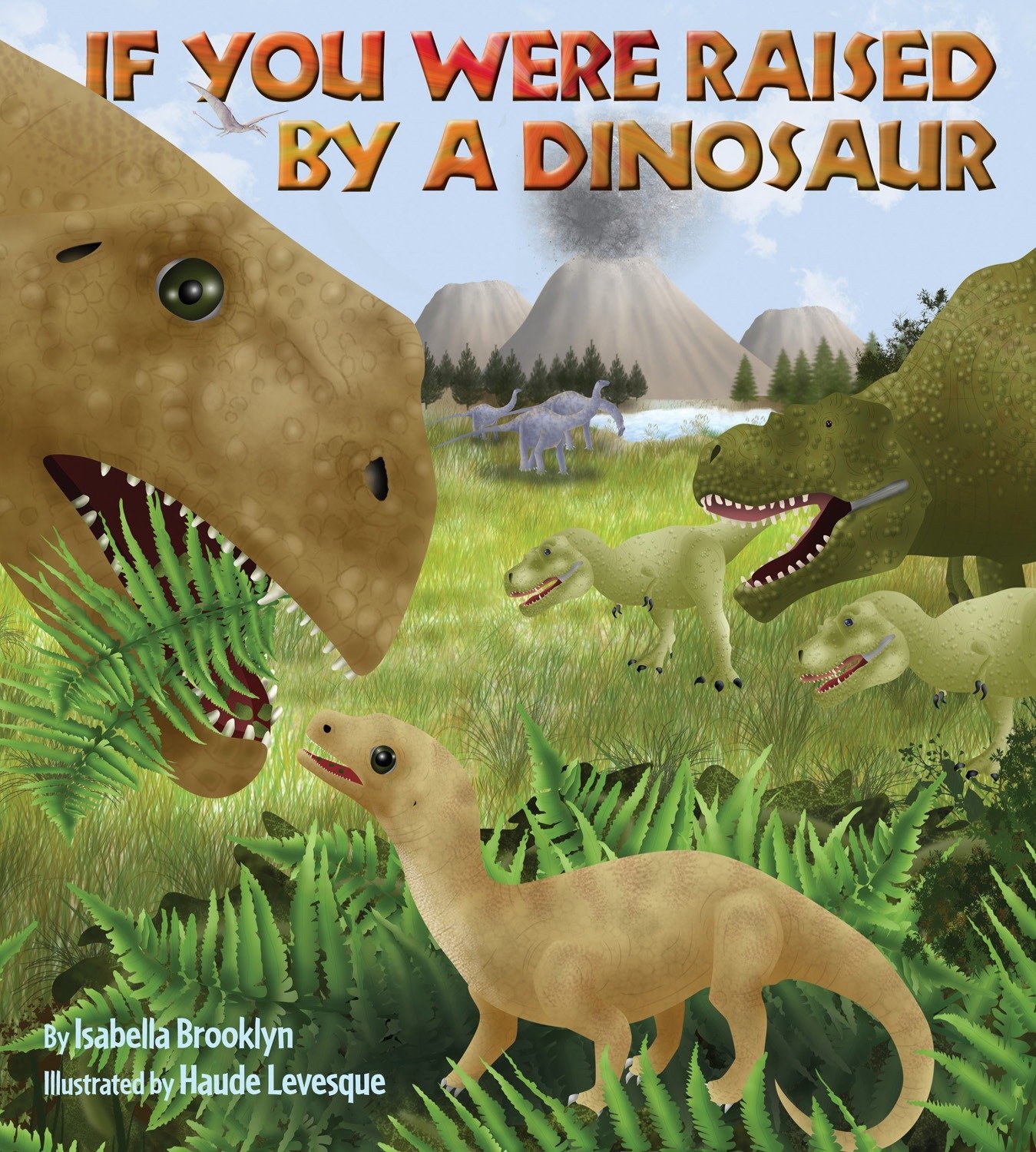
The worst popular baby dino book ( https://www.amazon.com/review/R2PBFKZ4BOZCNN/ref=pe_1098610_137716200_cm_rv_eml_rv0_rv ): 1/5
Short version: If you want the best baby dino book for older kids, get Zoehfeld's "Dinosaur Parents, Dinosaur Young: Uncovering the Mystery of Dinosaur Families" & read it in conjunction with other, more recent books (E.g. Holtz's "Dinosaurs" in general & Chapter 36 in particular). Brooklyn's "If You Were Raised by a Dinosaur" (henceforth You) may be the worst. It just goes to show what a difference some expert consulting & personal research can make.
Long version: Read on.
Many popular baby dino books are OK, but not great. There are 3 main reasons for why I think that is: 1) They're mixed bags in terms of paleoart (Quoting Miller: "I bought the book expecting a more technical discussion of the animals discussed therein...but was surprised to find beautiful paintings of questionably-restored dinosaurs"); 2) They're confusing messes in terms of organization; 3) They fail to cover many baby dino-related subjects & those that are covered are done so in an insufficient manner (I.e. Sometimes, they simplify things to the point of being meaningless; Other times, they're just plain wrong). In this review, I focus on reasons #1 & #3 & why I think they make You the worst popular baby dino book.
1) Not only is You's paleoart very questionable, but also very ugly. More specifically, it consists of cheap-looking collages of anachronistic assemblages of mostly gray/green/brown animals with wonky anatomy in inappropriate environments: In reference to "anachronistic assemblages", see the cover; There's a generic rhamphorhynchid pterosaur, a Massospondylus family, an Apatosaurus family, & a T.rex family; In reference to "wonky anatomy", see "Review update #52 (It's a big 1)!" for everything wrong with the cover in terms of anatomy ( https://www.deviantart.com/jd-man/journal/Review-update-52-It-s-a-big-1-772428585 ); In reference to "inappropriate environments", the cover depicts a grassland environment despite the fact that, to quote Holtz ( https://www.geol.umd.edu/~tholtz/G104/lectures/104shadow.html ), "grasses seem to have been relatively rare in the Mesozoic, and did not form grasslands until much later. Ground cover in the later Mesozoic was a mixture of ferns and herbaceous angiosperms. So as far as we know, no dinosaur other than birds ever wandered in prairies or savannahs".
3A) In reference to "Sometimes", You's writing is overcomplicated (as opposed to oversimplified). More specifically, it's like when "Chandler and Monica ask Joey to write a recommendation letter for them to the adoption agency. To sound smart, Joey uses a thesaurus [on every word]" ( https://globalnews.ca/news/315234/friends-sitcom-helps-esl-community-learn-english/ ). The Brooklyn quote in "Review update #52 (It's a big 1)!" is the best example of that ( https://www.deviantart.com/jd-man/journal/Review-update-52-It-s-a-big-1-772428585 ): For 1, it's also the best example of incorrectly pluralized dino names (Seriously, "T. rexes"?); For another, it shamelessly rips off Chapter 17 of Holtz's "Dinosaurs".
3B) In reference to "Other times", this is especially apparent in the Brooklyn quote below (which fails on so many levels that I need to quote the UCMP just to demonstrate): It fails to understand that Geist/Jones are 1) not dino experts, & 2) known for "publishing with a hidden agenda" ( https://scienceblogs.com/tetrapodzoology/2009/07/17/birds-cannot-be-dinosaurs ); It fails to understand "modern-day [precocial] birds and alligators", most of which DO need parental care, including most of those in Geist/Jones's study; It fails to understand Maiasaura (which, to paraphrase Anthony J. Martin, "is arguably the best understood of nesting dinosaurs, only rivaled by its neighbors in the same field area, [Troodon]"); It fails to understand that Geist/Jones's study was at least 9 years out of date at the time of You's publication.
1 more thing of note: To quote Dussart (See "Biosciences on the Internet: A Student's Guide"), "The speed and ease of email, plus its association with the web, mean that it is relatively easy to find and contact experts"; Thus, there's no excuse for You to not have expert consulting, especially given that some experts make a living from consultancy (E.g. Darren Naish: https://darrennaish.wordpress.com/ ); At the very least, having it would've helped prevent many of the textual fails (if not the visual ones too); In fact, said fails are so basic that they could've easily been avoided with up-to-date personal research; Unfortunately, there's very little of said research in You & it's mostly used incorrectly; In contrast, Sattler's "Tyrannosaurus Rex and Its Kin: The Mesozoic Monsters" shows how good a non-authoritative book can be with a lot of said research ( https://www.amazon.com/gp/customer-reviews/R3INFL96O3PWAS/ref=cm_cr_srp_d_rvw_ttl?ie=UTF8&ASIN=068807748X ).
Quoting Brooklyn: "Not all scientists agree with the interpretation that Maiasaura babies needed parental care. Scientists Nicholas Geist and Terry Jones examined the hip and knee bones of different birds and alligators. They compared the hip bones and knee joints of Maiasaura to that of modern-day birds and alligators, which don't need parental care. The Maiasaura hips were at least as well developed as the birds', and the knee joints were no weaker than the birds' or alligators'. This might mean that Maiasaura babies did not need care from their parents as Horner believed."
Quoting the UCMP ( http://www.ucmp.berkeley.edu/science/eggshell/eggshell_case1.php ): "In their original description of embryonic remains from the Willow Creek Anticline, Horner and Weishampel (1988) cited degree of ossification of the leg bones of Maiasaura and Troodon (then thought to be Orodromeus) to indicate the level of mobility of young after hatching. Subsequently, Geist and Jones (1996) compared extant perinatal (the developmental stage immediately prior to and following hatching) birds and crocodilians to fossil dinosaur embryos and hatchlings. They found that the extent of hip bone development was more important than leg bone development for recognizing precocial versus altricial hatchlings, and that the leg bones of Maiasaura, Troodon, and other dinosaurs did not reliably indicate the mobility of a hatchling. Geist and Jones suggested that the hatchling dinosaurs studied were likely precocial upon birth, although this does not preclude the provision of extended parental care. Horner et al. (2001) countered Geist and Jones' (1996) argument after an extensive histological analysis of turtle, crocodilian, non-avian dinosaur, and bird embryonic and perinatal bones that compared bone developmental patterns and growth rates. The authors correlated ossification and growth rates with life-history strategies. Horner et al. (2001) concluded that developmental differences (including growth rates) in embryonic and perinatal dinosaur bones from the Willow Creek Anticline indicate a precocial lifestyle for Troodon and Orodromeus hatchlings and an altricial lifestyle for hadrosaur hatchlings that necessitated parental care; this work supported their original hypothesis (Horner and Weishampel 1988)."
Wednesday, October 31, 2018
The Jurassic World 2 Movie and Challenge
 |
| https://images-na.ssl-images-amazon.com/images/I/91Vcg3SEomL._RI_SX300_.jpg |

As you may remember, I saw "Jurassic World", took the "Jurassic World Challenge", & in the process committed to eventually moving to Seattle ( http://blogevolved.blogspot.com/2015/06/the-jurassic-world-movie-and-challenge.html ). I've since moved to Seattle & seen JW2. Unfortunately, there was no official "Jurassic World 2 Challenge". I didn't wanna feel like I was watching JW2 without a greater purpose, so I took an unofficial "Jurassic World 2 Challenge" in the following way:
-1st, I read Vincent's JW2 review (I.e. "JURASSIC WORLD: FALLEN KINGDOM – MARC’S REVIEW", which sums up my opinion of the movie: https://chasmosaurs.com/2018/06/07/jurassic-world-fallen-kingdom-marcs-review/ ). My only nit-pick is that there's no mention of Lockwood's dioramas (which, to me, are the most interesting things in the movie).
-Then, I pledged $1/month (& thus, $12/year) to Darren Naish's Patreon ( https://www.patreon.com/TetZoo ). As a big fan of Naish's work in general & his dino-related work in particular (E.g. Naish/Barrett's "Dinosaurs: How They Lived and Evolved", which I reviewed: https://www.amazon.com/review/R3VQ7TMT8EFOC7/ref=pe_1098610_137716200_cm_rv_eml_rv0_rv ), I've been meaning to pledge for a while, but was waiting for the right time. Now is the right time for 3 main reasons: 1) The move; 2) The challenge; 3) "The Dinosaurs in the Wild book" (See the Naish quote; Also, my initial reaction to said quote: https://vignette4.wikia.nocookie.net/gravityfalls/images/0/00/S2e5_stan_react.png/revision/latest?cb=20141019052029 ).

-Last, I donated $12 to the Woodland Park Zoo's conservation efforts ( https://www.zoo.org/conservation ). In addition to the Burke (which has "the only real [dino] fossils on display in Washington state!": http://www.burkemuseum.org/calendar/i-dig-dinos ), there's also the Pacific Science Center (which has robot dinos) AWA the WPZ & Seattle Aquarium (which have live birds). Of the latter 3, the WPZ is the best choice for 3 main reasons: 1) Its physical closeness to me; 2) "The role [it has] to play in the world for conservation and education" ( https://www.theguardian.com/science/2017/mar/08/why-the-world-needs-zoos ); 3) Trevorrow's pretentious/ignorant zoo-shaming (See the Trevorrow quote; Also, my initial reaction to said quote: https://scontent-sea1-1.xx.fbcdn.net/v/t1.15752-9/38179678_10215258105798805_7253572186617675776_n.jpg?_nc_cat=102&_nc_ht=scontent-sea1-1.xx&oh=1fc9aa581f503135e14b936a97a2d3e9&oe=5C896123 ).

P.S. Happy Halloween!
Quoting Naish ( http://tetzoo.com/blog/2018/9/3/the-last-day-of-dinosaurs-in-the-wild ): "This blog, my research and many of my projects are made possible thanks to your kind support at patreon. The more support I receive, the more able I become to spend time producing the content you like to see: the Dinosaurs in the Wild book discussed here, for example, could be published if only I were able to devote the time to it."
Quoting Trevorrow ( https://www.slashfilm.com/jurassic-world-2-details/ ): "The dinosaurs will be a parable of the treatment animals receive today: the abuse, medical experimentation, pets, having wild animals in zoos like prisons, the use the military has made of them, animals as weapons."
Friday, September 21, 2018
My 25th Pair of Reviews
As an Art Evolved member, I post a pair of my reviews here every so often, the 1st being positive & the 2nd being negative. I'd greatly appreciate you reading & voting "Helpful" for said reviews in the bolded links below. Besides wanting to make sure said reviews give a good idea of what to expect, they need all the "Helpful" votes they can get because 1) the 1st is for a great book that deserves more attention, & 2) the 2nd is outnumbered by opposing reviews (which don't give a good idea of what to expect). Many thanks in advance.
P.S. For my previous reviews, see the following posts:
-My 1st-10th Pairs of Reviews: http://blogevolved.blogspot.com/2015/06/my-10th-pair-of-reviews.html
-My 11th-20th Pairs of Reviews: http://blogevolved.blogspot.com/2017/09/my-20th-pair-of-reviews.html
-"My 21st Pair of Reviews": http://blogevolved.blogspot.com/2017/11/my-21st-pair-of-reviews.html
-"My 22nd Pair of Reviews": http://blogevolved.blogspot.com/2018/02/my-22nd-pair-of-reviews.html
-"My 23rd Pair of Reviews": http://blogevolved.blogspot.com/2018/05/my-23rd-pair-of-reviews.html
Extremely bad ( https://www.amazon.com/review/R10WWVQJN8L3MP/ref=pe_1098610_137716200_cm_rv_eml_rv0_rv ): 1/5
P.S. For my previous reviews, see the following posts:
-My 1st-10th Pairs of Reviews: http://blogevolved.blogspot.com/2015/06/my-10th-pair-of-reviews.html
-My 11th-20th Pairs of Reviews: http://blogevolved.blogspot.com/2017/09/my-20th-pair-of-reviews.html
-"My 21st Pair of Reviews": http://blogevolved.blogspot.com/2017/11/my-21st-pair-of-reviews.html
-"My 22nd Pair of Reviews": http://blogevolved.blogspot.com/2018/02/my-22nd-pair-of-reviews.html
-"My 23rd Pair of Reviews": http://blogevolved.blogspot.com/2018/05/my-23rd-pair-of-reviews.html
-"My 24th Pair of Reviews": http://blogevolved.blogspot.com/2018/07/my-24th-pair-of-reviews.html
 |
| https://images-na.ssl-images-amazon.com/images/I/61EdWefHVIL.jpg |
Extremely nostalgic ( https://www.amazon.com/review/R1D5YN9OJS6MXU/ref=pe_1098610_137716200_cm_rv_eml_rv0_rv ): 5/5
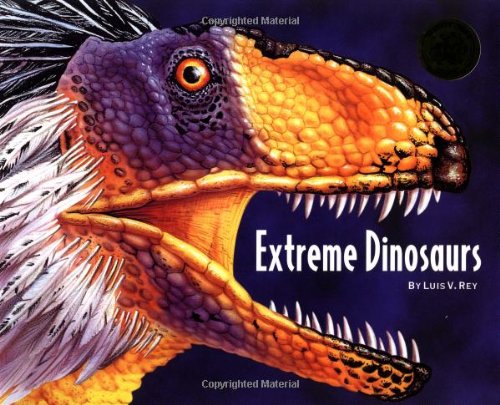
If there's 1 thing I'm nostalgic for, it's Rey's traditional paleoart (which is overall better than his digital paleoart). If there's 1 thing I'm definitely NOT nostalgic for, it's the extreme dino genre (which is usually at best just a buzzword & at worst an excuse to make dinos as monstrous as possible). Not only is Rey's "Extreme Dinosaurs" (henceforth ED) the best extreme dino book, but also the best traditional Rey book.* In this review, I list the 3 main reasons why I think that is.
1) Unlike other extreme dino books, "extreme" actually means something in ED. This is especially apparent in the 1st 2 chapters. Not only do said chapters define "extreme" (See the 1st Rey quote), but also use "the dinosaur-bird link" to reinforce that definition (See the 2nd Rey quote).
2) Unlike other extreme dino books, ED is very well-organized. More specifically, the middle chapters are arranged in both geographical & chronological order: In reference to "geographical", each chapter focuses on a different continent; In reference to "chronological", the chapters are arranged in order of their continent's 1st dino discovery, beginning with Europe & ending with Asia; Furthermore, the dinos in each chapter are described in order of their discovery (E.g. The Europe chapter begins with Iguanodon & ends with Scipionyx).
3) Unlike other extreme dino books, ED is very well-illustrated. The last chapter in particular features Rey's then-best/most bird-like dinos in terms of appearance & behavior. "Customising a life-size Velociraptor" (which, as far as I know, is the best Velociraptor model next to Kokoro's: http://www.luisrey.ndtilda.co.uk/html/custom.htm ) & "RAPTOR RED:Snow games" (which, as far as I know, is the best dino play behavior art, period: http://www.luisrey.ndtilda.co.uk/html/rapred.htm ) are especially good examples of the former & latter, respectively.
If I could, I'd give ED a 4.5/5. My only gripes are a few weird bits in the text (E.g. The Berlin Archaeopteryx is referred to as "the first Archaeopteryx fossil that was found") & writing (E.g. Some hadrosaurs are referred to as 4-legged, while others are referred to as 2-legged). However, for the purposes of this review, I'll round up to 5/5. I recommend reading ED in conjunction with other, more recent books (E.g. Holtz's "Dinosaurs") as well as "Luis V. Rey's Dinosaurs and Paleontology Art Gallery" (which provides more info about most of Rey's ED work).
*Gee/Rey's "A Field Guide to Dinosaurs: The Essential Handbook for Travelers in the Mesozoic" may be better in terms of paleoart (I.e. There's MUCH more of it), but definitely NOT in terms of text & writing.
Quoting Rey: "There has never been a more exciting time to study dinosaurs. The better we get to know them, the more weird and wonderful and extreme they seem. We know a lot more about dinosaurs than we did when I was a kid. We used to think that dinosaurs were sluggish, cold blooded and not very bright. Then in 1964, Yale paleontologist John Ostrom found the arms and claws of a two-legged meat-eater he named Deinonychus...Deinonychus had enormous sickle-shaped claws on its feet. This meant that in order to kill its prey, it had to be able to leap into the air, cling to the victim with its hand claws, and slash with its feet. Deinonychus must have been a real acrobat. Could it be that dinosaurs were much more active than we had thought? Other extraordinary discoveries followed."
Quoting Rey: "In 1988, my Deinonychus Pack was a controversial painting. Paleontologists who favored the idea of the dinosaur-bird link loved it. Others didn't. They thought dinosaur feathers were science fiction...they wanted to see scaly skin! Lots of evidence has piled up in favor of feathers since those days."
 |
| https://images-na.ssl-images-amazon.com/images/I/510crBKdlLL.jpg |

Extremely bad ( https://www.amazon.com/review/R10WWVQJN8L3MP/ref=pe_1098610_137716200_cm_rv_eml_rv0_rv ): 1/5
In my previous review, I referred to Rey's "Extreme Dinosaurs" as the best extreme dino book. In this review, I list the 3 main reasons why Mash's "Extreme Dinosaurs" (henceforth ED) may be the worst extreme dino book.
1) Trish's ED review ( http://babbletrish.blogspot.com/2011/07/lets-read-another-eye-searingly-bad.html ) sums up most everything you need to know about Martin's paleoart in ED. However, I'll add my own thoughts as well:
-Martin's Brachiosaurus & Edmontosaurus are shameless rip-offs of Graham High's Brachiosaurus model & the NHM's Baryonyx model, respectively.
-Remember when "Nigel-the-Pelican-flies-into-a-window" in "Finding Nemo" ( https://ohmy.disney.com/wp-content/uploads/sites/25/2014/06/Nigel-the-Pelican-flies-into-a-window.jpg )? Martin's Microraptor is basically a Mockbuster version of that.
-Remember the "All Yesterdays Cat" ( https://i.warosu.org/data/sci/img/0073/83/1436510676473.jpg )? Martin's T.rex is basically a Shar-Pei version of that.
2) Martin's paleoart isn't the only "Eye-Searingly Bad" part of ED. There's also Mash's writing: For 1, it goes back & forth between uncomfortably large & uncomfortably small; For another, it goes back & forth between several different fonts; Taken together, it's extremely difficult just to look at it, let alone read the words. & if that's not bad enough, Mash's writing is also annoyingly repetitive (E.g. "First, they were used first to kill the prey, and then to slice the meat")/inconsistent (E.g. Some of the info boxes list length; Others list length & weight; Still others list length, weight, & height)/derivative (E.g. See the Mash quote, which shamelessly rips off Chapter 4 of Gardom/Milner's "The Natural History Museum Book of Dinosaurs").
3) Mash's text is hit-&-miss in terms of getting the facts straight. This is especially apparent in the info boxes because the misses stick out more with less text.* However, the other sidebar misses may be worse in degree: Some of them are due to being extremely outdated (E.g. Not only are pachycephalosaurs & heterodontosaurs claimed to be ornithopods, but ornithischians & saurischians are claimed to be no more closely related to each other than they are to crocs & pterosaurs); Others are due to being extremely nonsensical (E.g. The skeleton on pages 10-11 is "[seemingly] based on Marsh's 1880s "Brontosaurus" skeletal, complete with mismatched macronarian head", yet is referred to as that of Diplodocus).**
*Even if you only read the info boxes, you'll see that there's an average of at least 1 or 2 factual errors per page in ED, a 32 page book (E.g. Brachiosaurus =/= 150-140 MYA & "up to 90 tons").
**Google "Vintage Dinosaur Art: The evolution and ecology of the Dinosaurs: Part 2".
1) Trish's ED review ( http://babbletrish.blogspot.com/2011/07/lets-read-another-eye-searingly-bad.html ) sums up most everything you need to know about Martin's paleoart in ED. However, I'll add my own thoughts as well:
-Martin's Brachiosaurus & Edmontosaurus are shameless rip-offs of Graham High's Brachiosaurus model & the NHM's Baryonyx model, respectively.
-Remember when "Nigel-the-Pelican-flies-into-a-window" in "Finding Nemo" ( https://ohmy.disney.com/wp-content/uploads/sites/25/2014/06/Nigel-the-Pelican-flies-into-a-window.jpg )? Martin's Microraptor is basically a Mockbuster version of that.

-Remember the "All Yesterdays Cat" ( https://i.warosu.org/data/sci/img/0073/83/1436510676473.jpg )? Martin's T.rex is basically a Shar-Pei version of that.

2) Martin's paleoart isn't the only "Eye-Searingly Bad" part of ED. There's also Mash's writing: For 1, it goes back & forth between uncomfortably large & uncomfortably small; For another, it goes back & forth between several different fonts; Taken together, it's extremely difficult just to look at it, let alone read the words. & if that's not bad enough, Mash's writing is also annoyingly repetitive (E.g. "First, they were used first to kill the prey, and then to slice the meat")/inconsistent (E.g. Some of the info boxes list length; Others list length & weight; Still others list length, weight, & height)/derivative (E.g. See the Mash quote, which shamelessly rips off Chapter 4 of Gardom/Milner's "The Natural History Museum Book of Dinosaurs").
3) Mash's text is hit-&-miss in terms of getting the facts straight. This is especially apparent in the info boxes because the misses stick out more with less text.* However, the other sidebar misses may be worse in degree: Some of them are due to being extremely outdated (E.g. Not only are pachycephalosaurs & heterodontosaurs claimed to be ornithopods, but ornithischians & saurischians are claimed to be no more closely related to each other than they are to crocs & pterosaurs); Others are due to being extremely nonsensical (E.g. The skeleton on pages 10-11 is "[seemingly] based on Marsh's 1880s "Brontosaurus" skeletal, complete with mismatched macronarian head", yet is referred to as that of Diplodocus).**
*Even if you only read the info boxes, you'll see that there's an average of at least 1 or 2 factual errors per page in ED, a 32 page book (E.g. Brachiosaurus =/= 150-140 MYA & "up to 90 tons").
**Google "Vintage Dinosaur Art: The evolution and ecology of the Dinosaurs: Part 2".
Quoting Mash: "It is estimated a human being could have been torn apart in less than thirty seconds by a pack of Velociraptors!"
Monday, August 6, 2018
Top 4 Natural Histories of Dinos
This post is the sequel to "Natural Histories of Dinos" ( http://blogevolved.blogspot.com/2017/08/natural-histories-of-dinos.html ). It's nothing formal, just a list of what I (as a non-expert dino fan) think are the best NHD books & why. Even still, I hope that at least some of you will get something out of it.
4/3) Tie btwn Fastovsky/Weishampel's "Dinosaurs: A Concise Natural History"/"The Evolution and Extinction of the Dinosaurs" & Sampson's "Dinosaur Odyssey: Fossil Threads in the Web of Life": Despite their obvious differences (E.g. Fastovsky/Weishampel's book is a textbook w/a phylogenetic format, while Sampson's is a non-textbook w/a chronological format), these 2 books have 3 major similarities: 1) In both books, "the story builds in a stepwise fashion," "each chapter [building] upon the previous ones"; 2) "Part of [the goal in both books] is to explore the relationships of organisms to each other and to the biosphere"; 3) "It is [hoped] that science educators in particular will embrace some of the approaches presented" in both books. This is especially apparent when you compare the Introduction of Fastovsky/Weishampel's book ( http://assets.cambridge.org/97805218/11729/excerpt/9780521811729_excerpt.pdf ) to the Preface of Sampson's ( http://www.scottsampson.net/index.php?page=dinosaur-odyssey ).
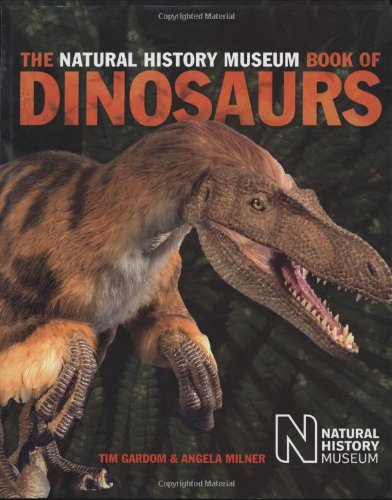
2) Gardom/Milner's "The Natural History Museum Book of Dinosaurs": To quote Hammond ( http://www.tehachapinews.com/lifestyle/pen-in-hand-wonder-bird-a-closer-look-at-a/article_d47df6a6-ba67-59b5-912d-3ec3620763d8.html ), the red-tailed hawk is "the archetypal bird of prey". Similarly, this book was the archetypal NHD from 1993-2016 (See "Synopsis": https://www.amazon.de/Natural-History-Museum-Book-Dinosaurs/dp/184442183X ). There are 2 main reasons for why I think that is: 1) To paraphrase Naish ( https://blogs.scientificamerican.com/tetrapod-zoology/naish-and-barretts-dinosaurs-how-they-lived-and-evolved/ ), this book is backed by "one of the world's greatest and most famous of natural history museums, and [based on] one of the world's most important scientific collections of dinosaur fossils"; This is especially apparent in "The Dino Directory" ("which serves as a nice supplement to [this] book": https://paleoaerie.org/2015/09/18/the-natural-history-museum-book-of-dinosaurs/ ); 2) This book has a day-in-the-life format (I.e. The 1st part introduces the dinos & their world; The 2nd part shows how the dinos lived & evolved in their world); This makes sense given that, according to Ernest Thompson Seton, day-in-the-life stories are the best way to write natural history (See "NOTE TO THE READER": http://www.mainlesson.com/display.php?author=seton&book=wild&story=_front ). It's also worth mentioning that the newer editions are very much "enlarged and updated" compared to the older ones (E.g. 144 pages in 2006 vs. 128 pages in 1993).
1) Naish/Barrett's "Dinosaurs: How They Lived and Evolved": In 2016, 10 years after the last edition of Gardom/Milner's book, this book became the new archetypal NHD. This book does everything Gardom/Milner's book does, but mostly bigger & better ( https://www.amazon.com/review/R3VQ7TMT8EFOC7/ref=pe_1098610_137716200_cm_rv_eml_rv0_rv ). In fact, if I could, I'd give this book an extra star for being extra authoritative (I.e. An extra half star for the NHM & an extra half star for the Smithsonian). In other words, this is a 6-star book.
Honorable Mention) Bakker's "The Big Golden Book of Dinosaurs": This book is the best children's NHD. There are 2 main reasons for why I think that is, besides the fact that this book is an updated version of a childhood classic:* 1) It's the best at emphasizing the safari aspect of natural history; This makes sense given that it's authored by Bakker ( http://www.hmns.org/exhibits/permanent-exhibitions/the-morian-hall-of-paleontology/ ); 2) It's the best at reminding readers that "the dinosaur story is our story, too"; Put another way, to quote Barton ( https://thedispersalofdarwin.wordpress.com/2011/12/12/humanist-perspectives-connecting-children-to-nature/ ), "we’re part of the natural world along with every creature great and small, plant, rock, wave, and breeze...We must care for our planet not just for ourselves to remain, but for all of our extended family".
*To paraphrase Paleoaerie ( https://paleoaerie.org/2013/11/26/its-big-its-golden-and-its-dinosaurs/ ), this book is the "totally updated edition" of "the classic book that most people old enough to be parents grew up on". Thus, to paraphrase Earl Sinclair ( https://www.youtube.com/watch?v=QXiwXVrjYHc ), "this [book] works on two levels!"
 |
| https://images-na.ssl-images-amazon.com/images/I/51X8Pdmtg7L.jpg |
4/3) Tie btwn Fastovsky/Weishampel's "Dinosaurs: A Concise Natural History"/"The Evolution and Extinction of the Dinosaurs" & Sampson's "Dinosaur Odyssey: Fossil Threads in the Web of Life": Despite their obvious differences (E.g. Fastovsky/Weishampel's book is a textbook w/a phylogenetic format, while Sampson's is a non-textbook w/a chronological format), these 2 books have 3 major similarities: 1) In both books, "the story builds in a stepwise fashion," "each chapter [building] upon the previous ones"; 2) "Part of [the goal in both books] is to explore the relationships of organisms to each other and to the biosphere"; 3) "It is [hoped] that science educators in particular will embrace some of the approaches presented" in both books. This is especially apparent when you compare the Introduction of Fastovsky/Weishampel's book ( http://assets.cambridge.org/97805218/11729/excerpt/9780521811729_excerpt.pdf ) to the Preface of Sampson's ( http://www.scottsampson.net/index.php?page=dinosaur-odyssey ).
 |
| https://images-na.ssl-images-amazon.com/images/I/51t8mO3z0sL.jpg |
2) Gardom/Milner's "The Natural History Museum Book of Dinosaurs": To quote Hammond ( http://www.tehachapinews.com/lifestyle/pen-in-hand-wonder-bird-a-closer-look-at-a/article_d47df6a6-ba67-59b5-912d-3ec3620763d8.html ), the red-tailed hawk is "the archetypal bird of prey". Similarly, this book was the archetypal NHD from 1993-2016 (See "Synopsis": https://www.amazon.de/Natural-History-Museum-Book-Dinosaurs/dp/184442183X ). There are 2 main reasons for why I think that is: 1) To paraphrase Naish ( https://blogs.scientificamerican.com/tetrapod-zoology/naish-and-barretts-dinosaurs-how-they-lived-and-evolved/ ), this book is backed by "one of the world's greatest and most famous of natural history museums, and [based on] one of the world's most important scientific collections of dinosaur fossils"; This is especially apparent in "The Dino Directory" ("which serves as a nice supplement to [this] book": https://paleoaerie.org/2015/09/18/the-natural-history-museum-book-of-dinosaurs/ ); 2) This book has a day-in-the-life format (I.e. The 1st part introduces the dinos & their world; The 2nd part shows how the dinos lived & evolved in their world); This makes sense given that, according to Ernest Thompson Seton, day-in-the-life stories are the best way to write natural history (See "NOTE TO THE READER": http://www.mainlesson.com/display.php?author=seton&book=wild&story=_front ). It's also worth mentioning that the newer editions are very much "enlarged and updated" compared to the older ones (E.g. 144 pages in 2006 vs. 128 pages in 1993).
 |
| https://images-na.ssl-images-amazon.com/images/I/91OaXhz1ihL.jpg |
1) Naish/Barrett's "Dinosaurs: How They Lived and Evolved": In 2016, 10 years after the last edition of Gardom/Milner's book, this book became the new archetypal NHD. This book does everything Gardom/Milner's book does, but mostly bigger & better ( https://www.amazon.com/review/R3VQ7TMT8EFOC7/ref=pe_1098610_137716200_cm_rv_eml_rv0_rv ). In fact, if I could, I'd give this book an extra star for being extra authoritative (I.e. An extra half star for the NHM & an extra half star for the Smithsonian). In other words, this is a 6-star book.
 |
| https://images-na.ssl-images-amazon.com/images/I/612bISoDw6L.jpg |
Honorable Mention) Bakker's "The Big Golden Book of Dinosaurs": This book is the best children's NHD. There are 2 main reasons for why I think that is, besides the fact that this book is an updated version of a childhood classic:* 1) It's the best at emphasizing the safari aspect of natural history; This makes sense given that it's authored by Bakker ( http://www.hmns.org/exhibits/permanent-exhibitions/the-morian-hall-of-paleontology/ ); 2) It's the best at reminding readers that "the dinosaur story is our story, too"; Put another way, to quote Barton ( https://thedispersalofdarwin.wordpress.com/2011/12/12/humanist-perspectives-connecting-children-to-nature/ ), "we’re part of the natural world along with every creature great and small, plant, rock, wave, and breeze...We must care for our planet not just for ourselves to remain, but for all of our extended family".
*To paraphrase Paleoaerie ( https://paleoaerie.org/2013/11/26/its-big-its-golden-and-its-dinosaurs/ ), this book is the "totally updated edition" of "the classic book that most people old enough to be parents grew up on". Thus, to paraphrase Earl Sinclair ( https://www.youtube.com/watch?v=QXiwXVrjYHc ), "this [book] works on two levels!"
Friday, July 20, 2018
Craig's Latest
For anyone paying attention (and I don't expect that to be many of you ;) ) I've been threatening a palaeoart project for quite sometime. The project kept dying in its tracks partially due to paying (board game) gigs, but also my over ambition.
I'd kept dreaming of doing animations for Youtube, but of course animation is very time consuming and hard. So I'd be overwhelmed fairly quickly.
However it has recently occurred to me why do I need animation for little sci videoes? Why not just do a series of storyboard style illustrations with narration?
So thus my big break through!
Here is a sample of what I'm up to now. Let me know what you think of the style.

I assure you this is not pure fan art. I'm planning on tearing this scene from the recent motion picture apart scientifically in a quick little kid friendly video.
Again I'm the guy who put together this Mosasaur Jurassic World size chart back in the day...

Sunday, July 15, 2018
My 24th Pair of Reviews
As an Art Evolved member, I post a pair of my reviews here every so often, the 1st being positive & the 2nd being negative. I'd greatly appreciate you reading & voting "Helpful" for said reviews in the bolded links below. Besides wanting to make sure said reviews give a good idea of what to expect, they need all the "Helpful" votes they can get because 1) the 1st is for a very good book that deserves more attention, & 2) the 2nd is outnumbered by opposing reviews (which don't give a good idea of what to expect). Many thanks in advance.
P.S. For my previous reviews, see the following posts:
-My 1st-10th Pairs of Reviews: http://blogevolved.blogspot.com/2015/06/my-10th-pair-of-reviews.html
-My 11th-20th Pairs of Reviews: http://blogevolved.blogspot.com/2017/09/my-20th-pair-of-reviews.html
-"My 21st Pair of Reviews": http://blogevolved.blogspot.com/2017/11/my-21st-pair-of-reviews.html
-"My 22nd Pair of Reviews": http://blogevolved.blogspot.com/2018/02/my-22nd-pair-of-reviews.html
-"My 23rd Pair of Reviews": http://blogevolved.blogspot.com/2018/05/my-23rd-pair-of-reviews.html
The best edition ( https://www.amazon.com/review/RZ0S3CGZFRCPL/ref=pe_1098610_137716200_cm_rv_eml_rv0_rv ): 4/5
As far as I know, there are 5 editions of "Dinosaur (DK Eyewitness Books)" (henceforth DD 1989/2004/2008/2010/2014). As much as I love DD, it was never truly great: For 1, see the Ben quote; What Ben says about "the AMNH fossil halls" goes for DD; For another, DD is a mixed bag in terms of paleoart.* If you want the current best DD-style book, get Abramson et al.'s "Inside Dinosaurs". If I were to recommend reading an edition of DD in conjunction with other, more recent books (E.g. Holtz's "Dinosaurs"), it'd be DD 2004. In this review, I list the 2 main reasons why that is.
1) In reference to "For 1" (which mainly refers to DD 1989), DD 2004 partially solves this problem with "8 pages of new text", all of which are "distinctly color-coded". This is especially apparent in the "Find out more" & Glossary sections: The former lists some of the best dino museums in the U.S. & their websites (which is good because [1] it makes DD interactive, & [2] to quote Norman/Milner, "You can also take a virtual tour of many museums over the internet if you cannot visit them in person"); The latter clearly explains all technical terms. DD 2008 is almost exactly the same in content, the problem being that much of what was accurate in 2004 was inaccurate in 2008 (E.g. The records for "biggest dinosaur", "biggest meat-eater", & "shortest dinosaur name"). DD 2010/2014 have the opposite problem as DD 1989. While DD 1989 is too esoteric, DD 2010/2014 are too simple & condescending (E.g. "Hadrosaur" is defined 10 times throughout DD 2010, including twice on page 70). & if that's not bad enough, DD 2010/2014 are even more inaccurate for their time (probably because they're authored by a non-expert) & exclude said websites.
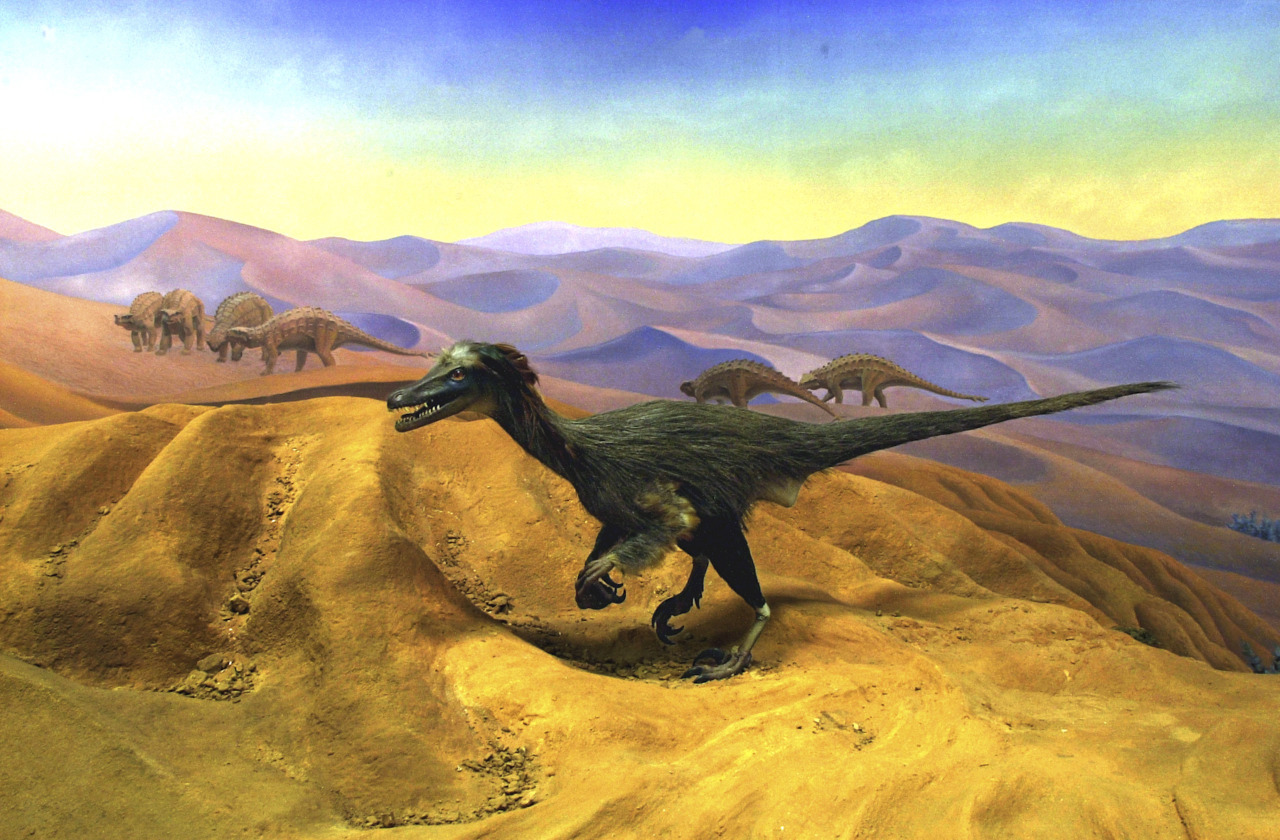
2) In reference to "For another", DD 2004 partially solves this problem with "stunning real-life photographs of dinosaur bones, skulls, teeth and more". This is especially apparent in the "and more" photos: Many of DD 1989's not-so-good life reconstructions, most of which were outdated even in 1989, were replaced in DD 2004 (E.g. Hill & Winterbotham's tail-dragging Mamenchisaurus & Diplodocus, respectively, were replaced by a herd of Graham High's Brachiosaurus); Many of those that weren't replaced got new captions (E.g. The new caption for Graham High's Deinonychus reads, "Most scientists now agree that, unlike the model shown here, Deinonychus was probably feathered"). Pixel-shack's bad life reconstructions started to replace DD's good ones in 2008 & almost completely took over in 2010/2014. Pixel-shack's "DK 2003" Velociraptor ( https://i037.radikal.ru/0805/62/0f35f1cca590.jpg ) replacing the AMNH's "Fighting Dinos" Velociraptor ( http://65.media.tumblr.com/tumblr_lru07qBMv11qio57co1_1280.jpg ) is an especially good example of that.
*I'm specifically referring to DD's life reconstructions, many of which are not-so-good (I.e. Those by various illustrators & Pixel-shack in the older & newer editions, respectively).
Definitely NOT the best ( https://www.amazon.com/review/R797Y6F6B6JEW/ref=pe_1098610_137716200_cm_rv_eml_rv0_rv ): 1/5
In my experience, when a non-fiction dino book is given a superlative title, it's being set up for failure. As far as I know, only 1 such book lives up to its title & Maynard's "The Best Book of Dinosaurs" (henceforth BB) is definitely NOT it or even just decent in its own right.* In this review, I list the 3 main reasons why I think that is.
1) BB's life reconstructions are mostly not-so-good. Those by Kirk are as good as it gets in BB, while those by Forsey are as bad as it gets: In reference to Kirk, the ornithischians & Barosaurus are depicted with too many claws; Otherwise, the dinos are mostly accurate for the time & completely awesome for all time (E.g. See the Deinonychus on the back cover, which have tiger stripes & a lightning storm background); In reference to Forsey, I've already said everything I have to say about him in my Wonder review (I.e. "Wonder's more realistic reconstructions": https://www.amazon.com/review/RGU1QQZ5DR8A5/ref=pe_1098610_137716200_cm_rv_eml_rv0_rv ); Unfortunately, most of BB's life reconstructions are by Forsey. Those by Field fall somewhere in between, but more towards Forsey (E.g. See the Triceratops on the front cover, which have cartoonishly angry eyes & 4 clawed fingers per hand).
2) BB is a confusing mess in terms of organization. There isn't even an Introduction. BB just begins with a chapter about baby dinos & continues with no logical transitions or flow between the chapters.
3) BB fails to cover many dino-related subjects & those that are covered are done so in an insufficient manner:** Sometimes, it simplifies things to the point of being meaningless; This is especially apparent in the chapter about the dino extinction because 1) the main text explains nothing about the science behind the dino extinction story, & 2) the sidebar text needlessly re-tells said story; Other times, it's just plain wrong; This is especially apparent in said chapter because it's claimed that 1) the asteroid "hit Earth in Central America" (Last I checked, Mexico =/= Central America), & 2) only "some scientists think that dinosaurs were the ancestors of modern birds" (Quoting Witmer from a 1995 book: "There are so many derived similarities between birds and these Deinonychus-like theropod dinosaurs that most paleontologists today believe birds are theropod dinosaurs!").
*By "1 such book", I mean Holtz's "Dinosaurs: The Most Complete, Up-to-Date Encyclopedia for Dinosaur Lovers of All Ages" ("Dinosaurs" for short).
**By "many", I mean half of all the dino-related subjects a decent introduction to dinos would cover. Using Gardom/Milner's "The Natural History Museum Book of Dinosaurs" as a guide, BB fails to cover "The dinosaur world", "Getting about", "Living animals", "Dinosaurs and people", & "Dinosaurs and birds".
P.S. For my previous reviews, see the following posts:
-My 1st-10th Pairs of Reviews: http://blogevolved.blogspot.com/2015/06/my-10th-pair-of-reviews.html
-My 11th-20th Pairs of Reviews: http://blogevolved.blogspot.com/2017/09/my-20th-pair-of-reviews.html
-"My 21st Pair of Reviews": http://blogevolved.blogspot.com/2017/11/my-21st-pair-of-reviews.html
-"My 22nd Pair of Reviews": http://blogevolved.blogspot.com/2018/02/my-22nd-pair-of-reviews.html
-"My 23rd Pair of Reviews": http://blogevolved.blogspot.com/2018/05/my-23rd-pair-of-reviews.html
 |
| https://images-na.ssl-images-amazon.com/images/I/51dWl9EXqzL.jpg |
The best edition ( https://www.amazon.com/review/RZ0S3CGZFRCPL/ref=pe_1098610_137716200_cm_rv_eml_rv0_rv ): 4/5
As far as I know, there are 5 editions of "Dinosaur (DK Eyewitness Books)" (henceforth DD 1989/2004/2008/2010/2014). As much as I love DD, it was never truly great: For 1, see the Ben quote; What Ben says about "the AMNH fossil halls" goes for DD; For another, DD is a mixed bag in terms of paleoart.* If you want the current best DD-style book, get Abramson et al.'s "Inside Dinosaurs". If I were to recommend reading an edition of DD in conjunction with other, more recent books (E.g. Holtz's "Dinosaurs"), it'd be DD 2004. In this review, I list the 2 main reasons why that is.
1) In reference to "For 1" (which mainly refers to DD 1989), DD 2004 partially solves this problem with "8 pages of new text", all of which are "distinctly color-coded". This is especially apparent in the "Find out more" & Glossary sections: The former lists some of the best dino museums in the U.S. & their websites (which is good because [1] it makes DD interactive, & [2] to quote Norman/Milner, "You can also take a virtual tour of many museums over the internet if you cannot visit them in person"); The latter clearly explains all technical terms. DD 2008 is almost exactly the same in content, the problem being that much of what was accurate in 2004 was inaccurate in 2008 (E.g. The records for "biggest dinosaur", "biggest meat-eater", & "shortest dinosaur name"). DD 2010/2014 have the opposite problem as DD 1989. While DD 1989 is too esoteric, DD 2010/2014 are too simple & condescending (E.g. "Hadrosaur" is defined 10 times throughout DD 2010, including twice on page 70). & if that's not bad enough, DD 2010/2014 are even more inaccurate for their time (probably because they're authored by a non-expert) & exclude said websites.
2) In reference to "For another", DD 2004 partially solves this problem with "stunning real-life photographs of dinosaur bones, skulls, teeth and more". This is especially apparent in the "and more" photos: Many of DD 1989's not-so-good life reconstructions, most of which were outdated even in 1989, were replaced in DD 2004 (E.g. Hill & Winterbotham's tail-dragging Mamenchisaurus & Diplodocus, respectively, were replaced by a herd of Graham High's Brachiosaurus); Many of those that weren't replaced got new captions (E.g. The new caption for Graham High's Deinonychus reads, "Most scientists now agree that, unlike the model shown here, Deinonychus was probably feathered"). Pixel-shack's bad life reconstructions started to replace DD's good ones in 2008 & almost completely took over in 2010/2014. Pixel-shack's "DK 2003" Velociraptor ( https://i037.radikal.ru/0805/62/0f35f1cca590.jpg ) replacing the AMNH's "Fighting Dinos" Velociraptor ( http://65.media.tumblr.com/tumblr_lru07qBMv11qio57co1_1280.jpg ) is an especially good example of that.

*I'm specifically referring to DD's life reconstructions, many of which are not-so-good (I.e. Those by various illustrators & Pixel-shack in the older & newer editions, respectively).
Quoting Ben ( https://extinctmonsters.net/2015/02/26/framing-fossil-exhibits-phylogeny/ ): "Within the actual fossil halls, interpretation remains stubbornly unapproachable. For example, the sign introducing proboscidians tells visitors that this group is defined primarily by eye sockets located near the snout. An observant visitor might wonder why scientists rely on such an obscure detail, as opposed to the obvious trunks and tusks. There’s a good teaching moment there concerning why some characteristics might face more selection pressure (and thus change more radically) than others, but instead visitors are only offered esoteric statements. Relatedly, the exhibit does little to prioritize information. Most label text is quite small, and there’s a lot of it. Compare this to Evolving Planet at the Field Museum, where there is a clear hierarchy of headings and sub-headings. Visitors can read the main point of a display without even stopping, and parents can quickly find relevant information to answer their charges’ questions (rather than making something up).
Evolving Planet also compares favorably to the AMNH fossil halls in its informative aesthetics and spatial logic. At FMNH, walls and signs in each section are distinctly color-coded, making transitions obvious and intuitive. Likewise, consistent iconography...such as the mass extinction zones...helps visitors match recurring themes and topics throughout the exhibit. AMNH, in contrast, has a uniform glass and white-walled Apple Store aesthetic. It’s visually appealing, but doesn’t do much to help visitors navigate the space in a meaningful way."
 |
| https://images-na.ssl-images-amazon.com/images/I/51%2BZrs5fTrL.jpg |
Definitely NOT the best ( https://www.amazon.com/review/R797Y6F6B6JEW/ref=pe_1098610_137716200_cm_rv_eml_rv0_rv ): 1/5
In my experience, when a non-fiction dino book is given a superlative title, it's being set up for failure. As far as I know, only 1 such book lives up to its title & Maynard's "The Best Book of Dinosaurs" (henceforth BB) is definitely NOT it or even just decent in its own right.* In this review, I list the 3 main reasons why I think that is.
1) BB's life reconstructions are mostly not-so-good. Those by Kirk are as good as it gets in BB, while those by Forsey are as bad as it gets: In reference to Kirk, the ornithischians & Barosaurus are depicted with too many claws; Otherwise, the dinos are mostly accurate for the time & completely awesome for all time (E.g. See the Deinonychus on the back cover, which have tiger stripes & a lightning storm background); In reference to Forsey, I've already said everything I have to say about him in my Wonder review (I.e. "Wonder's more realistic reconstructions": https://www.amazon.com/review/RGU1QQZ5DR8A5/ref=pe_1098610_137716200_cm_rv_eml_rv0_rv ); Unfortunately, most of BB's life reconstructions are by Forsey. Those by Field fall somewhere in between, but more towards Forsey (E.g. See the Triceratops on the front cover, which have cartoonishly angry eyes & 4 clawed fingers per hand).
2) BB is a confusing mess in terms of organization. There isn't even an Introduction. BB just begins with a chapter about baby dinos & continues with no logical transitions or flow between the chapters.
3) BB fails to cover many dino-related subjects & those that are covered are done so in an insufficient manner:** Sometimes, it simplifies things to the point of being meaningless; This is especially apparent in the chapter about the dino extinction because 1) the main text explains nothing about the science behind the dino extinction story, & 2) the sidebar text needlessly re-tells said story; Other times, it's just plain wrong; This is especially apparent in said chapter because it's claimed that 1) the asteroid "hit Earth in Central America" (Last I checked, Mexico =/= Central America), & 2) only "some scientists think that dinosaurs were the ancestors of modern birds" (Quoting Witmer from a 1995 book: "There are so many derived similarities between birds and these Deinonychus-like theropod dinosaurs that most paleontologists today believe birds are theropod dinosaurs!").
*By "1 such book", I mean Holtz's "Dinosaurs: The Most Complete, Up-to-Date Encyclopedia for Dinosaur Lovers of All Ages" ("Dinosaurs" for short).
**By "many", I mean half of all the dino-related subjects a decent introduction to dinos would cover. Using Gardom/Milner's "The Natural History Museum Book of Dinosaurs" as a guide, BB fails to cover "The dinosaur world", "Getting about", "Living animals", "Dinosaurs and people", & "Dinosaurs and birds".
Sunday, May 20, 2018
My 23rd Pair of Reviews
As an Art Evolved member, I post a pair of my reviews here every so often, the 1st being positive & the 2nd being negative. I'd greatly appreciate you reading & voting "Yes" for said reviews in the bolded links below. Besides wanting to make sure said reviews give a good idea of what to expect, they need all the "Yes" votes they can get because 1) the 1st is for a very good book that deserves more attention, & 2) the 2nd is outnumbered by opposing reviews (which don't give a good idea of what to expect). Many thanks in advance.
P.S. For my previous reviews, see the following posts:
-My 1st-10th Pairs of Reviews: http://blogevolved.blogspot.com/2015/06/my-10th-pair-of-reviews.html
-My 11th-20th Pairs of Reviews: http://blogevolved.blogspot.com/2017/09/my-20th-pair-of-reviews.html
-"My 21st Pair of Reviews": http://blogevolved.blogspot.com/2017/11/my-21st-pair-of-reviews.html
-"My 22nd Pair of Reviews": http://blogevolved.blogspot.com/2018/02/my-22nd-pair-of-reviews.html
 |
| https://images-na.ssl-images-amazon.com/images/I/511UvQyUtuL._SX313_BO1,204,203,200_.jpg |
Mostly good, part 1 ( https://www.amazon.com/review/R1BGIKWL90PWZD/ref=pe_1098610_137716200_cm_rv_eml_rv0_rv ): 4/5
Hone's "The Tyrannosaur Chronicles: The Biology of the Tyrant Dinosaurs" (henceforth TC) is mostly good, especially when it comes to describing key scientific concepts (E.g. Classification in Part 1). I say that b/c, unlike most of my positive reviews, this 1 is about TC's problems.
1) The paleoart is seriously lacking: For 1, most of the illustrations (I.e. Hartman's skeletal reconstructions) are great, but too small for good comparisons; For another, said illustrations are few & far between (I.e. Most of the chapters have only 1 illustration, 3 at most, & 5 of them have none); For yet another, there's only 1 life reconstruction in TC's entirety (I.e. Hartman's T.rex). This is especially problematic because, according to Hone, TC is meant for casual readers, yet it's laid out more like an enthusiast's book (I.e. Mostly black-&-white pages with a series of color plates). To put this in perspective, Sampson's "Dinosaur Odyssey: Fossil Threads in the Web of Life" is an enthusiast's book of similar length & layout, yet it has at least 3 illustrations per chapter, more in most, including a multi-species scene by Skrepnick at the beginning of every chapter.
2) The "scaly Tyrannosaurus" & "larger females" hypotheses are very misrepresented. Depending on the context, I don't mind if 1 or 2 non-major hypotheses are misrepresented once or twice.* My Riddle review shows what happens when many major hypotheses are misrepresented on many levels ( https://www.amazon.com/gp/customer-reviews/R47I7QPHDIHYD/ref=cm_cr_srp_d_rvw_ttl?ie=UTF8&ASIN=0300164351 ). However, while not as major as "Birds Are Dinosaurs", "scaly Tyrannosaurus" & "larger females" do have major implications for tyrannosaur biology, among other things (See the Willoughby & Bakker quotes, respectively). In reference to the former, the evidence for it is "essentially" ignored, while "a liberal coating of feathers" is taken as a given. Yes, said evidence hadn't yet been described in detail, but it had been mentioned in the technical literature. In reference to the latter, the problem is more layered. See "Review update #45 (It's a big 1)!" for how: https://jd-man.deviantart.com/journal/Review-update-45-It-s-a-big-1-743681263
In short, I recommend reading TC in conjunction with 1) GSPaul's "The Princeton Field Guide to Dinosaurs" for larger skeletal reconstructions & more life reconstructions, & 2) the Neal & Peter Larson chapters in Larson/Carpenter's "Tyrannosaurus rex, the Tyrant King" for more pre-TC info about T.rex skin & sexual dimorphism.
*E.g. In Chapter 10, Hone claims that "Richard Owen...regarded dinosaurs as giant lizards" in terms of physiology. That's not right (Quoting Owen: "The Dinosaurs, having the same thoracic structure as the Crocodiles, may be concluded to have possessed a four-chambered heart; and, from their superior adaptation to terrestrial life, to have enjoyed the function of such a highly-organized centre of circulation to a degree more nearly approaching that which now characterizes the warm-blooded Vertebrata"). Also, in Chapter 14, Hone claims that "the discovery of multiple remains of the famous dromaeosaurid Deinonychus with bones of the ornithischian Tenontosaurus...is mostly the limit of the evidence in support of the [pack hunting large prey] hypothesis". Depending on what he means by "large prey", that's not right either (Google "Taphonomy and Paleobiological Implications of Tenontosaurus-Deinonychus Associations" & "Days of the Deinos" for the technical & popular versions, respectively).
Quoting Willoughby ( https://www.amazon.com/gp/customer-reviews/R4VJXNM6VVEIV/ref=cm_cr_othr_d_rvw_ttl?ie=UTF8&ASIN=0300164351 ): "Along a similar vein, Kenneth Carpenter (1997) has pointed out evidence of Gorgosaurus scale imprints that have been known for at least twenty years, but have never been formally published. Research can of course take many years to publish for a myriad of reasons, but it seems highly likely that had these imprints been of feathers, they'd been published almost immediately. It seems like there is something fundamentally wrong with a system that more readily publishes research that is exciting and interesting because it conforms so smoothly with the dominant paradigm, when conflicting research that challenges some of these established lines of thinking might ultimately result in a more robust and less flawed theory overall."
Quoting Bakker (See "Raptor Red"): "Female dominance is a powerful piece of evidence that permits us to reconstruct the private lives of Cretaceous predatory dinosaurs. A family structure built around a large female is rare in meat-eating reptiles and mammals today, but it's the rule for one category of predatory species...carnivorous birds. Owls, hawks, and eagles have societies organized around female dominance, and we can think of tyrannosaurs and raptors as giant, ground-running eagles."
 |
| https://images-na.ssl-images-amazon.com/images/I/61TrsSw0HfL._SY458_BO1,204,203,200_.jpg |
Stop liking things! ( https://www.amazon.com/review/R37ELAMHP3KSEA/ref=pe_1098610_137716200_cm_rv_eml_rv0_rv ): 1/5
I was originally planning on reviewing Stan/Jan's "The Berenstain Bears and the Dinosaurs" (henceforth BB) the way I usually review bad dino books. However, I then remembered that Trish/Talcott's BB review is so perfect (especially when it comes to criticizing BB's art & message: https://berenstainbearcast.wordpress.com/2016/02/13/episode-37-the-berenstain-bears-and-the-dinosaurs/ ) that I can't possibly top it, so I won't even try. Instead, in this review, I'll point you to Trish/Talcott's BB review & add my own thoughts as well:
-The part around 13:00 reminds me of the "I Love Dinosaurs" series. I'm surprised said series isn't mentioned by name.
-The parts around 14:00 & 17:00 remind me of the Holtz quote below. More specifically, "it feels like...the creatures in the mind of a concerned parent whose only knowledge of [dinos] comes from the films of the 30s" (& thus, has "more in common with medieval bestiaries, conjured from rumor and imagination alone"). Furthermore, not only are said creatures inconsistent with "these [dino] skeletons on this page", but said skeletons are inconsistent with "the fossil skeletons on which [they're] based."
-The parts around 16:00 & 20:00 remind me of "The Berenstain Bears' Nature Guide": Not only do the Berenstain Bears explore "the whole of nature" (including non-bird dinos), but 1) they do so with Actual Factual (who supplies "actual facts about nature"), & 2) "they're happy" to spend the day together doing so; Keep in mind that this book was published 9 years before BB.
-The part around 30-32:00 sums up part of the reason why "The Berenstain Bears and the Bad Dream" does BB's story better, the other part being that Mama & Papa don't "take advantage of Brother's fear to talk him out of...his new interest".
-The part around 31-33:00 reminds me of 1) Switek's "Paleontological Profiles: Robert Bakker" (To quote Bakker, "We dino-scientists have a great responsibility: our subject matter attracts kids better than any other, except rocket-science"; This interview is especially good at showing both why an interest in dinos is good & why BB's message is bad), & 2) Waldrop/Loomis' "Ranger Rick's Dinosaur Book" (which is 1 of the "better kids' books of the time": https://www.amazon.com/review/R94XM1O8E45DV/ref=pe_1098610_137716200_cm_rv_eml_rv0_rv ).
-The part around 37:00 reminds me of Jan/Mike's "The Berenstain Bears' Dinosaur Dig" (which also does BB's story better).*
-At around 39:00, they recommend Bakker's "The Big Golden Book of Dinosaurs" & Holtz's "Dinosaurs: The Most Complete, Up-to-Date Encyclopedia for Dinosaur Lovers of All Ages", but forget the author & title, respectively (which surprises me given that [1] they mentioned "The Dinosaur Heresies" at around 9:00, & [2] Holtz's book has the best title ever).
*For 1, both Brother & Sister take an interest in dinos. For another, not only does Actual Factual encourage their interest, but he also takes them on a tour of a dino dig. For yet another, this book begins & ends with 2 important messages (See the Jan/Mike & Papa quotes, respectively).
Quoting Holtz ( http://blogevolved.blogspot.com/2013/05/holtzs-dinosaur-lovers-bookshelf-article.html ): "Paleoart is, admittedly, a difficult enterprise: after all, its subject matter is long dead, and science can never expect to know very much about the creaturers' external surfaces or, for that matter, any of their other perishable features. Nevertheless, there is one inviolate rule of dinosaur restoration: if the known fossil skeleton conflicts with the shape of the reconstruction, the reconstruction must be wrong. That rule gives the casual reader at least a fighting chance of separating the wheat from the chaff: distinguishing books that depict restorations consistent with fossil specimens from books that have more in common with medieval bestiaries, conjured from rumor and imagination alone. One reliable clue that a book belongs to the former group is the inclusion of drawings or photographs of the fossil skeletons on which the restorations are based."
Quoting Jan/Mike: "A special kind of beast lived very long ago.
Its different forms and names are very good to know."
Quoting Papa (in reference to sitting on Sister's Stegosaurus toy): "Sister...I'm delighted that you and Brother have this wonderful new interest. But...the Jurassic Age will just have to settle for the coffee table."
Subscribe to:
Posts (Atom)