Saturday, May 1, 2010

The Ichthyosaur Gallery

Welcome to our May gallery...
This time capsule celebrates one of the most interesting groups of reptiles to have ever evolved, the Ichthyosaurs!

Not only were these among the first fossil reptiles ever recognized as being an extinct form of life, but they played an important role in the very establishment of the science of palaeontology. They are a key study in the concept of convergent evolution, in which organisms of completely different origins independently adapt to similar environments by developing similar structures. Ichthyosaurs were the first group of vertebrates to return to the ocean and re-adapt back into an oceanic lifestyle much like those of their fish ancestors (though with the need to still breath air).

Yet they are a group of extinct reptiles which hold many secrets. We have found fossils of basal Ichthyosaurs, but no one can yet say with confidence what exact group of reptiles returned to the sea to give rise to these fish lizards. Just as mysterious as their origin, the extinction of the Ichthyosaurs is equally puzzling. They thrived throughout the Triassic and Jurassic, only to dwindle and disappear by the midway point of the Cretaceous. This makes them one of the only iconic groups of Mesozoic reptiles to go completely extinct before the famous KT extinction. Why that is though, we can not yet say for sure...

So let us venture back into Deep Time and pay our dues to the wonderful fish lizards! (Click on the picture to enlarge it, and click on the names to view the artist's site!)


Generic Ichthyosaur by Sarah Snell-Pym
This Ichthyosaur is based on the fossils I used to see everyday atthe Natural Museum London on my route to the palaeo and minerologylabs. The teeth are angled incorrectly and I have kept some of thebone structures that probably would not have shown through softtissue of the alive creature - the fins and eyes namely. It isn't aspecific type but more my mental image of what these creatures arelike as a whole!

Platyptergius longmani by Sean Craven


Cute Mixosaurus! by Trish


Cymbospondylus by Brett Booth


Chaohusaurus by Luis Perez


Utatsusaurus by Luis Perez


Mixosaurus by Luis Perez


Shonisaurus by Luis Perez

Stenopterygius by Luis Perez


Temnodontosaurus by Luis Perez
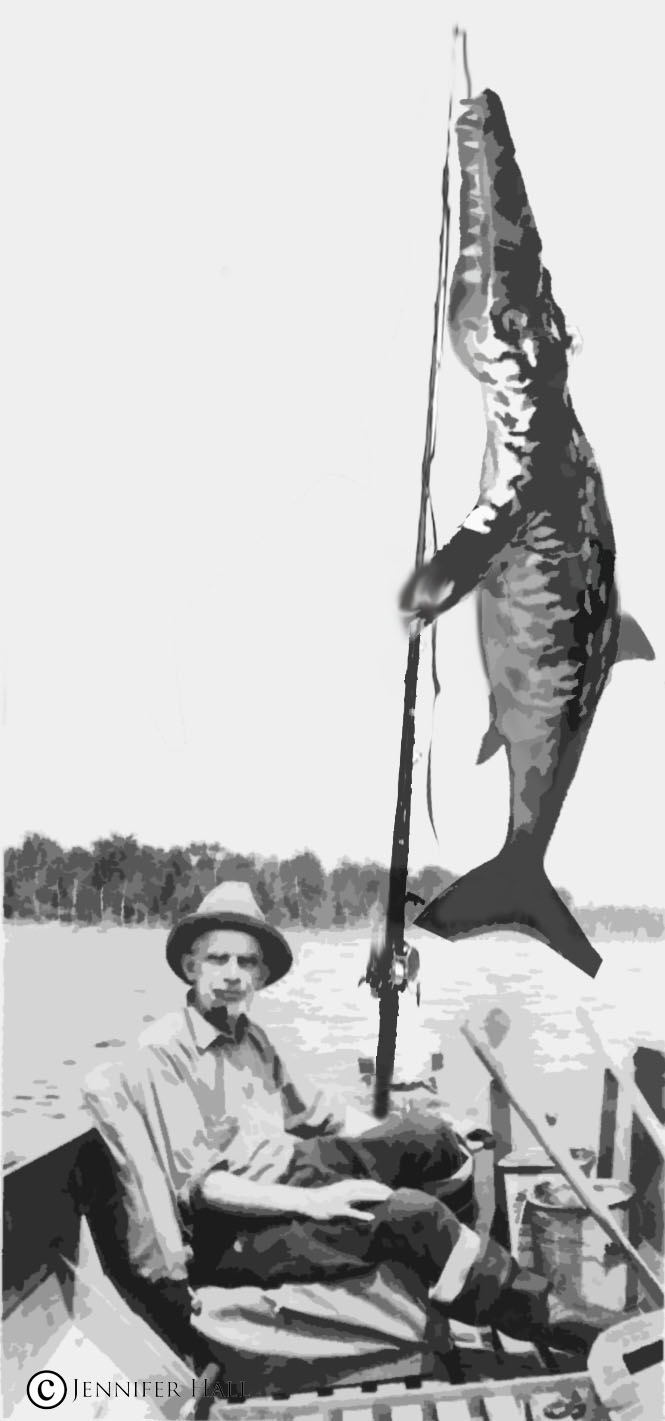


Ichthyosaur by Jenn Hall


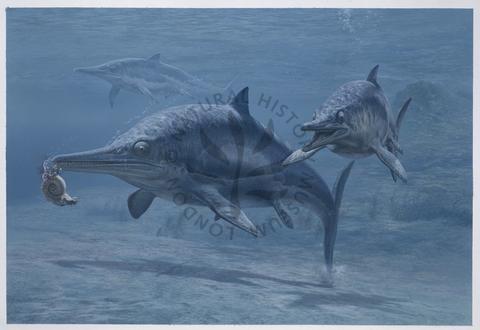
Cleaning Station by John Meszaros

This ichthyosaur is having its teeth and skin cleaned by a school of helpful Cleaner Belemnites, a hypothetical Jurassic parallel to modern-day Cleaner Wrasse.


Scratching Ichthyosaur by John Meszaros

I created this piece after reading the December 16, 2009 blog at Tetrapod Zoology, where Darren Naish talks about mysterious giant fossil “gutters”. The most likely explanation, according to the accompanying articles, is that these traces were made by marine reptiles plowing their snouts through the mud in search of food, or rubbing against the ground to scratch themselves. In my work I’ve depicted just that—an ichthyosaur scratching against the rocky ground to remove dead skin, inadvertently stirring up a bunch of crustaceans for the local fish to dine on.


Shonisaurus by John Meszaros

Like a lot of folks at ArtEvolved, I was intrigued by Shonisaurus’ mode of life. To me its huge, deep body suggests a slow-moving, plankton feeder. However its narrow skull would have made it difficult to obtain enough food to sustain its massive bulk, and its mostly toothless mouth would have made it difficult to snatch and hang onto fish, belemnites and other, larger prey. The closest modern parallels to the Shonisaurus body type that I could find are the beaked whales, which are generally toothless and feed through suction-feeding by rapidly expanding the throat and depressing the tongue. In fact, if you look at the skulls of many beaked whales (particularly Baird’s and Gray’s) they bear a strikingly long and narrow snout very similar to that of Shonisaurus. Thus I have depicted my shonisaurs with thicker throats to allow for this mode of feeding.

By the way, those two suction cup marks on the foremost Shonisaurus are meant to be feeding scars from a predator similar to a lamprey or cookie-cutter shark.

Triassic Giants by Craig Dylke
This piece is an art tribute to the late Betsy Nicholls, former curator of Marine Reptiles at the Royal Tyrrell Museum. She is most famous for her collection and description of the largest yet known marine reptile Shonisaurus sikanniensis. However I will best remember her as a friendly and enthusiastic spokesperson for her science and the topic of marine reptiles. I only wish I'd had a chance to get to know her better.
I was fortunate to have been able to talk to her after her last (or so I'm told) public address. During this discussion the topic of Shonisaurus feeding came up. Dr. Nicholls was of the firm belief that the adult (toothless) animals were somehow feeding on cephalopods. So it was in this direction I took my piece.
Here a small pod of Shonisaurus sikanniensis plunge into a school of Belemnites. Whether they have dived to extreme depths in the daytime or are simply catching them at night is up to you the viewer.
Mixosaurus by Peter Bond

See the step-by-step creation of this piece here!


Nannopterygius entheciodon by Mo Hassan - graphite pencil illustration


Shonisaurus popularis by Mo Hassan - graphite pencil illustration

Opthalmosaurus icenicus by David Tana

Opthalmosaurus icenicus, an opthalmosaurid that lived during the Middle and Late Jurassic, named for its comparative large eyes. Pen and color pencil on paper, with some Adobe Photoshop touch ups


Here sadly concludes out trip back to the seas of the Mesozoic.
For our next gallery in July, we travel to the seas of the Palaeozoic to explore the...
The long lasting, yet now completely extinct, group of Arthropods: the Trilobites!

If you are interested in participating in ART Evolved's Galleries of Life, send your artwork to artevolved@gmail.com, and we will display it. Welcome to the community!

Tuesday, April 27, 2010

Philosofossilising

So things don't get to boring and predictable around here, ART Evolved proudly launches another article series for your enjoyment.


This series plans on tackling the more academic and intellectual aspects of Palaeo-art. In our new "Philosofossilising" we are boldly thinking where no Palaeo-artist has thought before... At least on ART Evolved :P

We are going to be examining the various philosophic aspects and ramifications of when you mix Palaeontology and Art together. This series is going to be an editorial point of view series where we bring up a topic and then people respond with debate style essays. The idea being no one writer's opinion will be the definitive say on the topic.

We are also encouraging all readers to participate, whether you are an ART Evolved member or not. We want as many points of view on the topics as possible. So if you have something to say on the topic raised write it up for us, and we'll post it!

Like always we welcome comments on these posts, but if your comment on a particular essay turns into a big rebuttal you may find your comment suddenly becoming a post in the series. So please no complaining, as we've given you fair warning. Again the point of Philosofossilising is an open debate, not one to be hidden away in the comment section.

So put on your thinking caps and enjoy the big ideas we'll be exploring soon!

Friday, April 23, 2010

HERE BE SEA DRAGONS

My home town of Bristol in South West England doesn't boast of much, but we do have a dark and murky seafaring and pirating history; so it's quite fitting that Bristol is home to the 'Sea Dragons' exhibition housed in the central museum.

The Sea Dragons in question are ichthyosaurs and plesiosaurs, so as part of the build up to the ichthyosaur gallery I'd though I'd share a glimpse of the ichthyosaurs in this small but intriguing exhibition.


THE 3D ICHTHYOSAUR - Temndontosaurus - 'This specimen is unusual in keeping much of its original shape.' Its only about 2 metre long , a juvenile. Adults reach over 10 metres.


Look at those teeth!


PREGNANT ICHTHYOSAUR - 'This specimen below contains the earliest stage of growth of any baby ichthoysaur yet found.' See arrow in photo. AND the ichthyosaurs last meal ( dark patch in the stomach region).


EXCALIBOSAURUS - 'A few types of ichthyosaur had a lower jaw which was shorter than the upper. We do not know why.' (Not terribly useful information!)


GRENDELIUS -'A rare type of ichthyosaur found on the Dorset coast.'
This is a beast! There's a person in the photo for scale but doesn't really do justice to how large it actually looks. The length of my living room... ( My house is quite 'cosy' though)


As well as helping to determine what these creatures may have resembled in life the fossils themselves are beautifully sculptural in their own right.
The fossils are ready made masterpieces. All we as artists have to do is copy it, translate it, or use it as inspiration.


Whether your an artist, scientist or a creationist the sheer wonder of these creatures cannot be denied. The terrifying jaws of (often) incredible size make it easy to understand how, when first excavated, these fossils where thought to be the sea monsters of sailor's tales.

Maybe they are.


Photos by Alex Light.

Info in inverted commas taken from the museum boards.

Thursday, April 22, 2010

ART Evolved LIVE BLOGGING!

With ART Evolved's Ichthyosaur Time Capsule opening in less than nine days, a bunch of our members have been hard at work live blogging their marine reptiles!

Click on the links to see the work-in-progress posts showing the step-by-step method of creating amazing pieces of art.


Check out:
If I am missing anyone's ichthyosaur live blogging goodness, please let me know in the comments.  Keep up the art, and stay tuned for our fantastic Ichthyosaur Gallery next month!!!!

    Monday, April 19, 2010

    Revamped Ask a Biologist!

    As I'm sure most people who check out ART Evolved know, there is a fantastic site where you can get all your biologic questions answered by actual scientists. That site is of course Ask a Biologist (if you didn't know about it, now you do :P).


    Ask a Biologist has undergone a major revamp that goes public today. So pop over and check it out (here's the link again), ask a question or ten, and more important spread the word in your neck of the woods. (Schools at all levels should be informed in particular!)

    Monday, April 12, 2010

    Reconstruction Tips: Make your own skeletal references!

    Alright artists time for...

    Today brought to you by your friendly host Craig...

    Hi everyone. My tip for today is how to make any skeletal reference work for you.

    When trying to construct a scientifically accurate critter it is really important you stick to the proper anatomy of the animal. This means that being (pretty) precise on rough measurements and proportions of your creature are key. The best means to get these right is to use a skeletal reference.

    However typically when you find such a reference it isn't quite what you need (if one exists at all!...).

    I personally run into problems with pre-existing references as they are often in highly stylized poses, such as this Deinonychus skeletal reconstruction by Gregory Paul. These types of references though having excellently measured proportions and anatomical layout, make it hard for you to acquire useful information about how your animal is put together as the limbs are all folded up and angled in "weird" ways (okay not weird for the living animal [most of the time! sometimes people do impossible things in their skeletals]. However when trying to measure and compare proportions they are less than ideal!).

    Further more if your reconstruction is in an unconventional pose, such as my 3D Deinonychus, it is really unlikely you'll find a reference already in your pose. In fact if you do find one odds are really good it is an over done conventional pose anyways!

    Meaning if you want to compare your creation directly to a skeletal, you're almost certainly out of luck. Or you'll be forced to copy the preexisting pose. Which I urge you not to do! Too many people keep turning out the same general reconstructions. With an extra 20-30 minutes work you can come up with a reference that can be in any pose you'd like!

    So how do you do get this personalized skeletal reference? Why you make it yourself of course!

    I'll take you through how I made the reference that I used to cross check my 3D Deinonychus here. Now the pose I'm going for is essentially a dead laid out animal (needed for my 3D posing system), but you can use this procedure for any pose you want!

    Okay so the first thing you'll need to do is load your reference into photoshop. I suggest right away saving it as a new file just in case. That way you have the original still at hand should you need it.
    `
    1. Your first real step is carve apart the parts of the skeleton that are at the wrong angle for your purposes.

    Some general tips:

    Make sure your taking things apart at the joints. You can also take them apart a lot more thoroughly than I have here. Each vertebrae and digit bone can be separated if you want. I haven't gone this far, but you'll note I did separate a few individual neck verts.
    `
    Think about giving each separate bone or limb its own raster layer in photoshop. This makes it easier to manipulate them one at a time, and not risk wrecking your other parts by accident.
    `
    2. With your picture editing software's "Free Rotate" function manipulate your individual bone elements to your desired angles.

    Some general tips:

    Learn your undo hotkeys for this stage. As it can take some trail and error to get things to look right.
    `
    Have a protractor on hand if your program only allows manipulation by typing. (Some photo editing programs will have nice built in rotation tools that you can with your mouse just twist selections around in your drawing window. Sadly my version of Coreal Paintshop Pro only allows me to rotate things by manually typing in the number of degrees I want it to rotate by. Thus I can not be as precise to start off with unless I have a protractor to look at)

    Once you have your piece oriented roughly how you like, lay them out close to their final position to double check. Here is where separate raster layers can be handy, as you can lay them out in their final position, and move them after the fact if you don't like them.
    `

    3. With your parts oriented correctly put them all back together!
    General tips:
    `
    Keep a copy of the original picture handy, so that you can make sure you are repositioning all the joints back in exactly the same place.
    `
    If you were using separate layers save a copy of your skeleton in a layer supporting file format. That way you can repose this skeleton again in the future if you ever revisit it!
    Okay so once you have your own version of the skeleton you can use it to your hearts delight.
    `
    The way I use it, handy for anyone working in digital medium, is my transparency overlay technique (which you can read all about here), seen here.
    `
    In my case having built my raptor before I had the skeletal reference, I could now see I needed to fix it...
    `
    Just like that my 3D Deinonychus was pretty much spot on (with a few tiny variations, but I'm fine with 90% accuracy... the animals would have all varied individual to individual anyway).
    `
    Outside of my example I'm hoping you can see applications for this technique in your own work!
    `
    On the last topic of what if there is no pre-made skeletal reference for your current animal project?

    Well if you have a half descent photo of the actual fossils, my technique works just fine on them too!!!

    So good luck in the future with your own skeletal references!

    Wednesday, April 7, 2010


    I just put up an interview with Bruce Woollatt over at my blog. It's the first such feature interview that I've done, but Bruce's T.rex seemed to demand it. Have a look - click the title image or here - and please add comments. Bruce will be dropping by to field questions!
    Also makes me want to make this into a series...

    Monday, April 5, 2010

    Shonisaurus Modern Skeleton

    Just bringing a discussion thread out of the comment sections and to everyone's attention (though do be sure to read through the comment sections here on ART Evolved, you'd be surprised the great stuff that comes up in them!).

    In relation to Peter's fantastic summary of Ichthyosaurs in art post, commenter Neil brings up the excellent point that the huge Ichthyosaurs Shonisaurus is not as fat and deep chested as is typically reconstructed. This than raises the question what does it look like?

    As I've been starting work on my own Shonisaurus, I thought I'd share the answer rather than leave the point nebulous. As I've managed to get my hands on the solution.


    This is the modern take on Shonisaurus' skeleton, I believe by the Royal Tyrrell Museum's resident artist Donna Sloan (but I could be wrong). I acquired it from a plaque accompanying the fossils on display at the Tyrrell, and photoshoped it into this current form (the diagram itself is unmodified, I just removed it from the photo).
    The only difference (as already well said by Neil) between this and the old skool model is the number of forward ribs. The old model was missing several and thus the chest started towards the middle of what we see in this diagram.

    Hope that is a help to your Shonisaurus fans out there. Though hopefully we see a few other species than just this behemoth. Happy arting everyone!

    Ichthyosaurs in Art

    Reconstructions of ichthyosaurs are some of the earliest examples of palaeo-art in history.  Discovered in 1811 by Mary Anning and mulled over by scientists for the next 10 years, these fascinating fossils were named Ichthyosaurus in 1821, before "palaeontology" as a science even existed!

    This long history of ichthyosaurs has allowed for a wonderful array of restorations.  ART Evolved's look at Ichthyosaurs in Art begins with important and wonderful historical interpretations of these sea monsters, and then follows with more modern views of what Ichthyosaurs look like!

    Enjoy Ichthyosaurs in Art!


    Book of the Great Sea-Dragons, Ichthyosauri and Plesiosauri. Gedolim Taninim, of Moses. Extinct Monsters of the Ancient Earth from 1840 by John Martin


    Duria Antiquior by Henry De la Beche

    A great supporter of the work and importance of Mary Anning, of Lyme Regis, De la Beche drew a sketch, in 1830, entitled "Duria Antiquior - A More Ancient Dorset", which showed Mary Anning's finds: (three types of Ichthyosaur, a Plesiosaur and Dimorphodon. It even appears to show the production of coproliths, from a terrified plesiosaur. De la Beche assisted Anning, who was having financial difficulties, by having a lithographic print made from his water color painting, and donating the proceeds from the sale of the prints to her. This became the first such scene from deep time to be widely circulated. [Wikipedia]


    "Awful Changes. Man Found only in a Fossil State - Reappearance of Ichthyosauri." 

    Paleontology in a future age as imagined by Henry De la Beche in 1830. The famous cartoon lampoons Lyell's non-progressionist view of geological history. Standing above a human skull (below the rock supporting the lectern), Professor Ichthyosaurus addresses a toothy audience of friends and relations. The caption is as follows: "A lecture, — 'You will at once perceive,' continued Professor Ichthyosaurus, 'that the skull before us belonged to some of the lower order of animals; the teeth are very insignificant, the power of the jaws trifling, and altogether it seems wonderful how the creature could have procured food.'" [Wikipedia]


    Ichthyosaurs in Crystal Palace Park, London, 1852
    by Benjamin Waterhouse Hawkins (photo by Peter Bond)


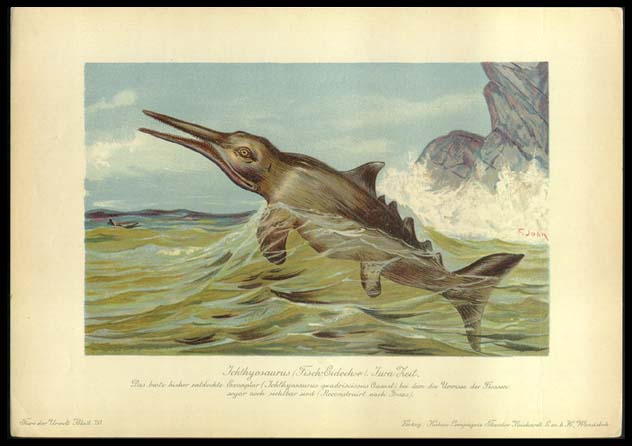
    Ichthyosaurus, 1902? by F. John


    Ichthyosaurus quadriscissus  by Charles R. Knight under the direction of Prof. H. F. Osborn. 
    (American Museum of Natural History, N.Y)


     Ichthyosaurus by Zdenek Burian


    The following are modern interpretations of the genera within the order Ichthyosauria, roughly ordered in chronological order (early Triassic to late Jurassic):

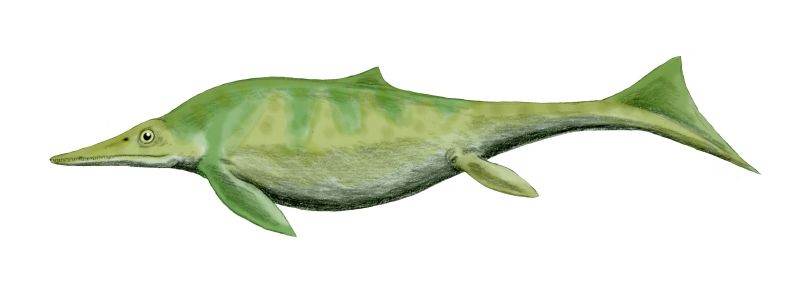
    Cymbospondylus by Nobu Tamura


    Cymbospondylus by Doug Henderson


     Mixosaurus by critter.pixel-shack

    Californosaurus by Nobu Tamura


    Shonisaurus by Mineo Shiraishi


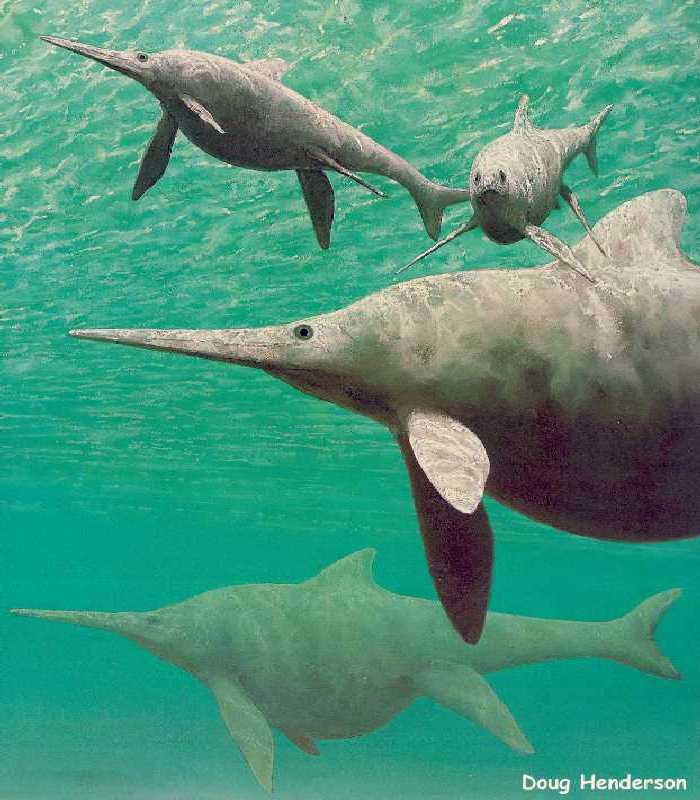
    Shonisaurus by Doug Henderson


    Shonisaurus accompanied by a Pack of Californosaurus by Todd Marshall


    Shonisaurus by Maximo Salas


    Eurhinosaurus by Nobu Tamura


    Temnodontosaurus by Karen Carr


     Stenopterygius by Doug Henderson


    Stenopterygius by Raul Martin


     Ichthyosaurus by John Sibbick


     Ichthyosaurus by John Sibbick

     Ichthyosaurs by Surface Vision


    I hope this look at Ichthyosaurs in Art has inspired you in your creation of ichthyosaur palaeo-art!  

    The Ichthyosaur Time Capsule opens May 1st 2010, so send in your Ichthyosaur art to artevolved@gmail.com!

    Saturday, April 3, 2010

    I've got Ichthyosaur Fever! how about you?

    Okay people, with just under a month before the Ichthyosaur gallery goes up it is time to get serious about the fish lizards.

    Not that many of you haven't already put in a good start to this effort! Peter's discussion post has been among the most successful yet here on ART Evolved. However it is time to match this talk with art!
    `
    As of such I send out a call to arms... errrr art :P

    It's time to get our funk on and conjure up some fish lizards! My friend Shoni is down with that, and hopes you'll get there too!

    Speaking of Shoni, me and her paid a visit to the Royal Tyrrell Museum this week, and paid homage to...

    Shonisaurus sikanniensis the largest known Ichthyosaur, marine reptile, and possibly reptile ever! (That overall reptile claim depends on whose weight estimates you believe between Shoni and the big Sauropods).
    Seeing this specimen once again I've got my inspiration. Wish I could have brought you all along to get the "infection".

    Here is a picture I finally managed to get snapped (I had intended on it 2 years ago, but it never happened :( ). The ultimate set of symptoms for "Ichthyosaur Fever". You'll note in such close proximity to the actual amazing fossil I hold not only the action figure of the beast, but wear the official T-Shirt as sold in the gift shop too!

    The back story on this awesome geeking out soon to follow on my blog.

    Speaking of outside blogs...


    It's live blogging time!

    If you're in, either leave a comment or pop off an email to artevolved@gmail.com. The live blogging post goes up in 3 days. Late participants will be added mind you, but why not be among the first to catch this year's plague?

    Hope to see you all in intensive care soon.

    (This deranged post brought to you by cold medication, mania {from 3 weeks of fruitless job searching}, and no sleep)