Thursday, July 1, 2010

The Trilobite Gallery

Here we go! July 1st brings us...

The Trilobite Gallery

A classic fossil from around the world, the trilobite are a group of extinct arthropod, which survived from the earliest Cambrian to the Permian mass extinction, with most groups going extinct in the Devonian. Where they come from is a mystery; Trilobites were already widely diverse and geographically dispersed when they first show up in the Cambrian Explosion.

Having a hard exoskeleton allowed them to leave a vast and extensive fossil record, allowing scientists to use trilobites as fossil markers in determining the stratigraphic of the Cambrian, as evidence for continental drift, and data for testing the Punctuated Equilibrium mechanism for evolution.

And if you live in Ohio, Wisconsin or Pennsylvania, then trilobites are your state fossil! But as this is the July 1st Gallery, then a Happy Canada Day to you all too!


Continue down to open the Trilobite Time Capsule, and marvel at the treasures inside...

(Click on the picture to enlarge it, and click on the names to view the artist's site!)


Trilobite Deco by Sean Craven


CRYPTOLITHUS by John Meszargos

 As pointed out by Sam Gon II on his excellent Trilobite website,
there are several species of trilobite with huge dome-like cephalic
chambers.  In addition, the bodies of these animals, if extended
straight back, would hang significantly far above the sediment.  Both
features suggest that these trilobites may have been filter feeders
that used the gills on their elevated thorax and pygidium to sweep
plankton into the cephalic chamber for processing.  Here I have
depicted one such trilobite based on a drawing from Gon's website.


OLENIMORPH by John Meszargos

The Olenina includes several species from rock layers that were
formerly sulfur-rich deep sea habitats.  Modern-day animals living in
these kinds of habitats often form symbiotic relationships with
sulfur-fixing bacteria, so it's not unreasonable to hypothesize that
deep-dwelling Olenids had similar relationships.  Evidence for this
symbiosis can be found in the large gills found in some well-preserved
fossils, since gills are often where the sulfur-eating bacteria live
in modern organisms.  These fossils also frequently possess an
increased number of body segments (and thus an increased number of
gills) as well as highly-reduced mouthparts (since most of their
nutrition would come from the bacteria).
 Here I've depicted one such symbiotic trilobite crawling over the
sea floor near a colony of prehistoric tube-worms.  The brown
clam-like creatures in the foreground are deep-sea brachiopods, while
the blue fish swimming overhead are Ctenurella, a species of
placoderms that convergently evolved to resemble modern-day chimeras.


Trilobite Dragon by Matt Harpold


Cambrian Portraits by Sydney Veltkamp


Trilobite Tattoo by Sydney Veltkamp


Fossil Necklace by Leslie Gordon

Leslie Gordon Designs
Jewelry, metal arts, lapidary


Tilobite! by Sarah Snell-Pym

This is a diagramatic representation of Radiaspis which I first came across in Richard Fortey's book TRILOBITE! of which I have a prized signed copy!


Dark Trilobite by Sarah Snell-Pym

This is a pen drawing I wanted to get a sort of sci-fi alien look, so I heavily textured the picture, adding the sort of detail a paleo-teacher would go mad about, marking you down heavily for obscuring the structure!


Fimo Trilobite by Sarah Snell-Pym

I love making things out of polymer clays, little sculptures out of things like fimo, this trilobite is 2 inches or 5 cm long, I made each segment and constructed it from the bits thinking about how trilobites are actually structured.  I have photographed it on a weathered concrete base to give it a bottom of the sea look.


Eco-Bites by Sarah Snell-Pym

Trilobites are amazingly diverse so I wanted to capture the idea of a trilobite lead eco-system with them as the grazers, scavengers, filter feeders, hunters, burrowers etc... covering the different sections of the water column and the different habitat niches.  The trilobites I have drawn probably did not all exist together as represented here.
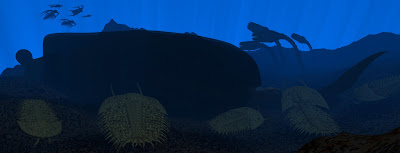


Scavenging Bounty by Craig Dylke

The carcass of the large (for its time) Odaraia falls to the Cambrian ocean floor relatively intact. Attracting many of the large (again for their time) trilobite Olenoides to feast on the remains. Dinomischus filter feed in the distance, while a swarm of Marrella swim overhead.

Note from the artist- This piece really has turned out to be a disappointment. I might revisit it when I have the time. I have just started a very full on 6 day a week job, and have spent the whole month of June moving on top of that... So hopefully one day when I'm not so busy I'll be able to do this concept justice.


Cambrian Awe by Craig Dylke

A unintentional but neat mistake on the piece above. It makes me wonder how many of the great works of art created throughout the ages were accidents that looked cool. Yet were never intended by the artist...


Triarthrus. by Rachael Revelle

An A4 collage in green paper.


The Last Refuge by Glendon Mellow

Oil on canvas, 2010. Commissioned by Kevin Zelnio of Deep Sea News.
Available as a print or poster.


Flying Trilobite Obelisk by Glendon Mellow

Oil on slate & Photoshop, 2010.


Trilobites had no Aries by Glendon Mellow


Trilobites had no Cancer by Glendon Mellow


Trilobites had no Gemini by Glendon Mellow


Trilobites had no Taurus by Glendon Mellow


Cheriurus, stippled drawing by Jacqueline Dillard


Based on a dream the artist had.


Acadoparadoxides sp., a Moroccan Cambrian trilobite by Mo Hassan

Colour pencil illustration


Cnemidopyge nuda, a Welsh Ordovician trilobite by Mo Hassan

Graphite pencil sketch


Flexicalymene caractaci, a British Ordovician trilobite by Mo Hassan
Colour pencil illustration


Quinquecosta williamsi, a British Palaeozoic trilobite by Mo Hassan

Colour pencil illustration


Post-Impressionist Trilobites by Peter Bond

One of a series of six prehistoric-themed post-impressionism paintings.
You can see them all here.


Happy Canadian Trilobite Day by Peter Bond


Dicranurus: One Spiky Trilobite! by Peter Bond

Pen illustration. Coloured version coming soon.


Graphite, monotype, spray paint, colored pencil, and transfer letters. 2008.
I was looking at trilobites, Aztec officers' helmets, and Rembrandt's Man in a Golden Helmet.


I'm a big fan of prehistoric invertebrates and I wanted to share their wonder with other people by personifying them. Trilobites are more than just fossils, they were once living things making their way in the world just like anyone else.


The Zenith of the Devonian Trilobites by Nima Sassani

The teeming trilobite sea floor in the Devonian period, time of some of the weirdest and most extreme trilobite species that ever evolved. Location is a continental shelf in Morocco, around 400 million years ago.

See if you can locate the exotic trilobites Dicranurus monstrosus, Dicranurus hamatus, Erbenochile Erbeni, Koneprussia sp., Droptops armatus, Paralejurus sp., Ceratarges sp., Scabriscutellum sp., Walliserops trifurcatus, the gigantic Terataspis grandis, and of course the worldwide favorite, Phacops!

The two giant fish in the background are Titanichthys, a far less vicious (though equally large) cousin of Dunkleosteus.
Phacops rana by David Tana

Phacops rana, a middle Devonian phacopid with large eyes and an uncanny ability to roll into a defensive curl and become buried in sediment. Pencil on paper


Hope we've all molted successfully! If you have a trilobite you'd like to include in this Time Capsule, these galleries accept pieces anytime - just send them in to artevolved@gmail.com!

BUT THERE'S MORE!

Must go faster!!!

The next gallery defies strict science and lets the imagination soar!

This summer brings you our first Pop Culture Gallery!!! Use your pencils and pixels to pay homage to your favorite famous monsters or create your own! Send them in to ART Evolved and we'll open the Time Capsule on September 1st 2010!

Spared no expense!

Wednesday, June 30, 2010

Summer Surprise!... A Pop Culture Gallery!

After 9 Time Capsules here on ART Evolved, the administrators were thinking a break from scientific Capsules might be a nice change of pace (not that anyone had to stick to the pure science to get into the galleries mind you :P). As the summer is supposed to be a fun time we tried to pick a theme to match.

So at the end of the summer we are pleased to host the first ever...


Palaeo Pop Culture Gallery!

`
As let's face it despite the coolness that was the prehistoric past, the fantasy of it running amok in the present (or at least against elements of the present) is too much fun to pass up!
`

This gallery is themed around the impossible, the fantastic, and just plain fun fiction that palaeontology has inspired. Whether it be a classic lost world, time travelling gone wrong, journey to the center of the Earth, atomic resurrection, or sci-fi cloned theme park we want your take on your favourite fictional prehistoric situations! Whether it be a homage to your favourite franchise, or a brand new idea in the genre this is your chance to share it with the world.
Be sure to check in here throughout July as we explore the various genres and themes that pop culture has used palaeontology to create!

`
This gallery goes up on September 1st so try to have your submissions in by then please... (though as always late entries will be accepted, and added to the gallery after the fact)
If you're new to the site, we accept any and all artwork submitted that is themed around any of our gallery topics. Just send your submission(s), along with any accompanying text you'd like with them, and the link to your website/blog/online picture gallery to our email artevolved@gmail.com, and we'll post them!

Tuesday, June 29, 2010

Trilobite Gallery Reminder

Just a quick reminder, that this Thursday is the next Time Capsule Gallery!


So get in your Trilobites ASAP!
If you're new to the site, we accept any and all artwork submitted that is themed around our gallery topic (again in this case Trilobites OR if you'd like to enter artwork into one of our previous galleries). Just send your submission(s), along with any accompanying text you'd like with them, and the link to your website/blog/online picture gallery to our email artevolved@gmail.com.
Also stay tuned for the upcoming summer of 2010 gallery theme. It was kept secret as a holiday treat/surprise!

Monday, June 28, 2010

Prehistoric Animal Alphabet


Prehistoric Animal Alphabet
Colour pencil illustrations
June 2010

Above is a collection of twenty-six illustrations, each a stylised letter of the alphabet. They are styled to look like various prehistoric creatures, some are based loosely on existing types, others completely made up. All of them have been given a binomial, with each name beginning with the letter the animal represents, and a bit of geological/biological 'information' has been made up to go with each animal. To reiterate, none of these animals actually exists or have ever existed, and I cannot guarantee that all the names I have given them are unique and not synonyms (technically these are all nomina nuda, but anyway, enjoy...)


Alpharaptor aetonyx (meaning 'eagle-clawed "A" plunderer) was a purple-feathered theropod from late Cretaceous China. It had large, eagle-like talons on all four limbs and preyed upon small birds and mammals.


Betasaurus beryllinus ('beryl-like "B" lizard) was a medium-sized hadrosaur from late Cretaceous Alberta. It lived in large herds to defend itself from large tyrannosaurs, and fed upon cycads. The B-shaped head enabled Betasaurus to produce a sound somewhat like a euphonium.


Cyanosuchus cadaverinus ('corpse-like blue crocodile', from the colour and odour of the fossil remains) was a mesoeucrocodylian from Early Cretaceous southern England. It was a fish-eater and swam in freshwater lagoons.


Deltaceratops dipsomanius ('alcoholic "D" horned face') was a protoceratopsid from Late Cretaceous Mongolia. It lived in deserts and fed upon whatever ground cover it could find. Its specific epithet 'dipsomanius' was derived from the sprawled position of the type specimen.


Epsilonodactylus erebennus ('gloomy "E" finger) was a pteranodontid pterosaur from Late Cretaceous Argentina. It was discovered on a particularly gloomy day. It was a fish-eater, being most partial to sharks. It is thus believed to be an oceanic wanderer, like today's albatrosses.


Falcunguis ferox ('ferocious sickle claw') is only known from the claws and phalanges of two digits. It is believed to be an ancestor of the therizinosaurs, due to its geological and geographical distribution in Early Cretaceous China.


Gammasaurus geophagus ('earth eating "G" lizard) was a small coelurosaur with a very long tail which curved backwards over its body. It used the elongated tail to carry leaves which it used to shade itself in hot weather. It dates from the late Jurassic of Bavaria and ate large subterranean insects. Fossilised beetle remains were found in the stomachs of several well-preserved specimens of Gammasaurus geophagus, but these were erroneously believed to be examples of fossilised earth (so basically, rocks).


Hypsiloura helioscopus ('sky gazing high tail') was a camarasaurid from late Jurassic Montana. It was a medium-sized sauropod, capable of reaching tall monkey puzzles in search of foliage and pine cones. It was able to camouflage itself against the trunks of such trees by erecting its neck and tail and pretending to be a tree.


Iotatitan ischyrus ('strong "I" giant) was a titanosaurid from late Cretaceous Argentina. It was the largest sauropod ever known, and it is only known from a single partial cervical vertebra, but its total length has been extrapolated as anywhere from 27 m at the most conservative to 1.3 km at the other extreme. Since nothing is known of the skull or dentition, we cannot say anything about the diet of Iotatitan, except that it definitely ate something, and a lot of it.


Jovigyrinus jocosus ('joking Bon Jovi's salamander') was an early tetrapod from Devonian New Jersey. It was named after local rock band Bon Jovi. Jon Bon Jovi, the lead singer of the band, who is also an unsuccessful actor, has been quoted as saying about the animal, "Wow, at last something in the last two decades I can be proud of!" The animal was probably a predator of small fish and aquatic invertebrates such as trilobites in shallow seas, and would have had external gills like modern salamander larvae and axolotls.


Kappatherodon keiolophus ('cloven-crested "K" mammal-tooth') was a sphenacodontid therapsid related to Dimetrodon, but can be distinguished from it by its cloven back sail. Like its relative, it dates from the Permian of Texas and was a predator of smaller therapsids. It could only be active on hot days, between the hours of 10 and 11 a.m. and 1 and 2 p.m., unless it was during daylight savings time, when the hours are shifted an hour ahead. If Kappatherodon overslept, it would starve and become food for many a hungry Dimetrodon.


Lambdatherium lanatum ('woolly "L" mammal') was a multituberculate mammal from the Late Cretaceous of Kazakhstan. It was a colonial animal, living in mass burrow systems like rabbits or prairie dogs. It managed to survive beyond the K-T boundary, with remains of Lambdatherium lanatum being found 10 million years into the Palaeocene, proving beyond doubt that dinosaurs were abducted by aliens.


Micromacropteryx minutissimus ('very tiny little thing with long wings') was the late Triassic equivalent of a hummingbird. Although there were no flowering plants at the time, individuals could be seen flitting from plant to plant looking for sources of nectar. Of course, because there was no such thing as nectar, Micromacropteryx became hypercarnivorous, eating just about any flesh it could wrap its tiny jaws around.


Neonothosaurus natans ('swimming new bastard lizard', for its unknown parentage, and the fact that it's not very nice) was not a true nothosaur, and was not even a reptile. It represents the only known member of a lineage of lissamphibians to have developed a coat of scales which makes it able to spend extended periods of time outside of water. It lived in early Triassic lakes across northern Pangaea, which was to become the supercontinent of Laurasia.


Omegaraptor ookleptes ('egg-stealing "O" plunderer') was a large turquoise-coloured oviraptoran closely related to Citipati osmolskae. Like that dinosaur, Omegaraptor had a large and brightly-coloured head, and probably didn't steal eggs. That didn't stop one taxonomist from naming the species ookleptes, because he felt that just because it hasn't been proven, doesn't mean it isn't true.


Piceratops psittacoides ('parrot-like "P" horned face') is a close relative of Psittacosaurus but is much larger. Reaching a maximum of 20 m, Piceratops was easily the largest of the ceratopsians, and dwelled in Late Cretaceous forests in China.


Quinquecornis quintilis ('five horns of July') was the smallest of the ceratopsians, with adults reaching no more than 40 cm in length. Most of that length was taken up by the huge frill. As its name suggests, it has five horns: two small jugal horns on each side of the face; and a single large nasal horn. It lived in late Cretaceous North America. Fossils of Q. quintilis are most often discovered in the month of July.


Rhosaurus reductus ('aloof "R" lizard) was a prosauropod from Late Triassic South Africa. Just like the same region nowadays, South Africa was full of noisy buzzing sounds, but instead of coming from plastic vuvuzelas, Rhosaurus would have contributed to the din. It was a plant eater but was believed to be nocturnal due to its large orbits, but this is now known to be where the buzzing sounds arise from. The nocturnal nature led early palaeontologists to believe Rhosaurus was timid and aloof, hence the specific name.


Sigmacorypha suchophaga ('crocodile-eating "S" neck') was an elasmosaur, a group of long-necked plesiosaurs. It was a significant predator of Cyanosuchus, eating several individuals in one sitting.


Tautherium tragocerum ('goat-horned "T" mammal') was an ox-like ungulate from Miocene Tibet, occupying a similar niche to today's yak (Bos grunniens). It had no external ears, because its ancestors were aquatic and had since lost their pinnae.


Upsilonobatrachus umbrivagus ('shade-dwelling "U" frog') was a large temnospondyl amphibian from Carboniferous Spain. It would have preferred to lurk in the shade of tree ferns and other such plants whilst submerged in the water with its jaws agape, waiting for small fish to approach. Its yellow coloration is believed to be the earliest example of aposematic coloration known.


Virididipennis vorax ('with two green feathers and a huge appetite') was a small tree-dwelling reptile related to lizards and snakes but with large scaly outgrowths on the head which resemble feathers. The rest of the body is not known, but it has been suggested that it could be upto several miles long. It dwelled in Pliocene Thailand.


Woganosaurus williamsi ('Robin Williams's and Terry Wogan's lizard') was an early reptile that defies classification. It was found in Scotland in Carboniferous rocks by members of the BBC Radio 2 crew, and was named after the veteran host Terry Wogan. Robin Williams was honoured in the specific epithet due to the taxonomist's fondness for the movie Mrs. Doubtfire.


Xipteryx xanthypothalassus ('Yellow Submarine "X" wing') was an early primate which experimented with gliding. It had a pair of patagia between the ankle and wrist and would glide from tree to tree in Eocene Europe. The type specimen was discovered by Ringo Starr while touring. The species was named after one of his band's most popular songs, and one of the easiest to translate into Ancient Greek.


Yahoolophosaurus yptios ('upside-down Y.A.H.O.O. crested lizard') was a therapsid discovered in Permian Russia. It was found by members of the Young American Historical Ornithological Organisation who were on a field trip to Russia. The first specimen to be exhibited was mounted upside-down, hence the name, and why all reconstructions of the creature are upside-down.


Zetaornis zaocys ('very fast "Z" bird') was a species of tern (family Sternidae) from Pliocene Alaska. It had disproportionally long wings to power its extremely fast flight. It has been suggested that it could have reached speeds of upto 186,000 miles per second, which is of course the speed of light.

Cross posted from my blog: The Disillusioned Taxonomist
All art and text by Mo Hassan

Wednesday, June 23, 2010

TRILOBITE REMINDER!

This is just a friendly reminder that the Trilobite Time Capsule will be opening on July 1st!  This gives us only EIGHT days to get all our critters created and our trilobites turned in!  

Send in your Trilobite art to artevolved@gmail.com and we will add it to the gallery!

T-minus 8 Days!

(Yes, this is me as a trilobite in the Drumheller Canada Day '04 Parade.  
Just another art form, right?)

Sunday, June 20, 2010

Guest Artist Artwork: David Williams' Theropods

Say hello to another guest artist here on ART Evolved:  David Williams aka "Dr XIII".  He has sent us in this series of theropods, including the fearsome Tyrannotitan!


Tyrannotitan chubutensis by David Williams


Tyrannosaurus rex by David Williams


Gigantosaurus carolinii by David Williams


Spinosaurus aegyptiacus by David Williams

See more of David's art on his DeviantArt site here.  Thanks, David!

Saturday, June 19, 2010

Tutorial: Digital Step-by-Step Raul Martin Painting

Follow this link to see amazing step-by-step pictures of the creation of Raul Martin's gorgeous Hesperonychus & Chasmosaurus.


Hesperonychus & Chasmosaurus.
Digital painting, 2010. by Raul Martin


It is a wonderful glimpse into the artistic process of a professional, and I am in awe of the detail in Martin's work. 

Thanks to our own Ville Sinkkonen for bringing this to our attention!

Thursday, June 17, 2010

For Your Consideration: Diabloceratops


I may not be Lukas Panzarin, but I think I got the gist of it. Sketched in about a twenty-minute period at an excellent local Himalayan restaurant. Scott may produce a sketch of Achelousaurus later, as I was coaching him through it. Here's hoping my copy of "New Perspectives on the Horned Dinosaurs" arrives by the weekend.*

*Pipe dream, I know.