Showing posts with label Article- Going Pro. Show all posts

Wednesday, September 26, 2012

Going Pro: Name files for Google searches

This is my last post inspired by Kalliopi Monoyios' amazing Symbiartic post. This tip is one I've been doing for years now, but I thought it'd be just as good a time as any to share it.


Something I've noticed many people don't do, is use their picture file names as optimally as they could (I'm not stalking people or anything. I just get sent a lot of artwork for galleries is all :P). Instead of just saving the final version of your piece with a simple name, think about instead cramming it full of as many Googlable key words as you can.
Zealandia Dinosaurs by myself (Craig Dylke)
Though in reality as far as search engines are concerned its name is
Zealandia Dinosaurs New Zealand Dinosaur fossil fossils ornithopod Sauropod titanosaur ankylosaur minmi Craig Dylke 2012
The Internet is a funny beast. Search engines such as Yahoo and Google don't care what name or typing you put around a picture file. They will outright search the file's name itself first (though the wording around the picture can also play a part). Meaning if you type every possible related search word into your piece's file name, you've increased Google's odds of grabbing it that much more. When I name a file I'll only use these sorts of key words, and not bother with its fancy title.

The important thing is to pick realistic search words normal people are going to use, not just technically correct terms only an expert would use. A couple technical terms sure to maybe put you apart from the crowd, but you want as much exposure as you can. Unseen work won't sell or get used, and even better the more search engine hits you get the higher up list you appear in future searches!

The only problem I've ever had with these key words is that most software will only let you use about 15-20 words in a file name, so you do have to choose them a little carefully.

My formula is roughly:
  1. The genus' and any possible variants of the genus name, such as the plural or dropping letters from the end (ex. Tyrannosaurus, Tyrannosaur, Tyrannosaurs or Iguanodon and Iguanodons) I personally don't use species names, as 99% of people probably aren't going to search for it (but you can include it if you have the space)
  2. Any similar genus to the one you've depicted (especially if yours is obscure, but the other one is more popular ex. Triceratops to go with Pentaceratops) 
  3. The family name up to order (ex. Tyrannosaur + Theropod + Dinosaur. Wolf = Canid + Mammal)
  4. The time period depicted (especially when you've done a palaeo-environment)
  5. The words fossil and fossils
  6. The geographic region or palaeo-region when it is likely to be unique or of interest to someone on the web
  7. A generic description of the creatures eating habits (meat eating, plant eating) When combined with the family or order name above, you've covered a common Google search many lay people use to describe animals (meat eating Dinosaurs)
  8. Any popular names or nicknames for the critter (Dromaeosaurs = Raptors, Hadrosaurs = Duckbills)
  9. Any relevant or related pop cultural connections to your piece. This is a cheap, but sadly extremely effective trick. Two of my most popular images are popular simply due to hits from their pop culture names (This one due to Jurassic Park, and this one due to "Sea monster")
  10. Your name in case someone searches for you personal!
  11. The date as it is only four characters
Give this a shot. I know in my case it has done me wonders (both my museum gigs were secured through their finding me in Google searches for specific topics). This versatility of search terms can see your piece appear in nearly any search for such animals, and is especially effective for more obscure animals (good luck ever getting high up on the popular subjects, in particular Tyrannosaurus Rex). 

The best part is the more hits a piece gets from any term the higher up it will appear on that specific search engine. Meaning hits to something silly like "meat eating marine reptile" can get you higher up the much more competitive "Tylosaurus" list.

Monday, September 24, 2012

Going Pro: Think about a Logo

This post now exits my tribute (aka ripping off) of Kalliopi Monoyios amazing post on Symbiartic from last year. This and the next post are both bits of knowledge I gleamed myself. However I mention Kalliopi and her post again, as I never would have thought of this logo idea without the wake up call that post gave me.


My current claim to palaeo-art fame is my renditions of the extinct Squalodon dolphin. Two museums are now using them in their exhibits, and the images are 2 of my 3 most viewed pieces of art (losing out only to this silly one from Traumador). In fact I'm starting to get a minor reputation as the "Squalodon guy" (in fairness I've only been referred to as this by one potential client, but as I've only ever seriously dealt with 5 of those I think it is fair I might have a nickname/reputation in the making).

As I've been further focusing on branding my art, something that some people on the net, and my wife (with a degree in marketing) have all said is thinking about creating a logo.

I suggest this as something you consider for your work too. It's not something that will immediately make an impact on your success. However I think in the long term it could have a cumulative effect.

My logo to commemorate/celebrate the subject of my first successful palaeo-art.
There are two difficulties in creating a logo. The first is picking an image that you want to visual represent yourself and art for a really long time (ideally, my wife tells me, your whole "career", given you are not a company with massive exposure. Switching your logo defeats the purpose). The second is composing the logo.

Now for me the choice as to my logo was made easy. The instant I got that email referring to me as the "Squalodon guy" I figured I might as well embrace the title and run with it. So one way or another I really will be the Squalodon guy for the rest of my palaeo-art career.

When choosing your own logo there are a lot of considerations to make. I think one of the biggest is picking something distinctive and memorable. Tyrannosaur skulls, rock hammers, thigh bones, Archeopteryx, and Trilobites while very iconic are also cliched nearly to death in palaeo logos. I'd say find something a lot more unique, or have your own distinct twist on the topic (like Glendon's Flying Trilobite). Above all else make sure that it jives and emphasizes your art and artistic style. A lot easier said than done I found out.

By myself (Craig Dylke)
Here is my logo with its inspiration. I think they go well together.

When refining the final look of my logo I followed this general philosophy (though at the time my wife was reading it out of one of her uni text books). In a nutshell keep the logo simple, memorable, and versatile.

Simple is talking about the use of lines and details. Less of these is more in a logo. The rule goes the simpler the better. Admittedly mine won't be winning awards, but I'm not a major corporation or ad firm.

Memorable hopefully is explanatory. Again avoid the above list of palaeo-cliches would be my only real suggestion (Tyrannosaur skulls, rock hammers, thigh bones, Archeopteryx, and/or Trilobites)

Versatile means you've designed your logo to go anywhere anyhow. Does it look good in both small and big formats? Does it look good in different colour combinations? It is suggested in various places you design it in black and white, and worry about colour later (if at all).

Beyond that there really isn't much to say.

Good luck and have fun creating your logo should you choose to give it a shot!

Going Pro: Over sign your work

Last year Kalliopi Monoyios put up this amazing post on Symbiartic, that forever changed my approach to marketing my art. Go read it, but I wanted to expand on it with a few twists of my own (which have seen me now land two museum exhibits).


Kalliopi had a great section on how to put your signature on a piece. I've not only followed her to the letter, I've expanded on her technique a bit.

Kalliopi insisted you:
  1. Sign your full name
  2. Put it somewhere that it can not be easily cropped
Great advice. I'm adding two more (for online use material):
  1. Always put your web address somewhere on the piece
  2. Include two signatures, one obvious, and one subtle but difficult to remove

Purpose of a Signature

This might seem obvious at first, but it never hurts to repeat and remind. We all the know the purpose of a signature is to identify a piece as your own, but there are two direct but different purposes to this.

Property- Right away a signature denotes not only the creator of the work, but additionally who the owner of it as well.

Promotion- If a signature is obvious it can work as an excellent part of your promotion when the art is first looked at by an interested party.

How not to sign your work...

There are a ton of different ways to sign your work, but here are some ways work that don't use the signature to its full advantages.

Can you find the signature in this piece?
It's not much help if no one knows it's there...
This is an example of how I was signing my work as of the summer of 2011. The idea was a minimalistic stamp that denoted the work was mine (in the case of attempted theft or misuse), but otherwise didn't ruin the overall piece. The problem being of course any interested people would never find my name without a very exhaustive search for the nearly invisible signature (it is in the wood paneling below the Dinos belly). Meaning I'm missing out on promotion from the piece itself.

This has a clear signature, but it has a clear problem. Who the Hades is Prehistoric Insanity?!?
Another silly one I used to do (back in the Traumador days) was signing everything with one of my online aliases. This is just confusing and unprofessional. Don't repeat my mistake, just sign with your (full) name! No one is going to take an alias as seriously as you being yourself.

This is definitely signed... a hundred times more than it needs to be
Now I've never signed my work like this, but I've hit several professional palaeo-artists who do. The idea here is your name is really out there, and it is obscuring the piece (so no one else uses I think is the theory).

In my opinion though this is not a good idea (especially if you aren't a big name pro yet). It ruins your art (enough said really). When I hit pieces like this, even if they are brilliant, my attitude/opinion of them gets a little tainted. I can't fully appreciate the art on its own merits, as I have to waste so much effort trying to see "past" the signature.

Instead of obscuring the art with a signature, if you're worried about misuse, instead just post a really low resolution version of the picture instead (400X400ish). That way people get a real feel for the aesthetics and look of the piece, without being able to do more than that (you can't do anything useful with that small a pic).

The only golden rule for digital signatures...

The only thing I am going to say about any signature you add via a computer is make all your signatures somewhat transparent. If they don't bleed into the piece the add distracting visual information for the viewer. Taking the edge off the writing with a bit of transparency makes the signature a bit more a part of the piece, and thus doesn't compete with your imagery as much.

If you sign your stuff in a non-digital medium ignore me, as you already know that being the same medium as the piece it'll just blend on its own...

How I sign my work

Now there are a million options on how you can sign your work, and don't feel I'm saying this is the only way. If anything my signing process has been evolving the past year, so go play with yours yourself. I just offer this as a starting point.

I do one big "in your face" signature (my website), and one subtle but still visible signature (my name and the year). I figure the web address is the important information I want people to get from my pieces about me, if they've found the picture elsewhere on the web.

I place the address in the least important corner of the piece so it doesn't take away from the visual or the narrative. Yes this puts it at the risk of cropping by a misuser, but that is why my subtle signature is in there, as a backup.

The subtle signature is a tip right out of Kalliopi's post, and so I merely restate here. The idea is that you put your full name somewhere important, so it won't be cropped, but not big enough or harsh enough to distract from the piece. On critters I tend to put it somewhere near the rear limbs/tail.

Good luck signing your own stuff, this is me signing off... pun intended :P


Tuesday, September 18, 2012

Going Pro: Don't Portfolio Here...

If you ask me what the most influential blog post of last year was, I'd have to say this amazing post by Kalliopi Monoyios of Symbiartic. In it she hits on three major mistakes many of us artists make online, and it is a must read for anyone hoping to have their work break out...

I wanted to expand a bit more on some of her points over the next little while. Today we look at how NOT to get a central online portfolio up and running. There are many options for us artists to post our work online, but in the past year I've been finding some that are not as promising as they might seem.


Getting a clear and central online presence for your art is key these days if you want to be discovered. Up until this time last year, I was myself without a clear Craig Dylke's art site, and this I think can be directly tied to my lack of success up until Kalliopi posted getting me to rethink this strategy. I put up a proper portfolio blog, and within a month I was contacted by an author interested in some of my NZ Dinosaurs (it was just a bite sadly, but more than I'd ever gotten before). Since then I've had two museum commission my stuff, and fans order prints.

The form your portfolio takes on is up to you, there is no one solution. Rather a happy spectrum of workable venues ranging from free blog sites to custom URL websites. I'm not an expert in these, and won't waste your time speculating about does work (I just went the lazy route and setup a standard blog for this purpose).

What I have gotten a grip on in the past 5 or so years are sites that are not your best bet for being your art flagship. I highly recommend not putting your main hopes and dreams into the following sites. Do feel free to disagree in the comment section, and I'd love to entertain debate and discussion.

DeviantArt

 Kalliopi hits on some of the problems she's had with DeviantArt in her post, but I am going to go further. She suggests against it, I tell you straight up don't set up your main portfolio on DeviantArt (there are uses for the site mind you, and I'll emphasis that at the end of this post, but serving as your  main portfolio is not one of them).

DeviantArt is not a user friendly laid out site. Getting around it is not clear if you've never used it before, and you should never make a potential client work to look at your stuff. While these days I can mostly get around, I still recall the days when looking around DeviantArt drove me up the wall, and I still don't like it. This is not me telling you this due to an inflated sense of my importance. If even just one person like me doesn't like using DeviantArt, that is one less person who'll find your stuff.

Worse the inbuilt DeviantArt search engine is terrible, and even when looking for posts you know exists on the site it is damn near impossible to find them. I've done searches to try and find a John Conway post many of his annoyed fans insisted I needed to read... They claimed I'd been an idiot for not finding it in my Googling his stuff. Not only did it not turn up on Google, but it didn't turn up in DeviantArt when I typed in everything from the key words all the way to the exact title in the Deviant search engine!!! That is not a site or search engine you want to count on as your main artisitc base of operations!

A lesser, but still important thing to remember is that DeviantArt (and the other sites I'm going to look at in a moment) is that it is a uniform community site. This means that overall you're corner of DeviantArt won't make you stick out as an individual, and in all likelihood won't leave any impression with a visitor other than "they're just another DeviantArt user".

Finally DeviantArt is covered in ads. It is never good to having someone else's ad competing with your work. Additionally some people are instantly turned off by the sight of an ad, and this could easily effect their option/take on your work.

Renderocity

Is much like DeviantArt only it is even less popular. It is not the easiest site to navigate, it's internal search engine is nearly useless (unless you are looking to buy 3D model files... which unless this is what you're trying to sell isn't much help), accounts display identically to each other making you just another user, and it is covered in ads (and as most of these are internal ads, they end up being for 3D models of nearly naked girls... not a good initial impression for a potential client).

The format of the site is a hold over to the site's origins in the late 90's, and it still feels like a bit of a 90's site in places. This also adds navigation and use problems for more modern net users.

The biggest reason not use Renderocity as your central portfolio is that pieces from this site do not readily show up in Google searches!!! Nuff said really.

Flickr

If I had to pick Flickr or DeviantArt I'd go (and have) with Flickr. It is a much friendlier to navigate site than DeviantArt for new users, its account display is much cleaner than DeviantArt, and it doesn't have ads. All this said don't use it as your main portfolio!

While easier to get around intuitively than DeviantArt, Flickr still suffers some navigation problems. These are mostly due to bell and whistle options on the sidebar. Flickr gives too many options that have the potential to send your visitors away from work and even worse possibly to other peoples work!

Flickr also really suffers the uniformity problem. Your account displays exactly the same to a visitor as every other Flickr user's.

I've had a flickr account for 5 years now, and I've gotten no action off it other than that Alien archeology show wanting to use my stuff... for free no less GRRRRRR!!!


ART Evolved (or any other joint community blog)

I've got to be honest, we here at AE are not a good option as a central portfolio (I tried it). Here you are competing with everyone else on the blog, and while we provide an individual flair from other palaeo-blogs, we can't do so for our individual members within the site. While we label all the work on this site, if a visitor isn't paying close attention they might miss who the artist of an individual piece was.

Best again to get your own site or blog, and use us as an auxiliary form of advertisement for it.

These sites do have their uses though!

Now don't get me wrong, I'm not saying never use these or similar site (especially ART Evolved :P) at all. They all definitely serve purposes a dedicated portfolio site never could.

They are all great means of networking with other artists (DeviantArt and AE in particular). There certainly can be no replacement for the feedback, idea sharing, and inspiration of discussing art with like minded peers on venues like these.

They are definitely a good secondary advertising and promotion location. In fact when it comes to getting soft hits on your portfolio and main site all the above are great places to have a secondary galleries up and running. Just make sure you link back to your main site on all of them.

All I'm saying is that when it comes to getting yourself out, make sure it is just you you're putting out there! Start up your very own site...

 Use all the sites I listed here as backups and/or supplementary tools in promoting your art. Just remember if you want to stand out, you typically need to stand alone.

Saturday, June 18, 2011

Going Pro: Working with Palaeontologists (Flukes Part 5)

Well if no else is going to do a Going Pro ARTicle this year, I guess I'm going to have to :P


For my first Going Pro contribution I'm going to tie into my Flukes series of 2009 and 2010. While attempting to create a Shark Toothed Dolphin (Squalodon) for Dr. Ewan Fordyce (the tale of my efforts and MISTAKES can be followed in Part 1, Part 2, Part 3, and Part 4) I picked up a few very good tactics and attitudes for getting yourself, as an artist, established with a working scientist. In the last couple of months I've gotten myself some more legitimate Palaeo-art gigs using these approaches with other palaeontologists here in Canada.


So I figured why not try to help everyone else out with my methods for all you aspiring and upcoming palaeo-artists to break into the palaeo-reconstruction field...


PART: 5
Working with (and for) Palaeontologists


Before I dive into this article, I'm going to clarify that the point of this article is for you to get gigs reconstructing critters for palaeontologists.


This is a very different task than what we usually get up to here on ART Evolved. Most often we are attempting to reconstruct something by ourselves for our own purposes. While you can certainly ask a scientists for their input in these effort, this is not the same as working on a legitimate reconstruction in my opinion.


Now before you get all enraged, I am not down playing independent palaeo-art, nor am I trying to insult people who create it. Hopefully everyone on this site knows how much "non-legit" palaeo-art I've created! When I use the word legitimate here I am solely referring to the fact the palaeo-art in question was commissioned by a scientist to accompany a formal publication. This to me means the artwork carries a bit more weight by having an outside authority's seal of approval and thus has had its own form of peer review.


Now with that quick preamble out of the way, how do you get yourself working for a palaeontologist in this way?


THE Attitude

I've found one's frame of mind toward palaeontology and their art that is the key to selling said art. To best illustrate this let me tell you a story...

Just a few months ago, I met for the first time a new palaeontologist (Dr. Potential I shall dub them). I was very interested in pitching myself as a possible artist for Dr. Potential should they need a reconstruction done in their area of expertise (a big interest of mine). While they were willing to meet with me, I was stressed when almost immediately into our introduction Dr. Potential became very withdrawn and almost confrontational. I thought I'd done something offensive by mistake, but I pressed on in my usual manner of selling myself and my art (humbly casual). The interview didn't improve. In fact I thought I was crashing and burning when we got to my portfolio, and I was unable to answer some rather pointed technical questions about my anatomy choices in my pieces. I thought that was the end of the meeting, and I braced for the "thank you but no thank" you". Taking me by surprise Dr. Potential told me they were interested in me working for them. What I thought, after all that hostility?!?

It turns out Dr. Potential had tried collaborating with two other amateur artists in the past, and neither those experiences had been positive for the good doctor. In both cases Dr. Potential found the artists approached the subject matters like they were the experts, and began questioning or ignoring Dr. P's input and requests due to their own "research" of the topic subject matter. In the end Dr. Potential aborted both collaborations, and had a somewhat lowered opinion of "palaeo-enthusiasts".

I won over Dr. Potential with my very laid back and open approach to both my palaeo-art and the science in general. More to the point Dr. P very much liked the way that while I was well informed on palaeo, I didn't have a need to "flaunt it" or pretend I knew as much (or more!) than Dr. P (as I do not!). So that is how I got the gig.


So my first very key piece of advice when approaching a scientist to create palaeo-art for them is to forget everything you think you know about palaeontology. Especially about the topic you will be creating.

I don't mean to harp on people, but this is very important as a palaeo-artist. It doesn't matter how many museums you've visited or papers you've read, the scientist is the expert in the case of a legit reconstruction. That is why they are the ones writing the paper. Approach them as such. Do this and I guarantee you'll have luck.

Besides you'd be surprised how much you can learn from talking to an expert (no matter how much or little reading you've done on their subject). Despite all the science that is out there in publication, I've always enjoyed direct conversations to learn about all that hasn't been published yet!


Your Price

While attitude is key, there is another sticking point I've encountered over my ten or so pitches. How much your art costs. How you answer can really effect your efforts to getting established.


I venture the suggestion, at least while you don't have any formal credentials or portfolio full of commissioned work, you think about doing your first few pieces for free...

Immediately I should caution, I am not aiming to make my entire living or even a significant portion of it doing palaeo-art. I would just like to see my hobby pay for itself, and maybe see myself advance to the contemporary big leagues of the artform. As of such my not making money on my first few legitimate palaeo-art pieces is not a big lose to me.

This has me as a diametric opposite camp from the real artists out there. As a good example of their point of view I will call on our AE comrade Glendon's stance on the pay issue (I've run this by Glendon for the record). He suggests not doing any work for free. If you do there is a risk it will set up an expectation in your clients of this being the norm, and might even establish you a reputation as a "freebie" artist. While I agree with this on its fundamentals, legitimate professional level palaeo-art is very cut throat. You might need an edge in your rookie gigs.

I've lost over half my initial pitches to already established professional palaeo-artists this year, particularly Dinosaur reconstructions, as they offer some pretty stiff competition. For starters they have established relationships within the field, have a tested true body of work, and have demonstrated they have the methods to capture what the scientists are after. Who am I to compete with that right now, one on one, unless I level the playing field? "Selling" myself as the cheaper (to free) alternative has really been my only way to slip into circulation. The compensation in this case is building up my portfolio with actual published credentials.

I personally have "lost" a couple potential gigs (initially I was signed on a the tentative artist due to being free) when the project got money for a press release. Rather than risk paying a no name unestablished talent such as myself, they go to the proven stars when money enters the equation.

The other way I justify not making money off this art is that at moment I am not making any money creating non-legitimate palaeo-art, how could not being paid to actually create legitimate stuff hurt anymore?

Working for free is just one strategy, and it has been working for me off and on this year. Take what you may from it. The payoff is I have a potential half dozen reconstructions in the works now (one possibly paying!). Of course I'm at the whim of marketing and communication departments for the majority of them, especially should money for a formal press kit come up with a project. So mine is not the most stable strategy. Mind you I'd venture there is no such thing in the palaeo-art game...


The Benefits


So what are the payoffs of doing your art for free while defaulting on all your prehistoric know how? Quite a few actually. Not only for your art but also your knowledge in the field of palaeontology.


Here are just some of the benefits I encountered working with Dr. Fordyce in New Zealand.


Access to totally brand new specimens. This one was huge. When working with scientists you often get a sneak preview of things no one else in the palaeo community has ever seen. While you typically aren't allowed to talk about them (at least if you want to keep your name good in the field) there is something extremely satisfying about getting to be one of the first to see a new prehistoric critter. Plus if you're really lucky you could find yourself to be the first person to ever reconstruct it!

Access to most recent knowledge and research. For me often the hardest part of reconstructions is ensuring all the details are in line with the science. While one can read the technical literature, often very important things aren't covered on how these animals are put together or figuring out how to translate them into a concrete image. Additionally the amount of research can be a little much for a part time palaeo-artist such as myself.


When working with a palaeontologist often a lot of this guesswork (or outright conjecture) can be taken out of the picture. Every palaeontologist I've talked to is sitting on some knowledge of these details, either not published yet or that they know of from obscure references you don't know about (they are paid to know this stuff). Working with them, you'll find suddenly your work can become the cutting edge reconstruction of the critter in question by including things previous reconstructions lacked!


You'll become a part of the research process. One of the other cool byproducts of working with a palaeontologist on a reconstruction is that your seeking as much information about a fossil as a living animal can spur new insights or areas of inquiry about them.


While working with Dr. Fordyce, a quick question I had about the placement about fins on the Shark Toothed Dolphin suddenly caused him to consider every other reconstruction of these animals previously made. He realized based on his own recent work on dissecting modern Dolphins that all previous reconstructions (and even most museum mounts of Dolphin skeletons both fossil AND modern) were wrong in the angle they were placing the ribs. Meaning not only was my reconstruction going to be the first to represent this cutting edge idea, but that I'd accidentally spurred it into entering the equation.

Direct feedback and input. The most rewarding and unique result of collaborating with a scientist is getting a qualified opinion on your reconstruction. While there is nothing wrong with feedback from palaeo people like those here on ART Evolved (seriously love you guys for it all!), this doesn't quite compare to getting it from one of the top minds on the subject. Especially when you finally nail the critter, and get the experts seal of approval!!!


So I hope this random ramble is of some use to you. While I'm by no means a professional or big name in the field of palaeo-art, using these steps I've definitely made headway to at least breaking into the scene later this year. I hope that one day you'll have the same luck as me!

Tuesday, October 26, 2010

The Art Thief vs. The Dinosaur Bloggers


This story concerns online art theft, copyright infringement, a plucky band of bloggers, and dinosaurs.  

How Not to Steal Artwork Online 
or, 

The Art Thief vs the Dinosaur Bloggers


Dramatis Personae:

  • ART Evolved, the online paleo-art blog and network of approximately 20 paleontology-inspired artists and illustrators who blog.
  • deviantArt (known as dA), the massive online art sharing site.  When I say massive, as of August 2010, dA has over 14.5 million members and over 100 million pieces of art uploaded into it (Wikipedia). For those in the science community unfamiliar with it, it acts like Facebook and Flickr, but heavier on the painting and drawing than photography with lots of manga and comics and inspired amateurs. 
  • Dr. Manabu Sakamoto, aka Mambo-Bob, an artist contributor to Art Evolved and paleontologist at the University of Bristol. He blogs at The Raptor's Nest. 
  • *theSpinosaurusGuy, aka Brenden, a dA user. 

The events:
Early yesterday morning, Manabu emailed the rest of the list of Art Evolved members about something all artists fear:  someone else was posting his artwork online and taking credit for it. This person, known by the dA pseudonym of theSpinosaurusGuy (real name listed as "Brenden") had posted about 12 of Manabu's dinosaur drawings on deviantArt and was taking credit for them, watermarking them with his pseudonym and posting dA-enabled widgets in his gallery saying they were not to be copied.

Another artist on dA who is also familiar with Manabu's work had alerted him.

You can see Manabu's artwork here in his online gallery.  Click on Allosaurus-top view for example.
You can see in the screen-captured images below, theSpinosaurusGuy clearly claiming this as his own.  Note the same Allosaurus top view drawing on the left. 

Click to enlarge.  Note the watermark on the right-hand image, claiming that as his own as well.
Note the watermark and the "artist's" comment.

It's theft.  Pure and simple.  It's not a re-use, or a fan homage to Manabu's art.  It's not a gallery where theSpinosaurusGuy collected his favourite pieces of art (dA does have that feature, and everything is clearly labeled as the original artists' work.) He is not claiming to be Dr. Manabu Sakamoto, he is instead claiming the artwork as his own labour.

Manabu doesn't have a deviantArt account.  A number of other dA members do however, and with a minimum of discussion, we acted as individuals, but part of a group helping our respected peer.

I started by making a brief comment on the Albertaceratops, the feathered raptor, the top-view Allosaurus and a few others.  DeviantArt is very aware that this type of behaviour can and does occur, and has a mechanism to deal with it.  Next to every posted artwork, there is a "Report a Violation" link, which allows you to write a brief description of the complaint, and provide a link to evidence it's a violation.

I filled about 6 of these out.  I also left comments beneath each one with links back to Manabu's gallery so others could see for themselves:  deviantArt is a very social site, you can add friends, comment and click "favourite" on art have nested conversations.  I left the comments so new visitors would see that theSpinosaurusGuy wasn't the artist he claimed to be.


The Art Evolved Network reacts:
Letting Manabu and our Art Evolved peeps know what I'd done, I came back a couple of hours later to find that theSpinosaurusGuy had blocked me from making further comments and labeled me a spammer. Of course, the comments I'd made were all deleted.

But it didn't matter.  You see, Peter Bond, of Bond's Blog and one of the driving forces behind the current Pink Dinosaur charity drive is also a dA user, and started to comment on the rest of the ones I had missed. And what Bond did was brilliant: he replied in the nested comments to previous commenters who had unwittingly praised the thief. Now, all of the people praising the work knew Spino-Brenden was a fraud.

While that was done, I had received automated messages from the dA moderators that they had removed the 6 pieces of art I had complained about: within about 4 hours! Not bad for a site with approximately 1.5 million comments daily!

Discussion in the Art Evolved emails was heating up.  More members of Art Evolved, like Ville Sinkonnen, Raven Amos, Trish Arnold and Nima Sassani jumped in and continued to post messages. Ville and Trish posted journal entries on dA about it, Peter re-posted Ville's, and I posted a critique of one of the works. Journals and critiques can't be deleted by the offender.

And we were civil:  let's be clear here, I think all of us recognized that theSpinosaurusGuy is likely somewhat young and naive about art, copyright and social media. This was not a pile-on with the intent rip him a new one.  Most of us called for the artist to stop deleting comments, feel ashamed, and give Manabu an apology.

More artwork was removed by the dA moderators (go moderators!) Some of theSpinosaurusGuy's former dA friends started to chastise him on his message wall. As I write this, only one of Manabu's drawings, a ceratosaurus, is still on the site.  Another dA user, not affiliated with Art Evolved has found that a computer-generated Barney the Dinosaur parody actually belongs to another artist Spino-Brenden has stolen from.

Message to theSpinosaurusGuy:

Once the jig was up, dude, if you're reading this, you should have apologized and taken them down immediately. Comments like the ones in the screen-capture below just enraged everyone.


    Click to read the jackass-ishness.
 
As I said before, I suspect you are younger than many of us in Art Evolved, and probably in your teens.  DeviantArt is a great place where you can find a niche for almost anything and have positive contact with people, and maybe that's what you were looking for.  


And I get that.  One of the ways to appear as a respectable, sensible adult is to take responsibility for your mistakes. It's still not too late.  You'll continue to take some heat from some people on dA no doubt, but suffer through it, and become what you admire.   
 
What this means:  
There's a reason I asked Manabu and our Art Evolved peeps if I could write about this experience.

You see, the online world has changed things. Now there's a niche for artwork of every kind, and lots of people with similar interests can find each other quickly.  And while dinosaurs are granted a certain fondness and awesomeness in popular culture, there's a relatively small niche of artists passionate enough about them to be really into it.

Theft is going to get found out.

All of us on Art Evolved experienced a point in time where we made a decision to go online with our artwork.  It's a tough decision, and everyone frets to varying degrees about what will happen if our work is stolen.
  • We slap copyright symbols on it, and some of us put obscuring watermarks on the images.
  • We employ Creative Commons Licences, or rail against Google ImageSearch for making it so easy.  
  • We vary on how much we protect our artwork, and how much we like to share it.  
  • None of us is likely to know if an indie punk band in Vienna has downloaded our Diabloceratops for their gig posters.  

So if you're an aspiring artist looking to get into paleo-art or any kind of image, and you're nervous about making a big enough name for yourself online, here's some stuff you can do.

  • Don't steal. 
  • If it's a fan homage, say it is.  
  • Don't re-post someone's stuff without asking.  
  • If they have a blanket statement saying it's okay, make sure you link back to them and give them credit.   
  • Always give artists, illustrators and image-makers credit. Always.
  • Just ask.  Always ask if it's cool.  Most illustrators love feedback.
  • Use the © symbol a lot. State what you want. 
  • Blog.  Post comments elsewhere.  Reciprocate.
  • Become friends and peers to others with similar interests. 
  • If you can, be part of a network or group online. 
  • "I got yer back" is one of the most heart-warming statements you can utter to a friend. 


If someone steals your work, 
  • make a fuss. 
  • Go through proper channels. 
  • Be civil and intelligent when you dialogue. 
  • Ask for help from your support network.  


I encourage anyone to put their artwork online.  And becoming part of a network makes everyone stronger than without it.

Thanks to:
All of the Art Evolved crew for giving one of our own your support and for carrying yourselves maturely. 
To the deviantArt moderators for reacting quickly.
To other dA artists for shaming the behaviour and not shrugging their shoulders. 
And to Manabu for agreeing I should write about this.

-Glendon Mellow
[All above opinions are my own.  Cross-posted on both Art Evolved and The Flying Trilobite]
- - - - - - - -

Artwork in those screen captures is by the talented Manabu Sakamoto © 2010 of The Raptor's Nest.

Tuesday, July 13, 2010

Sponsors as contributors - what would you do?


A bit of a different Going Pro article:  a situation online has provided us with an interesting thought experiment.
The past week, a large portion of the science blogosphere has been shifting.  I won't re-hash all the many posts and positions, but here's a brief summary as I understand it.

The ScienceBlogs.com network run by SEED Media has over 70 bloggers running their independent blogs (no editors, just bloggers) talking about science, and whatever other issues they like (atheism, gender issues, movies, shoes, politics and much more).  Scienceblogs.com put up a new blog, one paid for and run by Pepsico, to discuss advances in nutrition science.

Some bloggers felt betrayed: like Pepsico was buying credibility on the reputation the network had built up (it's indexed on Google News).  Others thought it was no big deal, they hadn't posted yet; wait for them to get out of line and address it.  Some complained about "Pepsi" and "nutrition".  Others cited this being the last straw in a number of complaints, some behind-the-scenes, and some public. A significant number of popular bloggers have left the network, including Laelaps by paleo-writer Brian Switek.

A Blog Around the Clock has a great list of posts on all sides of the issue.  Personally I'd recommend erv, Greg Laden, Living the Scientific Life (Scientist Interrupted) and Neuron Culture for a quick overview of some of the stances adopted.

* * * *

Now, here's the sauropod-meat of this article.  What would the various fans, contributors and artists here in the ART Evolved community do in a similar situation?

We're a smaller operation.  A large number of artists and illustrators and occasional posters but all on one blog.  We've all invested some of our online identity into this group, and most regular contributors have their own blogs. It's a loose network, but one I am proud to be a part of.

So, what if Peter, Craig and I announced one day, we were going to have one post a month from a corporate blogger, and they were giving money to us to maintain and keep AE afloat?  What if, the science-artsy street-cred of the corporate blogger seemed questionable:  a new Flintstones-type of unscientific t.v. series that popularized misconceptions about the prehistoric past,  (we could call it "Man & Dino", both sexist and inaccurate) and the articles seemed cobbled together by out of touch marketers?

What would you do?  As a reader, ignore those posts?  Ask for "paid advertisement" on the "Man & Dino" posts?  Not care, so long as it helped keep ART Evolved going?

There's not a right answer in my mind:  I have respect and see the points of people on both sides of the Pepsi divide. But here at ART Evolved, what would you do?

-Glendon

Thursday, May 20, 2010

Going Pro: copyright in the new digital world

In the past few posts of Going Pro, we've looked a lot at copyright. Again, a lot of people have opinions, but it's important to see what the legal definitions -and what steps you can take to protect your creations- really entail.

Today though, I want to propose a question.

Suppose you post a nifty image of a prehistoric critter online. It's awesome, you're proud, people give you kudos. You put it under a Creative Commons Licence, the most restrictive one that says your image a) must be attributed to you, b) cannot be altered, c) others cannot profit from it, and otherwise, it's okay to post and share.

1. Then someone copies it. Another blogger. Does their own riff. Are you okay with that?

2. What if they're more famous than you, getting lots of illustration gigs, but they notice it, do their own version, and give you a nod for your cool idea. Still excited, feeling the attention?

3. What if your painting happens to hit the zeitgeist and goes all viral all over the interwebs. Everyone is sharing it. There's a day on Facebook where all the users switch to you image. But you haven't made a dime. What do you do?

We're in interesting territory. Personally, I don't believe overly restricting images (insanely huge watermarks, disabling right-clicking) are helpful to make a successful career anymore. But neither is completely open sharing.

Consider this:

[h/t Boing Boing]

It makes a strong case about question number 3, doesn't it? But how do you capitalize on that image going viral? How does it put food on the table?

I suggest it's how you parlay that viral dinosaur image into getting new contracts.

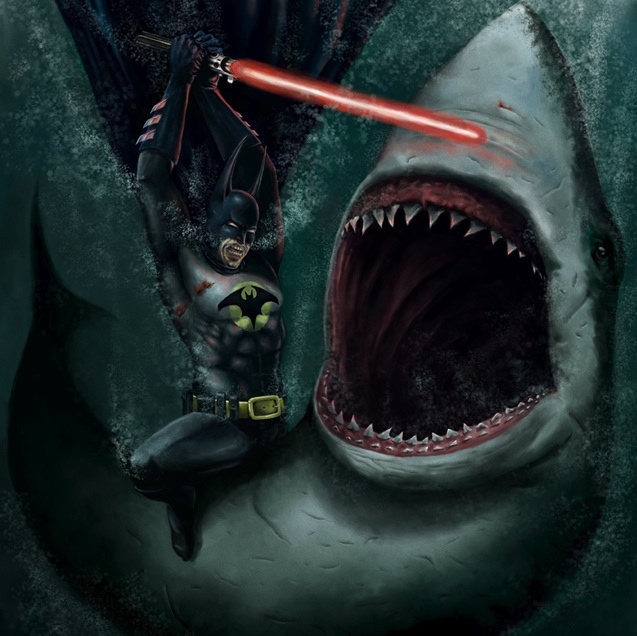
As for questions number 1 and 2, consider the post-modern, remixed, mash-up, variant-cover culture we live in. Think an Indiana Jones video game is fun? What about Indiana Jones Lego! Like Batman? Sharks? Lightsabers? Ta-da! (artist here) Authoring mash-ups and riffing on others' work is an integral part of pop culture.


Painting gets started at about the 4 minute mark in the video above.
[h/t to Boing Boing, again]

In the past, I've sometimes been the dissenting voice here at Art Evolved about all those posts showing past-art about upcoming themed galleries. I dislike them because sometimes attribution to the artwork cannot be easily found - though yes, as Peter and Craig have pointed out to me, sometimes we attribute an "orphan image" after the post goes up when a reader identifies it.

I'm uncomfortable with those posts because in a world of remixes and fun Photoshopped images, attribution and authorship can sometimes be your only coins to bank on. Literally.

Everyone has different comfort zones. Where do you feel comfortable with your images on questions 1-3 above?

-Glendon Mellow


Wednesday, January 20, 2010

Going Pro: types of copyright


Q: What kinds of copyright are there?

A: Let's have a look at a few definitions, remembering I am not a lawyer, but a fellow freelancing artist-illustrator trying to learn about these things. Despite the fact that it can contain inaccuracies, I will be linking to Wikipedia a lot in this Going Pro: I suggest confirming information with the useful citations and links found at the bottom of the entries.


1) Intellectual property
Most types of copyright fall under intellectual property laws. You'll often hear creative types discussing protecting their IP. What they generally mean, is it's not enough to protect the idea, you have to protect the execution of that idea. Intellectual property as a concept deals with the intangibles of the idea in the mind, and tangibles or artistic creation.


2) Copyright
Copyright refers to the legal right of a creator over their creations. You don't have to register to have copyright (though there may be good reasons to register, covered below). By creating a piece of art, you are now a copyright holder in most countries under the Berne Convention. Congratulations!

Copyrights are usually indicated by the © symbol. You can easily type this into your work in Photoshop or even blogging platforms by typing "[hold down alt]-0169".

3) Moral copyright
Moral copyrights refer to the right to have artwork credited to the creator, even if the economic rights to use the artwork is sold to a client. In some cases, moral rights can also extend to not altering the work.

In an important case in the city of Toronto, Canada, artist Michael Snow had been commissioned by the Toronto Eaton Centre to create an installation sculpture of a flock of Canadian geese, titled Flightstop (right). (Good info on Wikipedia, Jan 2010.) The Eaton Centre placed red bows on the geese for the Christmas holidays, and the artist successfully sued, contesting that they did not have the moral right to alter his artwork, despite that they had paid for it. This is an important example to artists, and I would suggest having a mention of moral rights in any contract.

The result of suing or contesting a disagreement may not always be for money, unless damage to the artists' reputation has occurred. You may be only seeking legal action to restore the artwork to its original state. As a thought experiment (I know of no such examples), what if you were commissioned to paint a barosaurus, and later discovered the client lied about their affiliations with their institution and were now using your work prominently to promote creationism? That may damage your chances to get future work within the scientific community and you would need to redress what has happened to your moral rights.

4) Trademark and registered trademark

Trademarks are a way of identifying an image or product as representing a badge or symbol of a company. You may be a freelancer who incorporates their job, and uses a small symbol to denote your art - that could be your trademark. It's basically a way of identifying your brand, and trademarks refer to a brand.

If your trademark has been infringed, you can sue, but it may be difficult to do so out of a legal jurisdiction to which it originated.

Trademarks are generally noted by the ™ symbol. There's a similar symbol, ℠ for services rather than goods.

Registered Trademarks are usually allowed if you can prove your brand is distinct from all others, and register it with an agency, such as the U.S. Patent & Trademark Office. Individual countries will have similar agencies.

Registered trademarks are noted with the ® symbol.

5) Patent
Patents generally refer to created or invented goods, so are not likely to be relevant to illustrators here at Art Evolved. Unless you invent a spiffy new brush for doing delicate scale work and wish to market it, patents don't need to be covered too much. If you do create a patent, you may want to register it to your country's patent office.

Interestingly, the Danish company Lego has taken legal action in a number of countries against upstart Canadian company MegaBloks.
In most cases, Lego has failed, due to the shape of their bricks belonging to patent law and not trademark law, and the patents have expired in many countries. In Canada, I believe the decision was that you could not trademark or patent a geometric shape. Picture at right shows a MegaBlok on the top, and Lego brick on the bottom.

6) Fair-use
So say you are sitting in a lecture at a university about dromeosaurs. And lo and behold, a piece of your artwork appears on the screen, illustrating a species' long running legs. You haven't granted any use to the professor: what's going on? Fair-use is an exception to copyright, allowing educational institutions to skirt the necessity of paying or procuring the right to use artwork for the sake of a single example, in lectures or talks. It may also come into play in journalism, such as a magazine article covering your art show and including a photograph.

Fair use can be a bit of a grey area, and in most districts, something like re-printing your artwork on a handout for a class is still considered a violation of your copyright.

7) Transferred copyright and licencing
In some cases, a copyright can be transferred. When this occurs, the client may ask the artist for unlimited use of their tyrannosaur cartoon for mugs, t-shirts, stuffed toys and so on. Typically, artists charge up to a few hundred percent more than their usual fee before surrendering unlimited, transferred copyright to a client (I would suggest looking at the Graphic Artists Guild Handbook to get an idea of what you should charge - great book).

In some cases, an artist may be hired to make all of their drawings while working for a company. Tim Burton created his Nightmare Before Christmas characters while under a contract to Disney: when he wanted to make the movie, he did it with Disney's Touchstone label, since they had rights to the works. Similarly, Barbie-rival Bratz is alleged to have been created while the Bratz creator worked for Mattel, so Barbie may effectively own the Bratz.

A common licencing arrangement artists may want to consider in any contract, is to grant unlimited rights for a specified time period. If you create that tyrannosaur for unlimited rights, you may want to specify it as only being for the next two years, after which the client's use expires or needs to be re-negotiated. This is useful in case the image you've made becomes a runaway hit, and gives you another shot at further monetary compensations, such as royalties.

In most cases, I would not advise my fellow Art Evolved illustrators to transfer their rights, or grant unlimited licences. It's generally better to work use by use in my experience.


- - - -
I hope this has been a useful reference, and thanks for joining me for another Going Pro here on Art Evolved. Cue the theme music.

Sunday, October 11, 2009

Going Pro: Let's Discuss Copyright


Welcome to Going Pro at Art Evolved. Today, we begin to dip our toes into the copyright ocean.

First of all, I am not a lawyer. I do not belong to copyright advocacy groups. I may be wrong about some things I say. I would appreciate any corrections to be backed up with facts and linked references.

I am paying some attention to the issues though, and I thought this would be a useful place to share my knowledge while many of us enter into the dizzying realm of professional illustration together. So whether you are member of Art Evolved who knows the secret handshake, a regular contributor, or an appreciative lurker, this series is for you. (If you’d like to read this series of posts, click on the copyright label below and you‘ll find them all as they are posted.) And this is meant to be an overview, and introduction and most of all to get your mind considering some possible issues about copyright after you have created your art.

Copyright is the boogeyman of art, the dark spectre that looms and tells us to hide our art away. “Your art online could be stolen! You could be being ripped off and you’d never know!“, our adoring public warns. But we brave, foolhardy paleo-artists buck trends anyway. Let’s discuss copyright. There is a lot of ground to cover.

Copyright definitions - what’re we talking about?

Copyright: Authorship of a creative work that provides the exclusive legal right to reproduce, publish and sell that work. Any artist creating artwork automatically owns the copyright to that work unless provisions have been made prior to the start of the project to transfer authorship to the buyer (see work-for-hire).
Source: Graphic Artists Guild Handbook: Pricing & Ethical Guidelines, 12th Edition, p319.

To keep things simple, let’s start with this one definition.

In both my day job and online freelance work, one of the many misconceptions I encounter with copyright is that it needs to be registered to be there. It doesn’t. As the American Graphic Artists Guild definition points out, copyright is automatically deferred to the creator when the work is created.

Think about that. You own those puppies. You are a creator who can reproduce, publish and sell them. Doing all three of those activities leads to a tangle of issues to decide on and grapple with, but being a copyright owner doesn’t. You made it, it’s yours.

The second part of the definition deals with project ownership. A classic case involves Tim Burton’s cult classic The Nightmare Before Christmas. Tim Burton had created many of the character concepts and designs while working as a contract animator for Walt Disney Pictures. Years later, when he returned to the idea of making this project happen, Disney had ownership over Burton’s designs, as he was under their contract when he created them You sit at the Disney desk, signed Disney contract saying you are creating for them, and you don’t get to walk out with the art afterward. Disney produced the film with Burton under their Touchstone production company.

There is a similar case being worked out with Bratz possibly being owned by rival Barbie’s company Mattel.

Another definition:

Copyright is a form of intellectual property that gives the author of an original work exclusive right for a certain time period in relation to that work, including its publication, distribution and adaptation, after which time the work is said to enter the public domain. Copyright applies to any expressible form of an idea or information that is substantive and discrete and fixed in a medium. Some jurisdictions also recognize "moral rights" of the creator of a work, such as the right to be credited for the work. Copyright is described under the umbrella term intellectual property along with patents and trademarks…
…Copyright has been internationally standardized, lasting between fifty to a hundred years from the author's death, or a shorter period for anonymous or corporate authorship. Some jurisdictions have required formalities to establish copyright, but most recognize copyright in any completed work, without formal registration. Generally, copyright is enforced as a civil matter, though some jurisdictions do apply criminal sanctions.


Wikipedia, Oct 11 2009.

Here we have a lengthier definition. First, let’s not get copyright confused with patents and trademarks, but simply recognize that all three are types of intellectual property. To grossly oversimplify, think of patents as having to do with inventions being disclosed to the public, usually for profit, and trademarks as generally being symbols and slogans. Copyright is the artsies’ concern.

You’ll note that Wikipedia includes mention about the reality that works under copyright do not remain so forever and ever. Copyright runs out, often 50 to 100 years of the creator’s death. In some cases it can be passed down. And in the case of something like say, the Sistine Chapel ceiling by Michaelangelo, you must remember that Fuji Film paid for the cleaning, and may have an agreement with the Chapel’s owner’s that no one else may reproduce photos from their efforts for a specified time. That’s not to say you couldn’t copy a portion of the ceiling for say, satirical use in a painting, since Michaelangelo has been dead for more than 100 years. (I haven't thoroughly checked out the Ceiling issue specifically mind you - it's an off-the-cuff example.)

Berne Convention

There are international rules for copyright and protecting the rights of artists. Much of this has been built up from the Berne Convention for the Protection of Literary and Artistic Works, accepted in 1885. The link here is easy to follow, and is cross-referenced with links. There was an update adopted internationally in 1996 for dealing with the internet, called the World Intellectual Property Organization Copyright Treaty.


Ground rules for discussion
Keep this stuff in mind and it’ll make everyone’s discussions a little clearer.

-While a lot of discussion happens in the media about music, that’s not what this series is about. It may be useful to draw parallels to the legalities and practices of the music biz and how consumers treat it, but I think we’re interested in visual art and illustration here.

-Copyright is not whatever knee-jerk opinion you have of it is. It is a complicated legal structure surrounding who owns what idea in which material form. So please let’s not clutter up the comments with what people think it ought to be without backing up their statements with real world issues.

-Copyright is not the same country by country. A lot of what I will talk about is Canadian, so keep that in mind. Mention what country you are speaking about. Don’t assume we’re all American.

-The nature of copyright law is changing rapidly in many countries. Here in Canada, Bill C-61 was dropped in 2008. Orphan Works legislation in the U.S.A. possibly offers new opportunities for corporations and tough times for the individual. We'll deal a bit with these issues soon.

-It is possible to navigate the benefits of showing off your art and dealing with the trade-offs that it may be ripped off some time in the future. It happens to top artists as well as amateurs but you don’t make it to the top by hiding your art in the attic.


Homework
This is an introductory post. I’ll start off with a small exercise for people to comment on, shall I?

I live and create the art in Canada. My artwork is uploaded onto Google’s Blogger service, on servers in the U.S. Someone in let’s say, the U.K. accesses the art, and downloads it to their computer. Where was the copyright breach, if there has been one? In which country is the copyright laying? (Hint: not all the info you need is in this example. What important information am I leaving out of this example that can be found in my blog's sidebar?)

Recommended sources
Graphic Artists Guild
Illustrator's Partnership of America
Berne Convention text
World Intellectual Property Organization (WIPO)
Creative Commons