
Monday, March 26, 2012
Science, art and the wonder of it all.
I noticed that Glendon retweeted a tweet suggesting that artists and poets could help communicate science to people. This is a subject close to my heart, and if it's of interest to you I posted on this very subject last week over at Paleo Illustrata. Swing by and have a look!

Monday, March 19, 2012
ART Evolved is a No Pin Zone sadly...
Our apologies to any and all Pinterest users, but ART Evolved is a pin free site for the time being.
Given all the uncertainty and potential worry caused by the copyrights and ownership terms on Pinterest regarding posted material, I am blocking AE material from being posted there until I can better confier with the rest of the AE administration.
My concerns stem from ART Evolved being a trusted group content site. If it turns out that Pinterest can somehow gain ownership of any material posted on its site (or even try to claim such ownership), I do not want to see our ranks of gallery participants find their work all snipped off this site (fish in a barrell as it were with the galleries). Given how many people have entrusted us with their hard made art I feel it is my duty to protect this art from potential theft (which admittedly Pinterest hasn't outright done yet, BUT what I've been reading shows some worry about it in the future).
This is not necessarily a permanent situation. Again the administrators need a chance to touch base on the issue. Additionally if you are not pleased with this move please let us know in the comment section below or an email to artevolved@gmail.com. Again I'm not trying to be a killjoy. I'm just safeguarding the needs of the many till I know more.
This also will not effect member's work posted elsewhere. This block only exists (at least as far as I'm aware) on the ART Evolved site itself.
Sorry for the trouble this might cause you.
Craig
Thursday, March 15, 2012
Ankylosaur Memes or Reality?
So I was in the process of trying to recreate the Australian Ankylosaur Minmi, and I hit a few interesting questions along the way.
Here is one of the most complete skeletons of Minmi, and while it is a beautiful specimen, it leaves me a palaeo-artist with one big problem. How exactly did the bony armour look when the beast was alive? Yes the bones are certainly perfect for seeing the underlying structure of the real animal, but what about its armour?
Peter Bond did an awesome survey of Minmi art available in 2008 while reconstructing the same animal. The basic conclusion he reached was that no two were alike. I think this is a fair observation of Ankylosaurs in general in art more so than any other group of Dinosaur. Ankies are reconstructed in the most diverse range of methods.
I think a big part of this is the nature of Ankylosaur outer anatomy. Their skin was covered in literally thousands of little tiny bones. I like to think of Ankylosaurs as having a true exo-skeleton. This is not even remotely scientifically correct in terminology, but to me the concept reinforces just how alien they are compared to any other animals we know of today. While there are some animals (crocodiles, turtles, armadillos) with similar bony structures (osteoderms) none have them in the same configuration or degree as Ankylosaurs.
To literally illustrate the confusing nature of these animals to palaeo-artists I've further collected Minmi recreations from those Bond's first post to directly compare. It seems Minmi, being the most complete Dinosaur of Australia, has seen a recent surge in popularity. I remember when helping Bond look for them 3 years ago there was only a fraction of what is out there now.
To better examine this issue, I only collected pieces that were likely to have received direct scientific input of some sort. As a result I'm only looking at pieces from scientific institutions or publications with the logic being someone with some sort of professional palaeontologic knowledge vetted the pictures.
I'm curious how many of these artistic conventions are based on actual fossil proof, and how many are palaeo-art memes (recycled ideas from old palaeo-art that are solely artistic imagination in origin)?
 From Australian Geographic by Xing Lida
My main focal point will be this piece, known from here on as Lida in honour of its creator. Right off the bat I absolutely love this recreation. This is my favourite Minmi I have yet to see.
Yet I have questions as to how legitimate it is. Comparing the fossil above with this, the details in armour don't work for me. I don't follow where the ridged lining of armour on the back came from. Why does the armour suddenly stop on the sides like that?
I'll go into more detail in a moment, but to me these seem based more on other Ankylosaur reconstructions and fossils rather than the actual Minmi fossil itself. However I admit right now, I state these things as a non expert.
 From the Kronosaurus Korner
Reconstructions like this one from the Krononsaurus Korner museum of northern Australia are more what I see looking at the fossils (again as an amateur). The armour is not defined, and casually covers the body.
 From the Australian Museum photograph by myself.
This sculpture from the Sydney museum looks like a traditional Ankylosaurus reconstruction, and I don't see how it relates at all to the Minmi skeleton. This is an old skool Ankylosaur that has removed the tail club (and the incorrect side spikes). I could be wrong, and an Ankylosaur expert might have directed the creation of this sculpture. However to me all I see in this (with fond childhood memories) is the Ankylosaurus statue I grew up with at the Calgary Zoo.
 From Australian Age of Dinosaurs by Laurie Beirne
To me the most believable are the renditions by Beirne. Much like the Kroner sculpture this restoration casually covers the animal in its armour, but it actually feels like armour.
 From Queensland Museum by an uncredited artist (though I think it is Laurie Beirne again, but I could be very wrong. Please correct me if you know)
Another angle of a similar style (if not different angle by the same artist... I'm not sure at the Queensland Museum website didn't list this pieces artist) This is more what I see in the fossil.
Yet my artistic and personal tastes keep drifting back to the Lida piece as my preference. Yet it is so alone in its depiction of Minmi. The Korner and Beirnes all share basic concepts in minimalism. The Lida and Australian museum ones are anything but simple, but I know the Aus Museum one is based on old skool logic (though it could be correct... I don't know).
As I'm more interested in the Lida, I'm only going to examine it. I think I have found the origin in its armour "design". If I'm right it is a good lesson in avoiding over analogising your subject, and not falling into a meme trap.
 Euoplocephalus by John Sibbick
I think a lot of Lida's armour is based on Euoplocephalus. Meaning I'm going to have to look at the art surrounding Euoplocephalus (bonus!).
Euoplocephalus enjoys a rich history of recreations going back to the 1920's. The definitive Euoplocephalus of my childhood was by Sibbick. Even this one from the early 80's has back armour ridges.
The armour here goes beyond ridges and is almost like a big cover or shell, that is very defined to its composition.
 "Ankylosaurus" from TYCO's Dinoriders toyline.
Heck even my key childhood Euoplocephalus toy had these. (Yes I know I said I was sticking to reconstructions with definite scientific input, but I couldn't fight this nostalgic shout out to a favourite toy lost years ago)
 Euoplocephalus by Micheal Skrepnick
More modern versions while being more toned down, like this Skrepnick, still display the top armour as something more like a shell. It just isn't as structural as the Sibbick.
 Ankylosaur byRaul Martin
Even Ankylosaurus gets this treatment, despite to the best of my knowledge we have no truly armoured skeleton of Ankie proper. This starts to trigger my meme detector.
When an animal is recreated with a feature like other animals it warrants investigation. So follow my round about way of trying to get at the truth.
 Euplocephalus and Albertosaurus at the Royal Tyrrell Museum of Palaeontology my own photograph
Typically the best method here is to look at fossils and papers. However here we're talking about Ankylosaurs. Sadly this group of Dinosaurs is very hard the average joe like me to get hard facts about (scientists of course don't have the following issues). Ankylosaurs are suffering some bad coverage outside of scientific circles (I have no clue about in the circle), and hopefully if we all do our part we can help them out!
Most Ankyosaurs are mounted and displayed in museums with only the more impressive armour scutes. While this can be informative about the bigger armour, it is missing some 8 to 10 thousand pieces of armour from the animal (if my palaeo sources were correct in their statements). There are only a few exclusive museums that display whole Ankylosaurs as it were. I've been amazed that in my efforts to search the web for photos of these specimens I can ONLY find a few photos of them!
Popular books on Dinosaurs are not helpful at all. They have such a wide and differing range of Ankylosaur reconstructions I don't feel I can trust any of them. So I need the technical literature. Here I hit the huge problem (faced by non academic palaeo people everywhere) of restricted access to technical literature. While Mike Taylor of SVPOW has made many great suggestions on how you can track down scientific papers, I think I like his current rants about dismantling the restricted access model and move to open source publications better.
Speaking as an artist taking the time to track down papers that might be a help to me is sacrificing time I could make art with. The challenge is I don't care about the technical writing in this case, I need photographs and diagrams of specimens. Not all papers have these (no disrespect... I'm the one with special requirements here). So even if I hunt down papers it is a gamble as to whether they will include what I need or not...
All in all what I'm saying is Ankylosaurs are a bit nebulous at moment in the current "Dinosaur Golden Age"-Scott Sampson. Theropods, Ceratopsians, and Sauropods are stealing all the love, and it is leaving armoured Dinosaurs hard for amateurs and the public to really appreciate. So come on people spread your Dino love! Try and help bring the Ankylosaurs out into the spotlight too...
 I could only find this one photograph of the BMNH "Scolosaurus" aka Euoplocephalus. This Albertan specimen collected by the Sternbergs preserves much of the back armour of the animal. Here I can certainly see where the armour lines on the back come from.
 BMNH "Scolosaurus" from Arbour et al. 2011
This diagram modified from the original description by Ankylosaur expert Victoria Arbour helps really show that this is a feature of Euoplocephalus armour. So in Euoplocephalus this part of the reconstruction is based on reality.


Even on my old 80's era toy! How often did that happen in those days?!?

Now I have no idea how complete or accurate our understanding of Ankylosaurus proper's armour is, but to me it is acceptable to reconstruct the animal with these armour ripples. It is closely related to Euoplocephalus, the two come from the same geographic areas, and are close in time. So to me if this is a case of referencing Euoplocephalus it is still a reasonable one.
 However Minmi is NOT from the same region, closely related to Euoplocephalus, nor that close in time. So does referencing Euoplocephalus work in Minmi's case?
Looking at this specimen in this particular photograph I see no evidence of the ridges like in the BMNH specimen of Euoplocephalus. Granted I'm not an expert, and the quality of this photograph in regard to the armour is wanting, and it is not as complete a fossil.
 So despite loving the look, I'm not convinced this is an accurate Minmi.
I understand Lida's referencing an Euoplocephalus, and it certainly has created a nice look. Whether I should use the same method on the other hand is tricky. Lida has made a very solid Minmi, but a (from what I personally know) speculative one. Given my current discussion about Palaeo-art myths versus Palaeo-art memes, I do not wish to help create a Minmi meme.
 I also did a quick comparison with the other fully armoured ankylosaur fossil I knew of, and that is Edmontonia. Now yes Edmontonia is an advanced member of a completely different Ankie family than Euoplocephalus (though the two lived together in Cretaceous Alberta), and Minmi is considered a primitive member of Euoplo's family, but there is debate about this.
I just wanted something else to compare my armour too.
So from the fossil we can see that Edmontonia did not have the armour ridges along its back.

This is reflected in the majority off of reconstructions of Edmontonia.
 James Gurney
By
I do notice in both the Euoplocephalus and Edmontonia reconstructions is that their armour is typically reconstructed as ending midway down their sides.

While I can see the possible reason for this in the fossils I've just shown, I do wonder if the armour truly ends there or is it a perservational artifact? I ask this as a non expect again.

So on Minmi I can see there being a much stronger arguement for the heavier armour ending on the side of the animal. Though I'm not certain this is a completely persasive arguement (especially since is is currently just based on my own random research here).
When I look at this fail to see any of the reconstructions of Minmi I have presented so far to be honest. To me this looks more like the really primitive armoured dinosaur Scelidosaurus (so primitive no one is sure if it is an Ankylosaur or Stegosaur ancestor). Mind you what do I know. I am curious about other people's thoughts on the subject.
Here is one of the most complete skeletons of Minmi, and while it is a beautiful specimen, it leaves me a palaeo-artist with one big problem. How exactly did the bony armour look when the beast was alive? Yes the bones are certainly perfect for seeing the underlying structure of the real animal, but what about its armour?
Peter Bond did an awesome survey of Minmi art available in 2008 while reconstructing the same animal. The basic conclusion he reached was that no two were alike. I think this is a fair observation of Ankylosaurs in general in art more so than any other group of Dinosaur. Ankies are reconstructed in the most diverse range of methods.
I think a big part of this is the nature of Ankylosaur outer anatomy. Their skin was covered in literally thousands of little tiny bones. I like to think of Ankylosaurs as having a true exo-skeleton. This is not even remotely scientifically correct in terminology, but to me the concept reinforces just how alien they are compared to any other animals we know of today. While there are some animals (crocodiles, turtles, armadillos) with similar bony structures (osteoderms) none have them in the same configuration or degree as Ankylosaurs.
To literally illustrate the confusing nature of these animals to palaeo-artists I've further collected Minmi recreations from those Bond's first post to directly compare. It seems Minmi, being the most complete Dinosaur of Australia, has seen a recent surge in popularity. I remember when helping Bond look for them 3 years ago there was only a fraction of what is out there now.
To better examine this issue, I only collected pieces that were likely to have received direct scientific input of some sort. As a result I'm only looking at pieces from scientific institutions or publications with the logic being someone with some sort of professional palaeontologic knowledge vetted the pictures.
I'm curious how many of these artistic conventions are based on actual fossil proof, and how many are palaeo-art memes (recycled ideas from old palaeo-art that are solely artistic imagination in origin)?
From Australian Geographic by Xing LidaMy main focal point will be this piece, known from here on as Lida in honour of its creator. Right off the bat I absolutely love this recreation. This is my favourite Minmi I have yet to see.
Yet I have questions as to how legitimate it is. Comparing the fossil above with this, the details in armour don't work for me. I don't follow where the ridged lining of armour on the back came from. Why does the armour suddenly stop on the sides like that?
I'll go into more detail in a moment, but to me these seem based more on other Ankylosaur reconstructions and fossils rather than the actual Minmi fossil itself. However I admit right now, I state these things as a non expert.
From the Kronosaurus KornerReconstructions like this one from the Krononsaurus Korner museum of northern Australia are more what I see looking at the fossils (again as an amateur). The armour is not defined, and casually covers the body.
From the Australian Museum photograph by myself.This sculpture from the Sydney museum looks like a traditional Ankylosaurus reconstruction, and I don't see how it relates at all to the Minmi skeleton. This is an old skool Ankylosaur that has removed the tail club (and the incorrect side spikes). I could be wrong, and an Ankylosaur expert might have directed the creation of this sculpture. However to me all I see in this (with fond childhood memories) is the Ankylosaurus statue I grew up with at the Calgary Zoo.
From Australian Age of Dinosaurs by Laurie BeirneTo me the most believable are the renditions by Beirne. Much like the Kroner sculpture this restoration casually covers the animal in its armour, but it actually feels like armour.
From Queensland Museum by an uncredited artist (though I think it is Laurie Beirne again, but I could be very wrong. Please correct me if you know)Another angle of a similar style (if not different angle by the same artist... I'm not sure at the Queensland Museum website didn't list this pieces artist) This is more what I see in the fossil.
Yet my artistic and personal tastes keep drifting back to the Lida piece as my preference. Yet it is so alone in its depiction of Minmi. The Korner and Beirnes all share basic concepts in minimalism. The Lida and Australian museum ones are anything but simple, but I know the Aus Museum one is based on old skool logic (though it could be correct... I don't know).As I'm more interested in the Lida, I'm only going to examine it. I think I have found the origin in its armour "design". If I'm right it is a good lesson in avoiding over analogising your subject, and not falling into a meme trap.
Euoplocephalus by John Sibbick I think a lot of Lida's armour is based on Euoplocephalus. Meaning I'm going to have to look at the art surrounding Euoplocephalus (bonus!).
Euoplocephalus enjoys a rich history of recreations going back to the 1920's. The definitive Euoplocephalus of my childhood was by Sibbick. Even this one from the early 80's has back armour ridges.
The armour here goes beyond ridges and is almost like a big cover or shell, that is very defined to its composition.
"Ankylosaurus" from TYCO's Dinoriders toyline.Heck even my key childhood Euoplocephalus toy had these. (Yes I know I said I was sticking to reconstructions with definite scientific input, but I couldn't fight this nostalgic shout out to a favourite toy lost years ago)
Euoplocephalus by Micheal SkrepnickMore modern versions while being more toned down, like this Skrepnick, still display the top armour as something more like a shell. It just isn't as structural as the Sibbick.
Ankylosaur byRaul MartinEven Ankylosaurus gets this treatment, despite to the best of my knowledge we have no truly armoured skeleton of Ankie proper. This starts to trigger my meme detector.
When an animal is recreated with a feature like other animals it warrants investigation. So follow my round about way of trying to get at the truth.
Euplocephalus and Albertosaurus at the Royal Tyrrell Museum of Palaeontology my own photographTypically the best method here is to look at fossils and papers. However here we're talking about Ankylosaurs. Sadly this group of Dinosaurs is very hard the average joe like me to get hard facts about (scientists of course don't have the following issues). Ankylosaurs are suffering some bad coverage outside of scientific circles (I have no clue about in the circle), and hopefully if we all do our part we can help them out!
Most Ankyosaurs are mounted and displayed in museums with only the more impressive armour scutes. While this can be informative about the bigger armour, it is missing some 8 to 10 thousand pieces of armour from the animal (if my palaeo sources were correct in their statements). There are only a few exclusive museums that display whole Ankylosaurs as it were. I've been amazed that in my efforts to search the web for photos of these specimens I can ONLY find a few photos of them!
Popular books on Dinosaurs are not helpful at all. They have such a wide and differing range of Ankylosaur reconstructions I don't feel I can trust any of them. So I need the technical literature. Here I hit the huge problem (faced by non academic palaeo people everywhere) of restricted access to technical literature. While Mike Taylor of SVPOW has made many great suggestions on how you can track down scientific papers, I think I like his current rants about dismantling the restricted access model and move to open source publications better.
Speaking as an artist taking the time to track down papers that might be a help to me is sacrificing time I could make art with. The challenge is I don't care about the technical writing in this case, I need photographs and diagrams of specimens. Not all papers have these (no disrespect... I'm the one with special requirements here). So even if I hunt down papers it is a gamble as to whether they will include what I need or not...
All in all what I'm saying is Ankylosaurs are a bit nebulous at moment in the current "Dinosaur Golden Age"-Scott Sampson. Theropods, Ceratopsians, and Sauropods are stealing all the love, and it is leaving armoured Dinosaurs hard for amateurs and the public to really appreciate. So come on people spread your Dino love! Try and help bring the Ankylosaurs out into the spotlight too...
 I could only find this one photograph of the BMNH "Scolosaurus" aka Euoplocephalus. This Albertan specimen collected by the Sternbergs preserves much of the back armour of the animal. Here I can certainly see where the armour lines on the back come from. BMNH "Scolosaurus" from Arbour et al. 2011
This diagram modified from the original description by Ankylosaur expert Victoria Arbour helps really show that this is a feature of Euoplocephalus armour. So in Euoplocephalus this part of the reconstruction is based on reality.
Even on my old 80's era toy! How often did that happen in those days?!?
Now I have no idea how complete or accurate our understanding of Ankylosaurus proper's armour is, but to me it is acceptable to reconstruct the animal with these armour ripples. It is closely related to Euoplocephalus, the two come from the same geographic areas, and are close in time. So to me if this is a case of referencing Euoplocephalus it is still a reasonable one.
However Minmi is NOT from the same region, closely related to Euoplocephalus, nor that close in time. So does referencing Euoplocephalus work in Minmi's case?Looking at this specimen in this particular photograph I see no evidence of the ridges like in the BMNH specimen of Euoplocephalus. Granted I'm not an expert, and the quality of this photograph in regard to the armour is wanting, and it is not as complete a fossil.
So despite loving the look, I'm not convinced this is an accurate Minmi. I understand Lida's referencing an Euoplocephalus, and it certainly has created a nice look. Whether I should use the same method on the other hand is tricky. Lida has made a very solid Minmi, but a (from what I personally know) speculative one. Given my current discussion about Palaeo-art myths versus Palaeo-art memes, I do not wish to help create a Minmi meme.
I also did a quick comparison with the other fully armoured ankylosaur fossil I knew of, and that is Edmontonia. Now yes Edmontonia is an advanced member of a completely different Ankie family than Euoplocephalus (though the two lived together in Cretaceous Alberta), and Minmi is considered a primitive member of Euoplo's family, but there is debate about this. I just wanted something else to compare my armour too.
So from the fossil we can see that Edmontonia did not have the armour ridges along its back.
By Robert Bakker
This is reflected in the majority off of reconstructions of Edmontonia.
 James Gurney
I do notice in both the Euoplocephalus and Edmontonia reconstructions is that their armour is typically reconstructed as ending midway down their sides.
While I can see the possible reason for this in the fossils I've just shown, I do wonder if the armour truly ends there or is it a perservational artifact? I ask this as a non expect again.
So on Minmi I can see there being a much stronger arguement for the heavier armour ending on the side of the animal. Though I'm not certain this is a completely persasive arguement (especially since is is currently just based on my own random research here).
When I look at this fail to see any of the reconstructions of Minmi I have presented so far to be honest. To me this looks more like the really primitive armoured dinosaur Scelidosaurus (so primitive no one is sure if it is an Ankylosaur or Stegosaur ancestor). Mind you what do I know. I am curious about other people's thoughts on the subject.
Feathered Dinosaur Gallery has even more!
We finally have gotten a chance to add all the late submissions to the Feathered Dinosaur gallery. They are definately worth revisiting the gallery for!

Also remember the Dan Varner Tribute gallery coming up in May...
 Please consider a submission to pay homage to the departed palaeo-art master...
Also remember the Dan Varner Tribute gallery coming up in May...

Wednesday, March 14, 2012
Phylopic is back!!!
My huge apologizes to Mike Keesey! I wrote up this post over a month ago, and forgot to hit the blasted post button!!!
Anyways at the risk of being late (though late is better then never ;P) we are excited to inform you Phylopic has once again resumed operations!
 For those of you who haven't heard of Phylopic it is a site that collects silhouettes of organisms that are free for the use of anyone who might need them. It is a great resource for researchers and educators alike, but it needs the silhouettes.
That's where anyone interested out here comes in. If you interested but don't know how to start, silhouettes aren't very hard to make, and I have a tutorial for how to make a JPEG silhouette here. One of the big improvements on the new Phylopic is that it now supports vector based files. Sadly I don't know a thing about how to make these, but if you do fire them Phylopics ways, and maybe consider writing up a brief tutorial for us here on ART Evolved.
Have fun silhouetting once again people!
Anyways at the risk of being late (though late is better then never ;P) we are excited to inform you Phylopic has once again resumed operations!

That's where anyone interested out here comes in. If you interested but don't know how to start, silhouettes aren't very hard to make, and I have a tutorial for how to make a JPEG silhouette here. One of the big improvements on the new Phylopic is that it now supports vector based files. Sadly I don't know a thing about how to make these, but if you do fire them Phylopics ways, and maybe consider writing up a brief tutorial for us here on ART Evolved.
Have fun silhouetting once again people!
Sunday, March 11, 2012
Remember we're going underwater in May
Just a quick reminder about our next up coming Time Capsule gallery coming up in May 2012. This time it is everything and anything prehistoric underwater as a tribute to the recently passed away palaeo-art legend Dan Varner.

The gallery goes up on the first week of May. Though we will take late submissions (though you are warned after the post date you are at Peter's and my own busy teacher schedules for updating. So do please try to get it in early).
If you're new to the site, we accept any and all artwork submitted that is themed around any of our gallery topics. Just send your submission(s), along with any accompanying text you'd like with them, and the link to your website/blog/online picture gallery to our email artevolved@gmail.com, and we'll post them!
Wednesday, March 7, 2012
Scientific Literature Access Debate: How does it affect us artists?
If you follow Saurpod Vertebrae Picture of the Week (SVPoW) you'll know they've been engaging a fairly meaty and important diversion from their usual fair lately. That topic is access to scientific literature. In particular how mainstream (for profit) publishers are exploiting their control on what should be easy to access to universal knowledge, by locking scientific papers behind outrageously priced paywalls. The SVPoW crew have become part of the much larger movement in academia to dispense with this outdated mode of information distribution and for scholarly works to be all published in some sort of open access model.
While not all aspects of this issue hit us palaeo-arts, it does have a very clear impact how and where we can get scientific information for our reconstructions. This to me is a huge one. Especially given many of the debates about accuracy in palaeo-art we've seen over this site's existence. To me while the paywalls lock up a lot of that important information we can't possibly expect accuracy in every piece of palaeo-art out there.
Mike Taylor was kind enough to invite me to do an interview on what I see a palaeo-artist's view on the restricted vs. open access topic to be. Please feel free to check it out.
Here is a bit of an expansion on my points in this interview...
1. Open access is better for everyone!
2. Proxy for the actual fossils
There is no greater reference material for a reconstruction than the fossils themselves. However in most cases it is not possible to see the specimens firsthand. In addition to the lack of funds to visit all the collections you might like to (oh unless you're Gregory Paul), most of us artists wouldn't be permitted to openly roam an institution's collection anyways (especially their type specimen section).

This is where papers are invaluable. They are a direct reliable reference/source to this material. The work in papers has been double checked by multiple palaeontologists, unlike anything in the popular literature. When we are getting information from a paper we know that at it has had some fact checking and vetting.
3. Literature could cause the Extinction of Memes!
If everyone can get their hands on the proper information and diagrams of the fossil material in papers we'll get better researched and referenced palaeo-art. At the moment this is not the case, so many people (even well meaning artists) are restoring to referencing other artists reconstructions as their primary resource.
As we know this can lead to art memes. While not the greatest threat in the whole world, to many in the palaeontologic community they are a nuisance. They do the opposite of what palaeoart should. Rather than connect people with prehistory, they create a false fictional version of our past world. Any idea in palaeo-art once is harmless, but repeated too much it takes on an implication of authenticity regardless of whether it is based on fact or not.
If we got more of the scientific literature out there than (hopefully) more artists could create more accurate or plausible palaeo-art. This would still improve the work of those who insist on just referencing other artists, as the overall pool of art they are looking at would be of an averagely higher scientific quality.
4. More Pictures and Diagrams in the Literature
While not a direct part of the free vs. limited literature debate, the issue of diagram restrictions on scientific papers comes up in an odd way. The traditional (for-profit) publishers still maintain restrictions on the number of diagrams a paper can contain, despite the state of modern publishing technology. Meaning that any paper published in a mainstream journal will likely feature very few figures or diagrams.
As an artist, and not a researcher, the most useful thing a paper can have for me are diagrams and photos of the fossil specimens in question. All too often I've gone to the trouble of tracking down a key paper on a topic in a mainstream journal only to find there is nothing of use in the paper for me to work with.
On the other hand new modern free access journals have no such diagram restrictions and as of such, I've found, these papers tend to be very diagram heavy. Exactly (or closer to) what I need...
Regardless of how the restricted vs. free access journal situation ends in our favour (otherwise I say we keep fighting!), I would like to see the emerging publishing system incorporate no limits on diagram and figure inclusion in papers!
What are your thoughts on the topic?
These are just the aspects of the issue I choose to bring up. I'm sure there are many more things artists can say on this. So please feel free to fire away in the comment section.
These are just the aspects of the issue I choose to bring up. I'm sure there are many more things artists can say on this. So please feel free to fire away in the comment section.
Monday, February 13, 2012
"Dinosauri in Carne e Ossa" 2012, in Florence!

Dracorex are saying: "this year, come in Italy to see the best dino-exhibit of the world!"
Here in Italy we have great expectations for the 2012. It will be another amazing year for paleontology and paleoart!
After the stages in cities of Piacenza, Courmayeur and Pavia, the wonderful exhibit of "Dinosauri in Carne e Ossa" (Dinosaurs in the Flesh) will move in the city of Florence (Firenze), from the 1st day of March until September 2. For this new stage, the largest fleshed-out restorations will be seen in one of the world’s oldest and suggestive botanical gardens, the Garden Semplici of the Florence Natural History Museum!

A year has passed from the first opening of the exhibit, in Piacenza, and now our paleoartists and the Geomodel team prepared a lot of new attractions and services for the fans.
First of all, new life-size sculptures of prehistoric animals (not only dinosaurs). Parasaurolophus, Stygimoloch, Triceratops and many other beasts will join into the pack!

Stygimoloch spinifer (preview)
Visitors can view the progress of the 3D Paleoaquarium, 110 educational illustrated panels, 120 illustrations of internationally renowned paleoartists, and some surprises!

For the kids, some week ago was inaugurated "Dinosauri in Carne e Ossa Junior", a nice initiative finalized to promote in the web the art of young dinosaur enthusiasts of today... and yesterday. Someone have recognized the artist who made the drawing above? Is a work by Davide Bonadonna, when he was 7 years old! :)
Here, some interesting websites related to "Dinosauri in Carne e Ossa":
The Official Website.
Blog Geomodel: The blog of Geomodel, contein a lot of photos about this incredible dinosaur models.
Dinosauri in Carne e Ossa Official Facebook page.
Go Go Dinosaurs: The blog of Andrea Pirondini, graphic designer for the exhibit and member of the team "Prehistoric Minds".
The photos posted in this article belongs to Geomodel.
The "Dinosauri in Carne e Ossa" poster and the other graphic manipulations belongs to Andrea Pirondini.
Sunday, February 12, 2012
Feathered Problems... The Gallery is up but can you see it?
Howdy folks...
The gallery has been up a while now, but we've got no comments on it. This combined with a major site formatting issue I encounter with the post (I lose the whole right sidebar) and the fact my blog feed hasn't shown the gallery as posted leads me to suspect there is a malfunction.
In good news I think this problem is caused by the absolute sheer volume of awesomeness that is the gallery (though I suspect the number of picture files rather than awesomeness is causing the problem). If you could leave us a comment here or on the gallery post if you are having similar issues so we can approach blogger about solutions.
So check out the gallery either here, or by refreshing the blog. It exists, I'm just not sure people can see it on feeds and the like. Please also help spread the word if you could...
Saturday, February 11, 2012
The Feathered Dinosaur Gallery
Welcome ladies and gentlemen to ART Evolved's Feathered Dinosaur Gallery!

Thank you for waiting, but we've got a big one here!
Amazing fossil evidence show irrefutably that several dinosaurs had feathers. In an effort to promote the current view to the public, ART Evolved is proud to showcase art by incredible artists. Banish the recreations of naked JP velociraptors, and embrace the soft downy feathers! Science in action!
OR
 (shared by Dr. Thomas Holtz!)

Scroll down to see the modern science view of feathered dinosaurs!
Click on the images to enlarge them!
Enjoy the over 70 submissions!
Enjoy the Feathered Dinosaur Gallery!


Evolution of the Raven (Corvus corax) by Mike Keesey
You can link toPhyloPic: http://phylopic.org/
Click to enlarge.
Click to enlarge.

Raptor PSA by Trish Arnold

A Panoply of Protobirds by Albertonychus

I don’t hate the idea that some dinosaursmay have had feathers, (as a matter of fact I find that some dinosaurs actuallylook cooler with them) but after watching the goofy fluffysaurus (Gorgosaurusand Albertosaurus) on that documentary “March of the Dinosaurs,” Iknew they took this “Dinosaur evolved to birds” thing has gone to far!

Deinonychus Prey Restraint by Emily Willoughby
Digital illustration of predation behavior of dromaeosaurids as recently proposedby Fowler and colleagues. Paper is free to download here.

Baluar by Asher Elbein

Dromaeosaurus albertensis by Bill Unzen

The Smell of Rain by Emily Willoughby
Digital illustration of Deinonychus antirrhopus in a mistyforest.

Deinonychus Link by Jonathan Kane
This is how it wouldhave looked in The Legend of Zelda: Twilight
Princess if Link had transformed into a Deinonychus instead of a wolf.
Princess if Link had transformed into a Deinonychus instead of a wolf.

Deinonychus Pair by Niroot Puttapipat

Flying Velociraptors by Niroot Puttapipat

'Happy Birthday, Marc' by Niroot Puttapipat
Portrait of Marc Vincent (Love in the Time of Chasmosaurus) as a Deinonychus

Deinonychus antirrhopus by Pablo Lara
Pablo's website.

Ormr the Assassin by Bruce-Earl Barr
Sort of a Tramador the Tyrannosaur Fan character. Ithink the pack of the primordial feather is one of the most dangerous andinteresting characters in the Tyrannosaur chronicles! (mind spelling errors)

Deinonychus by Anthony Contoleon
The Deinonychus is based on a museum mount from the American Museum of Natural History.
Unfortunately at this angle, it looks like it is riding an invisible bicycle.

Mantling Dromaeosaur by Asher Elbein

Tongue Firmly in Cheek by Trish Arnold

DromaeosaurDigging Behavior by Emily Willoughby
Digital illustration of Saurornitholestes based on a discovery of fossilized burrows with claw marks that likely belonged to a dromaeosaurid,from around 80 mya Utah.

Saurornitholestes by Tom Parker
Saurornitholestes langstoni. Based on the MORmount, but with the posture of the arms fixed.

A Saurornitholestesuses the talons and the body weight to restrain its prey, an unfortunate andstill alive sub adult Stegoceras, while feeding on it.

Troodon and Gorgosaurus by Craig Dylke
A test of my new 3D lighting techniques. I had planned on illustrating the "recent" paper
by Chris Carbone, Samuel T. Turvey and Jon Bielby talking about how Tyrannosaurids probably HAD to hunt some of the time due to the far larger population of smaller theropods finding and eating carrion before the Tyrannosaurids could get there first. Sadly the time constraints of creating the new lighting, and memory consumption of 3D feathers caused me to create a more traditional scene.

Life of Maniraptors by Albertonychus

Talos by Emily Willoughby
Digital illustration of new troodontid Talos sampsoni, described as having a healed-over wound onits sickle toe, possibly injured in the act of predation. See the open-accesspaper here.

Talos sampsoni by Tom Parker
Talossampsoni; a newly described Campanian troodontid from the USA. The holotypespecimen (UMNH VP 19479) consists of little more than the hindlimbs, ulna andsome vertebre, so this reconstruction is mostly modeled on Saurornithoides andTroodon formosus. Plumage reconstructed after Jinfengopteryx elegans(CAGS-IG-04-0801) and the Rhea, an extant flightless paravian of similar weightand size to T. sampsoni.

Graciliraptor by Vasika Udurawane

'Come Here Fishy, Fishy' by Julio Lacerda
Stunning Buiteraptor. DeviantArt gallery.

The Southern Thief by Elia Smaniotto
Austroraptor cabazai

Sinornithosaurus by Emily Willoughby
Oil painting of Sinornithosaurus, a feathered dromaeosaurid from theearly Cretaceous of China.

NGMC 91 by David Tana
Life reconstructionof a feathered dromaeosaurid from the Yixian Formation of Early CretaceousChina. This specimen has been described in great detail, but is still notassigned to any particular species. The feathers on "Dave" andhis friend are not speculative; the exceptionally well preserved fossilmaterial clearly shows a dinosaur covered in various types of feathers. Iused photos of casts of NGMC 91 as reference, as well as the following paper:
JiQ., Norell, M.A., Gao K.Q., Ji S.-A. and Ren, D. (2001). The distribution ofintegumentary structures in a feathered dinosaur. Nature 410(6832),1084-1087.

Sinosauropteryx by Asher Elbein

Microraptorgui by Kalliopi Monoyios
Originally published in Jerry Coyne's Why Evolution is True
© 2008 Kalliopi Monoyios

Urvogel by Trish Arnold

Liaoning Scene by Emily Willoughby
Digitalillustration representing a hypothetical scene from the Jehol group of earlyCretaceous Liaoning of China, something like 122 million years ago. Severalanimals from the Yixian formation are represented here: A microraptoriddromaeosaur, Sinornithosaurus millenni, a feathereddromaeosaurid dinosaur; Liaoxitriton zhongjiani, asalamander; Alloraphidia, a snakefly; Epicharmeropsis, a mayfly, and a dead Callobatrachus,a frog.

Anchiornis by Emily Willoughby
Oil painting of Anchiornis, the first dinosaur for a which a full colorpattern was established, chasing a lizard.

Archaeopteryx by Terry Thielen
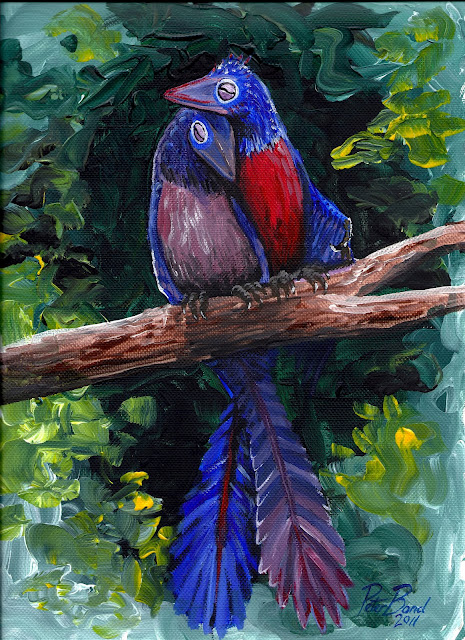
Archaeopteryx Pair by Peter Bond

Malagasy Bluebirds by Vasika Udurawane
My interpretation ofthe dinosaur Rahonavis ostromi (Maevarano Formation, Maastricthtian,Madagascar). A small (crow-sized) unenlagiine raptor which might've been aflying genus. Here, I have presented sexual dimorphism in these two, thecrested one being a male, the crestless one being a female.
Pencil drawing, coloring in Photoshop CS

Xiaotingia, the newarchaeopterygid (or troodontid) by Maija Karala
It's possible that at least some of these four-winged dinosaurs were
feathered right to the tip of the nose, since they apparently did not
have a proper keratinous beak. I have never seen anyone depict them
like that, however, so I gave it a try. It looks somewhat like a yeti.
It's possible that at least some of these four-winged dinosaurs were
feathered right to the tip of the nose, since they apparently did not
have a proper keratinous beak. I have never seen anyone depict them
like that, however, so I gave it a try. It looks somewhat like a yeti.

Xiaotingia zhengi by Tom Parker
Xiaotingia zhengi; a recently described archaeopterygid from the Late Jurassic of China. (Xu et al. 2011)

Feather Distribution by Albertonychus

Shuvuuia deserti by John Meszaros
A male Shuvuuiadeserti defends his small harem from a younger rival
by inflating his fleshy "horns" and throat wattles. Theinterloper
shows his submission by tucking his head between his legs.
by inflating his fleshy "horns" and throat wattles. Theinterloper
shows his submission by tucking his head between his legs.

Sketch of Avimimus by Glendon Mellow

Caudipteryx by David Orr

Shuvuuia by Christopher Hutson
An alvarezaurid moving between insect mounds encounters a snack.

Giant Alvarezosaur by Asher Elbein

Epidexipteryx hui by Pablo Lara
Pablo's website.

Incisivosaurus gauthieri by Pablo Lara
Pablo's website.

Conchoraptorgracilis by Jaime Headden

Sandstorm by Vasika Udurawane
Just to show howperilous life could be in the desert with dangers other than VelociraptorXD.....this is Citipati osmolskae, very often mistaken for Oviraptor. A veryold picture, from around middle of last year, drawn in eleventh grade. So Ihaven't got everything good and nice....under exam stress......sorry.... (BarunGoyot Formation, Campanian, Mongolia)

Citipati osmolskae by Niroot Puttapipat

Gigantoraptor erlianensis by Mo Hassan
Created in ArtRage Studio Pro using Bamboo tablet


Struthiomimus altus by Bill Unzen

Kinnareemimus khonkaenensis by Niroot Puttapipat

Coelophysis bauri by Pablo Lara
Pablo's website.

Guanlong wucaii by Niroot Puttapipat

Daiya and Xueman by Bruce-Earl Barr
Yet another Tyrannosaur chronicles OC. I wentwith a yin yang theme. Note that I like to use some sort of Dragon motif when Ido something with dinosaurs. Dragons will come up in future cartoons, assumingthat SOPA and PIPA don’t get passed. I think these would be cool to see in a TCadventure. (mind spelling errors)

SchyteLizard by Elia Smaniotto
Therizinosaurus cheloniformis

Therizinosaurs in Forest by Terry Thielen

A Very Speculative Daspletosaurus! by Alexander Lovegrove

Tarbosaurus Head Study 1 by Niroot Puttapipat

Tarbosaurus Head Study 2 by Niroot Puttapipat

The Mighty Handful by Niroot Puttapipat
Albertosaurus mobbed by Ornithomimus


The New Traumador by Craig Dylke
Just my equivalent of a doodle, but my planned future direction for Traumador. Don't expect the blog to restart (sadly) anytime soon though. I'm thinking more a reboot of his "universe" in some sort of book form. So do watch for more developments and tweaks on his new look.

Leaellynasaura amicagraphica by Niroot Puttapipat

I'm a Dirty Dirty Parrot by Elia Smaniotto
Psittacosaurus sibiricus.

Parrot's Face by Vasika Udurawane
Psittacosaurus major,a small experimental fun pic. (Yixian Formation, Barremian, China). I omittedthe background in it. (Photoshop coloring on pencil drawing)

Waller's Titan by Elia Smaniotto
(it's the terror bird Titanis, hope it's fine with that)
Psittacosaurus sibiricus.

Follow That Dream by Trish Arnold

Owl by Anthony Contoleon


Anchiornis by Bruce-Earl Barr
Hears a picture of an Anchiornis. If you see this picture then I must be more lovedaround the paleo art community then I thought! This is a drawing I made becauseI wanted to see if you guys would post such a Interesting piece of artwork. Plus it give me something for my local art show! Oh, and in case youdon’t want to go looking for the verse yourself and “risk yourscientific credibility” it says “For I am not ashamed of the gospel,because it is the power of God that brings salvation to everyone who believes:first to the Jew, then to the Gentile.”
[Admin - We at ART Evolved are proud of our policy of not censoring art that is sent in to us. Enjoy the art for what it is!]

The Future? by Trish Arnold
NEWLY ADDED ARTWORK!

Troodon in the Rushes by Raven Amos
Read more on Raven's blog The CAW Box here.

A Cold Day Out by Raven Amos
See more about this family of Albertosaurs here.


Feathered Dinosaur by Simon Farrell
See more at Simon Farrell's website.
There we are! Thank you so much for checking out ART Evolved's Feathered Dinosaur Gallery!
This is by far our largest gallery to date and one that I am sure will continue to grow! If you want to add to the gallery, send your art to artevolved@gmail.com!
Huge thank yous to all the amazing artists who submitted incredible work!
The next gallery here at ART Evolved will be in celebration of a fantastic paleoartist, Dan Varner, who we lost this year.
The Dan Varner Tribute Gallery will open May 2012.
Please join us in a tribute to the master of marine reptiles by sending your art to artevolved@gmail.com.
Subscribe to:
Posts (Atom)